
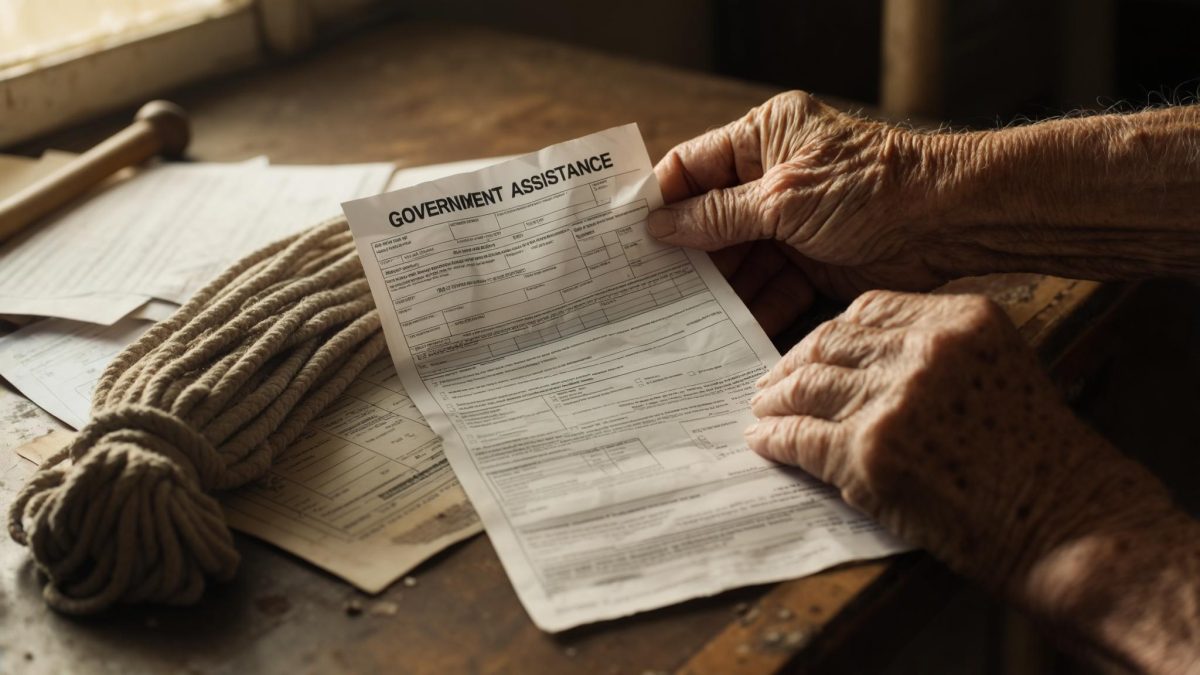
Have you ever done everything you were supposed to do — worked the job, paid what you could, showed up — and still found yourself on the wrong side of a system that was supposedly built for you?
I was covering a Medicare enrollment event at the Lawson McGhee Public Library in Knoxville, Tennessee, on a cold Tuesday afternoon in February 2026. The room was packed with retirees, caregivers, and a handful of people who looked like they weren’t quite sure why they’d come in but were desperate enough to try. Janine Underwood was one of the latter. She walked up to me during a break between presentations, holding a manila folder thick with papers, and asked if I was the one writing about benefits. When I said yes, she looked relieved in a way that told me she had been waiting a long time to talk to someone.
We sat down together at a table near the back of the room, and over the next hour, she walked me through two years of applications, denials, side hustles, and a financial crisis she is still climbing out of today.
A Custodian, a Toddler, and a Budget That Didn’t Add Up
Janine Underwood is 61 years old. She has worked as a custodian at an elementary school in Knox County for the past nine years. It is physical, unglamorous work — early mornings, chemical fumes, floors that never stay clean — and it pays her approximately $29,400 per year before taxes. She is also, improbably and by her own admission unexpectedly, the sole parent of a three-year-old daughter named Reese.
“People look at me like I have two heads,” she told me, laughing. “A 61-year-old raising a baby. But she’s mine, and that’s that.” Janine adopted Reese in late 2023 after the child’s biological mother, a relative, was no longer able to care for her. Janine had no co-parent, no child support arrangement, and no financial cushion.
Her school district’s health insurance plan cost her $387 per month in employee premiums for single coverage — and that didn’t include Reese. Adding a dependent would have pushed the monthly cost to $641, according to the benefits summary Janine showed me. On her income, that was simply not possible.
In Tennessee, the income threshold for TennCare — the state’s Medicaid program — for a family of two is set at 138% of the federal poverty level, which in 2025 worked out to roughly $23,792 per year. Janine’s income of $29,400 put her above that line. She didn’t qualify for TennCare based on income alone. But Reese, as a child in a low-income household, was potentially eligible for CoverKids, Tennessee’s CHIP program, which covers children in families earning up to 250% of the federal poverty level.
That should have been a manageable process. It was not.
The First Denial — and the One She Didn’t Expect
Janine first applied for CoverKids coverage for Reese in March 2024. She submitted the application online through Tennessee’s benefits portal, uploaded her pay stubs and the adoption paperwork, and waited. Six weeks later, she received a denial letter. The reason cited was “income verification discrepancy.”
“I read that letter four times and I still didn’t understand it,” she told me. “My income is what it is. I’ve got one job. I’m not hiding anything.”
She reapplied in June 2024 with additional documentation — a letter from her employer confirming her salary, three months of bank statements, and a handwritten explanation of her household situation. That application was also denied, again citing an income discrepancy. This time, the denial letter referenced a “secondary income source” that Janine says she had never heard of.
What had happened, Janine later discovered, was that her Social Security number had been used to open a small business account in the Atlanta area sometime in 2022 or 2023. That fraudulent business had reported income to the IRS under her SSN. When the Medicaid eligibility system cross-referenced her tax data, it found income she had never actually earned — enough to push her well past the eligibility threshold on paper.
How Identity Theft Silently Derailed a Benefits Application
Janine’s situation sits at a painful intersection that I have seen more often than I expected while covering public assistance programs: the gap between what a person’s financial life actually looks like and what government databases believe it looks like.
According to the Federal Trade Commission, tax-related identity theft — where a fraudster uses someone’s SSN to file a return or register a business — is one of the most damaging forms of identity theft precisely because it embeds false information into federal systems that other agencies rely on. Medicaid eligibility systems in many states, including Tennessee, pull data from IRS records as part of the verification process.
Janine had not known her identity had been stolen until the second denial forced her to dig. She pulled her credit report — something she had not done in over two years — and found accounts she had never opened, an address in Savannah she had never lived at, and the business registration that had contaminated her income record. Her credit score, which had already taken hits from a period of lifestyle inflation after a small raise in 2022 (she told me she had opened two store credit cards and a personal loan she couldn’t sustain), had dropped to the low 500s.
“I got that raise and I thought, finally, I can breathe a little,” she said. “So I spent. And then I couldn’t keep up. And then somebody stole what little I had left.”
The Long Road to Getting It Corrected
Untangling identity theft from a Medicaid application is not a quick process. Janine filed an IRS Identity Theft Affidavit — Form 14039 — in August 2024. She also filed a report with the FTC through IdentityTheft.gov and placed a fraud alert on her credit files with all three major bureaus. Her caseworker at the Tennessee Department of Human Services told her the IRS resolution could take six to twelve months to reflect in the systems used for benefits verification.
Reese was finally enrolled in CoverKids in March 2025 — twelve months after the first application. During that year, Janine paid for Reese’s well-child visits and one ear infection treatment out of pocket, totaling approximately $740. Janine herself remained uninsured as of our conversation in February 2026, falling into what is known in Tennessee as the “coverage gap” — earning too much for TennCare but too little to comfortably afford marketplace plans, even with premium subsidies.
Still Hustling, Still Searching for Solid Ground
One thing that comes through immediately when you talk with Janine Underwood is that she is not someone who waits for things to happen to her. Even as the benefits system failed her repeatedly, she was moving. She picked up a weekend cleaning contract with a property management company — roughly $320 a month in additional income — and sold handmade wreaths through a Facebook marketplace page she started in late 2024. Neither made her rich. Both kept Reese fed during months when her budget was at its most stretched.
“I’m always looking for the next thing,” she told me. “Some people think that’s a flaw. But if I wasn’t like that, I don’t know where we’d be right now.”
The identity theft resolution is still incomplete as of April 2026. The fraudulent business account has been flagged by the IRS, but Janine says she has not yet received written confirmation that her tax record has been fully corrected. Her credit score, according to a monitoring service she now uses, has climbed from the low 500s to approximately 561 — meaningful progress, she says, but still far from where she needs it to be to qualify for favorable loan terms if she ever needs emergency credit.
She is also, quietly, thinking about what happens when she turns 65 and becomes eligible for Medicare. That’s partly why she was at the library event where we met. She wants to understand the landscape before she gets there, so she isn’t caught flat-footed again.
“I learned my lesson,” she said, closing the manila folder and setting it on the table between us. “You have to know what you’re walking into before you walk into it.”
Sitting across from Janine at that library table, watching her organize her papers with the careful efficiency of someone who has learned that every document matters, I thought about how many people navigate these systems alone — without a caseworker who catches the fraud flag, without the stubbornness to apply a third time, without the energy to work weekends on top of everything else. Janine has all of those things. Reese has health coverage now because of it. But the system, as Janine experienced it, did not make any of this easy.
Related: He Fell on the Job at 61, Got Denied Workers’ Comp, Then Discovered His Identity Had Been Stolen
Related: She Called Financial Aid ‘Not for People Like Her’ — Then She Was $14,000 Behind on Her Mortgage
.pvv-faq-section details summary::-webkit-details-marker{display:none}.pvv-faq-section details summary::marker{display:none;content:””}.pvv-faq-section details[open] summary .pvv-faq-arrow{transform:rotate(90deg)}




Leave a Reply