

Have you ever followed every rule, earned a steady paycheck, and still felt the financial ground shifting under your feet — not from one catastrophe, but from a slow accumulation of reasonable decisions that quietly went wrong? That is the question I kept turning over after spending an afternoon with Marlene Guzman.
Marlene, 56, is a registered nurse with more than two decades of experience at a hospital system in Richmond, Virginia. In early March 2026, she responded to a call for sources I posted on social media, asking to hear from people who had navigated government benefit programs while earning what most would consider a comfortable income. Her message was short: “I make good money. I still almost lost everything. I think your readers need to hear this.”
When I sat down with Marlene over a video call on a Tuesday evening — she had just finished a 10-hour shift — she looked tired in the specific way that has nothing to do with sleep. Her husband, Derek, 59, a U.S. Army veteran who served two tours in Iraq and was honorably discharged in 1997, moved into the frame partway through our conversation. Their daughter Sofia, 17, has been accepted to Virginia Commonwealth University for fall 2026 and is counting down the days.
On paper, the Guzmans look financially stable. Marlene earns approximately $82,000 per year. Derek brings in another $45,000 through part-time logistics work. Their combined household income sits near $127,000 — firmly upper-middle class by most measures. But as Marlene told me within the first five minutes, income and financial security are not the same thing.
When Good Salaries Are No Longer Enough
The Guzmans’ financial pressure didn’t begin with one dramatic event. It accumulated. Their Richmond mortgage runs $2,100 per month. Sofia’s first year at VCU — even with partial merit aid — is projected at roughly $22,000. Inflation since 2022 has eaten steadily into the margin between what the family earns and what they spend, and their liquid savings, once a comfortable cushion, had eroded to approximately four months of expenses by the time Marlene reached out to me.
“People assume that if you’re a nurse and your husband works, you’re fine,” Marlene told me. “But fine is not the same as secure. Every month I’m doing math in my head at 2 a.m.”
The family also carried a $480 monthly car payment. Together, these fixed costs left little room for error — and in 2023, an error arrived from a direction Marlene had not fully anticipated.
The Loan That Cost More Than Money
In the fall of 2021, Marlene cosigned an $18,000 auto loan for her younger brother, Carlos. He had poor credit, needed a reliable vehicle for a new job offer, and Marlene believed in him. By January 2023, Carlos had stopped making payments entirely. By March 2023, the lender had reported the default to all three major credit bureaus — under Marlene’s name as a cosigner.
“I knew the risk when I signed,” she said, her voice flat. “But knowing the risk and living with the consequences are two very different things.”
Marlene’s credit score dropped from approximately 740 to 618 within three months. The impact was immediate and concrete. A mortgage refinance she and Derek had been planning — which would have reduced their monthly payment by roughly $310 — became unavailable at favorable rates. A home equity line of credit she had hoped to use toward Sofia’s first year of college was denied outright.
It was in that parking lot moment, Marlene told me, that she started searching in earnest for what help might exist for her family. She had never thought of herself as someone who needed government benefits. What she found challenged that assumption entirely.
A Veteran’s Benefits Left Unclaimed for Years
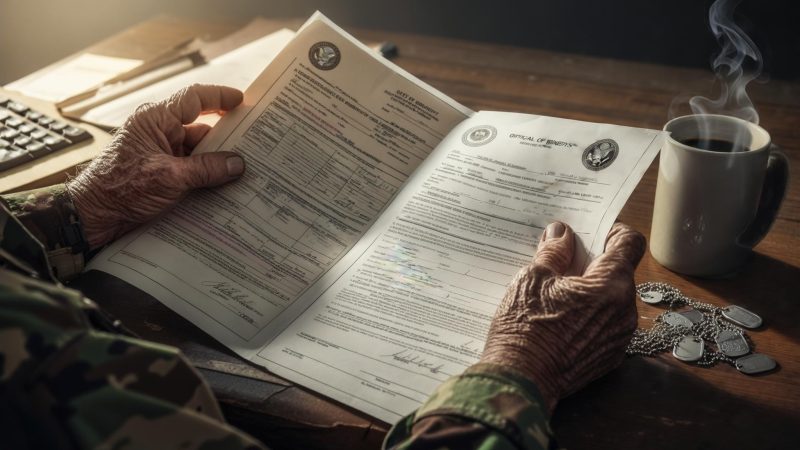
Derek served in the U.S. Army from 1989 to 1997, including two Iraq deployments. He was honorably discharged with documented service-connected injuries: chronic lower back damage from a training accident and partial hearing loss in his left ear. In the nearly three decades since his discharge, he had never filed a VA disability claim. “We didn’t think we qualified for much,” Marlene told me. “Derek wasn’t severely wounded. He didn’t think of himself as disabled.”
A coworker of Marlene’s whose husband had recently filed a VA claim for a service-connected hearing condition changed that calculus. According to VA.gov’s disability eligibility guidelines, veterans may qualify for compensation for physical or mental conditions connected to active military service — including conditions that developed gradually after discharge, provided the service connection can be documented.
Marlene found her way to a local Veterans Service Organization in Richmond in the summer of 2023. VSO representatives helped Derek gather his service records and begin the claims process at no cost to the family. The process, she warned me plainly, required patience.
What Marlene Learned About the VA Disability Process
From initial submission to rating decision, Derek’s claim took approximately 17 months. His combined disability rating came back at 40 percent in February 2025, accounting for both his back condition and left-ear hearing loss. At the 2026 VA disability compensation rate for a veteran with a spouse and one dependent, a 40% rating translates to approximately $820 per month in tax-free compensation.
The 2026 VA disability pay rates reflect a projected Cost-of-Living Adjustment estimated between 2.5% and 3.0%, consistent with adjustments tracked through the SSA.gov COLA information page, which sets the benchmark used across federal benefit programs. For the Guzmans, that monthly figure — $820 — was not a windfall. But it was consistent, tax-free, and retroactive to the date of Derek’s filing, which produced a lump-sum back payment of approximately $13,940.
Derek’s VA health care enrollment — for which he was newly eligible given his service-connected rating — eliminated a significant insurance cost the family had been absorbing for years. Combined with the monthly disability compensation, the Guzmans effectively recovered more than $13,000 in annual financial breathing room they had not expected.
Where Things Stand Now — and What Still Keeps Marlene Up at Night
When I spoke with Marlene in April 2026, she described her family’s situation as “better, but not finished.” Sofia’s college enrollment is set. They’ve assembled a first-year plan that includes a modest federal student loan, the savings Derek’s back pay helped restore, and a revised monthly budget that finally has a small margin built in. Marlene’s credit score has recovered to approximately 668 — still damaged, but climbing steadily.
Carlos repaid a portion of the original $18,000 debt through a negotiated settlement, but the credit damage will take several more years to fully resolve. Marlene checks her credit report quarterly through all three bureaus and disputes inaccuracies methodically. She has also bookmarked USA.gov’s benefits portal as a reference for tracking any additional programs her family might qualify for as circumstances change.
What remains unresolved is the emotional cost. Marlene told me she carries a low-grade anxiety about money that didn’t exist five years ago. The credit default, she said, changed something in how she thinks about risk — about trusting people she loves with her financial identity. “I don’t regret helping Carlos,” she said quietly. “But I’d be lying if I said it didn’t change things between us.”
She is also watching federal policy closely. Changes to SNAP work requirements and ongoing debates about student loan structures matter to her — not because the Guzmans currently rely on food assistance, but because she understands now, with a clarity she didn’t have before the parking lot moment, how quickly the distance between stability and crisis can shrink.
What stays with me from our conversation isn’t any single number. It’s the image of Marlene — a woman who spent 20 years caring for other people’s emergencies — sitting in her car, doing math, and realizing she had never thought to look for help for her own family. Derek earned his benefits in desert heat two decades ago. They were there the whole time.
“The system doesn’t come looking for you,” she told me at the end of our call, just before her phone buzzed with a hospital notification. “You have to go find it. And sometimes you find it too late, and sometimes you find it just in time.” She paused. “We found it just in time.”



Leave a Reply