
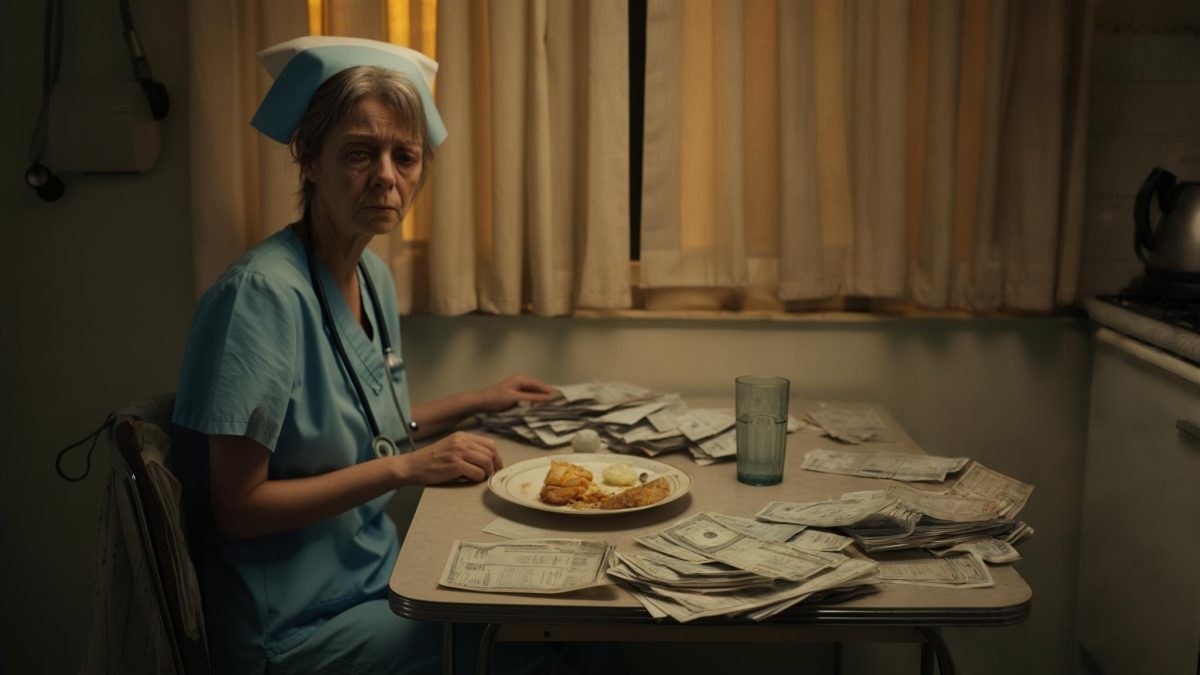
The free tax preparation clinic on Alum Rock Avenue in San Jose runs every Saturday from February through mid-April, staffed by certified volunteers and crowded with people who cannot afford a CPA. I visited on a Saturday in early March 2026 looking for families navigating public benefits during a period when federal SNAP rules were shifting and California’s housing assistance programs were stretched thin. That is where I met Dianne Gantt.
Dianne was sitting in a plastic chair near the intake desk, a tote bag of documents balanced on her knees. She is 44, works full-time as a registered nurse at a regional hospital, and was there because, as she put it plainly when I introduced myself, she had “run out of other ideas.” She agreed to speak with me after her appointment, and we talked for nearly ninety minutes in the parking lot.
A Salary That Does Not Tell the Whole Story
On paper, Dianne’s income looks stable. She earns roughly $72,000 a year before taxes — a figure that, by most measures, should cover a family’s basics in most of the country. But San Jose is not most of the country. After rent, utilities, and the specialized therapies her nine-year-old son Marcus requires for his developmental disability, Dianne told me the household brings in very little discretionary income each month.
Her husband, Kevin, left his warehouse job in late 2024 to become Marcus’s full-time caregiver after the family’s in-home support costs exceeded what Kevin’s paycheck covered. The math, Dianne said, barely worked. “We kept thinking it would get easier,” she told me. “It just never did.”
The home repair issue had been building for two years. A licensed contractor quoted the family $22,400 in early 2025 to address a deteriorating roof, failing HVAC system, and water damage along the back wall of their home. Dianne had been setting aside $200 a month toward the cost, a pace that would take nearly nine years to reach the total — assuming nothing got worse.
What the Tax Clinic Volunteer Told Her
The volunteer who processed Dianne’s return that morning flagged something she had not expected: given Kevin’s zero employment income, the family’s adjusted household earnings and allowable deductions might place them within California’s CalFresh eligibility range. CalFresh is California’s version of the federal Supplemental Nutrition Assistance Program, known as SNAP — the nation’s largest anti-hunger program, which according to Think Global Health has faced significant rule changes entering 2026, including new federal work requirements that began rolling out on December 1, 2025.
Dianne had never considered applying. “I’m a nurse. I thought food stamps were for people who had nothing,” she told me. “I didn’t think that was us.” The volunteer suggested she check eligibility through Benefits.gov and connect with a county social worker before dismissing the idea.
According to Pew Research, states are navigating new fiscal terrain as federal SNAP cost-sharing structures shift — meaning benefits, timelines, and eligibility screening may vary more by state than they did even a year ago. California’s program remained among the more expansive in the country as of early 2026, but caseworker capacity had not kept pace with demand.
The Application Process — and Where It Stalled
Dianne submitted a CalFresh application online in the second week of March. The process itself was manageable, she said, though gathering the documentation — Kevin’s caregiving status, Marcus’s disability records, household expense breakdowns — took three evenings of paperwork she did not have energy for after 12-hour shifts.
The sticking point was Marcus’s care costs. The county caseworker told Dianne those expenses could be used as a deduction that might bring her net household income below the eligibility threshold — but only if documented through the In-Home Supportive Services program, which Kevin is not formally enrolled in. “She told me I might need to reapply once Kevin is registered with IHSS,” Dianne told me. “That’s another application, another wait. I just nodded and said okay.”
The Housing Repair Question — and the Limits of What Exists
Separately, Dianne had begun asking about housing repair assistance. The volunteer at the tax clinic mentioned HUD’s Title I Home Improvement Loan program and California’s own HOME Investment Partnerships grants — programs that help low- and moderate-income homeowners fund necessary repairs. The eligibility criteria vary, but a household with documented low income and a primary residence in need of health-or-safety-related repairs can sometimes qualify for deferred loans or outright grants.
Dianne had not yet submitted a housing repair application when we spoke. She said she intended to, but acknowledged something quietly devastating: she was not sure she had the bandwidth to manage another process. “I know these programs exist for people like me,” she said. “But filling out forms after a twelve-hour shift, when Kevin is exhausted and Marcus had a hard day — it’s not as simple as it sounds.”
The emotional weight of that statement stayed with me for days. Dianne is not disorganized or passive. She is a healthcare professional who navigates complex systems at work every day. The barrier is not capability — it is capacity. That distinction matters, and it rarely appears in policy discussions about why eligible families fail to access benefits they qualify for.
Where Things Stand — and What Dianne Knows Now
As of this writing in early April 2026, Dianne’s CalFresh application is still pending a final determination. She has begun the process of enrolling Kevin in IHSS, which she was told could take four to six weeks on its own. The home repair application remains unsubmitted but not abandoned.
Dianne told me she is glad she went to the clinic that Saturday — not because anything has been resolved, but because she now knows what questions to ask. According to SSA.gov, families with a disabled household member may also qualify for supplemental income programs separate from SNAP — a path Dianne said she had not fully explored yet.
What I took away from Dianne’s story is not a lesson about persistence or optimism. It is something more complicated. The programs she may qualify for have existed for years. The income thresholds and deduction rules that could make her eligible are not new. What was missing was the single conversation — in a folding chair at a free tax clinic — that pointed her toward the door. That gap between existing help and actual access is where a lot of families quietly disappear.
Dianne drove away from that parking lot the same way she arrived: tired, calm, and carrying more to do. She had three shifts that week and a follow-up call with the county on Thursday. She would figure it out, she said. She always did. I believed her — and I also thought about how much energy it costs to keep saying that.




Leave a Reply