
Roughly 2.3 million low-income older homeowners in the United States live in homes with at least one critical physical problem, according to estimates from the U.S. Department of Housing and Urban Development. Leaking roofs, failing heating systems, crumbling foundations — for many retirees on fixed incomes, the costs are real, and so is the paralysis that comes with facing them.
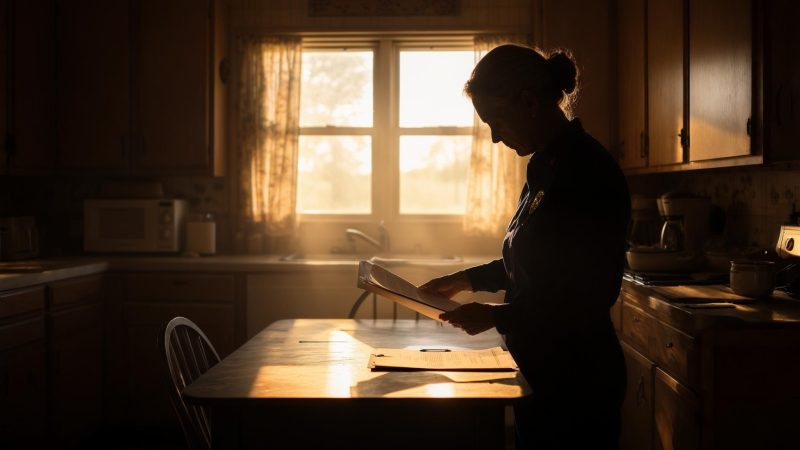
I met Patricia Novak on a gray Tuesday morning in late January, sitting at the kitchen table of the house she has owned in Pittsburgh’s West End neighborhood since 1987. She had a mug of coffee in her hands and a grocery store circular open in front of her, circled in red pen. Outside, there was a tarp over part of her roof. It had been there since October.
A Pension, a Social Security Check, and a Tarp on the Roof
Patricia spent 32 years as a mail carrier and postal clerk for USPS before retiring in 2019. She told me she felt good about her retirement at first. Her federal pension came to roughly $1,450 a month, and between that and her Social Security benefit of $1,090, she and her husband Donald managed the basics.
Donald died in March 2023. His Social Security check — approximately $1,380 a month — stopped coming. Patricia told me she knew it would happen, but said knowing something intellectually and actually living it are completely different things.
“After Donald died, the math just didn’t work anymore,” she told me. “I was doing all right before — not great, but all right. Now I clip coupons and drive out to the Giant Eagle in Bridgeville because it’s cheaper. I never thought at 65 I’d be doing that.”
Her savings, about $34,000, are set aside entirely for medical expenses. She has a cardiac condition requiring quarterly specialist visits and two medications not fully covered by Medicare Part D. She told me she will not touch that money. It is, as she put it, “the floor I’m standing on.”
When the Furnace Started Making a Sound She’d Never Heard Before
In November 2025, Patricia’s furnace — original to the house and installed sometime in the 1970s — began making a grinding, intermittent noise. A heating technician quoted her $4,800 for a full replacement. She told me she sat in her car in the driveway for about 20 minutes after he left.
Her daughter, who lives in Cleveland, suggested she call 211 — Pennsylvania’s statewide social services helpline. Patricia told me she almost didn’t. She was worried about what it meant, about being seen as someone who needed charity. She called on a Wednesday afternoon because she’d run out of other options.
The 211 operator directed her to Pennsylvania’s Low Income Home Energy Assistance Program, known as LIHEAP. Patricia had heard of it vaguely and associated it with utility bill discounts, not furnace replacements. She didn’t know about the Crisis component.
What LIHEAP’s Crisis Component Actually Covers
Pennsylvania’s LIHEAP Crisis program exists for households facing an imminent heating emergency — a broken furnace, a shutoff notice, a depleted fuel tank mid-winter. According to the Pennsylvania Department of Human Services, the Crisis component can provide up to $1,500 for emergency heating system repairs or replacement equipment, depending on household income and the nature of the emergency.
Patricia’s household income of approximately $30,480 annually put her below 60 percent of Pennsylvania’s state median income threshold, which made her eligible. She applied through the Allegheny County Assistance Office in late November, submitting proof of income, proof of homeownership, and the contractor’s written estimate.
She waited 11 days. The Crisis component approved $1,500 toward the furnace. Patricia paid the remaining $3,300 out of pocket — money set aside from a small tax refund and several months of careful budgeting. The new furnace was installed on December 9.
The Roof Is Still Covered by a Tarp
The furnace problem had a partial answer. The roof does not, at least not yet.
When I visited Patricia, a contractor’s report from September 2025 was held to her refrigerator by a magnet shaped like a USPS mail truck. It estimated $14,200 for a full roof replacement — the flashing was gone in several sections, and two underlying decking boards had rotted through. Through the same 211 referral process, Patricia learned about Pittsburgh’s Urban Redevelopment Authority Home Repair Program, which provides forgivable loans to low- and moderate-income homeowners for critical repairs including roofs, structural problems, and electrical systems. She submitted her application in January 2026.
As of the day I spoke with her, Patricia had received no decision on the URA application. A program administrator had told her the waitlist for roof repair assistance in Allegheny County was running four to eight months. She told me she had already called twice to confirm her place in line.
She has also applied for Pennsylvania’s Property Tax/Rent Rebate Program, which provides rebates of up to $1,000 for qualifying senior homeowners. Based on her income and the property taxes she paid in 2025, Patricia expects to receive approximately $780, which she plans to apply toward any roofing gap the URA grant does not cover.
What Patricia Wants Other Retirees to Know
I asked Patricia whether she’d encourage other seniors in similar situations to seek out these programs. She paused for a long moment before answering.
“I spent months thinking it wasn’t for me,” she said. “I kept telling myself there are people worse off who need it more. And maybe that’s true. But the programs exist. They’re there for a reason. I paid taxes for 45 years. I’m not ashamed anymore.”
The programs Patricia navigated are not obscure. LIHEAP is federally funded through the U.S. Department of Health and Human Services and available in every state, though benefit amounts and income limits differ significantly by location. The challenge, in most cases, is not the existence of the program but the awareness gap: HHS data has estimated that only about one in five eligible households actually receives LIHEAP benefits in a given year.
Patricia’s situation is not resolved. When I left her house that Tuesday morning, the tarp was still on the roof. She walked me to the front door and pointed up at it — not dramatically, just matter-of-factly, the way you acknowledge something you’ve had to make a kind of peace with. She said she was driving to Bridgeville that afternoon for the weekly circular sale.
What stayed with me after that visit was not the paperwork or the wait times, though both are real. It was the cost of pride — the months Patricia spent not calling 211 because she didn’t think help was meant for someone like her. The $1,500 she received from LIHEAP didn’t change her life. But it kept her warm through a Pittsburgh winter while she waits for the rest of the answer to arrive.
Related: I Thought I Made Too Much for Help. A Denver Nurse Found $4,200 She Didn’t Know She Had



Leave a Reply