
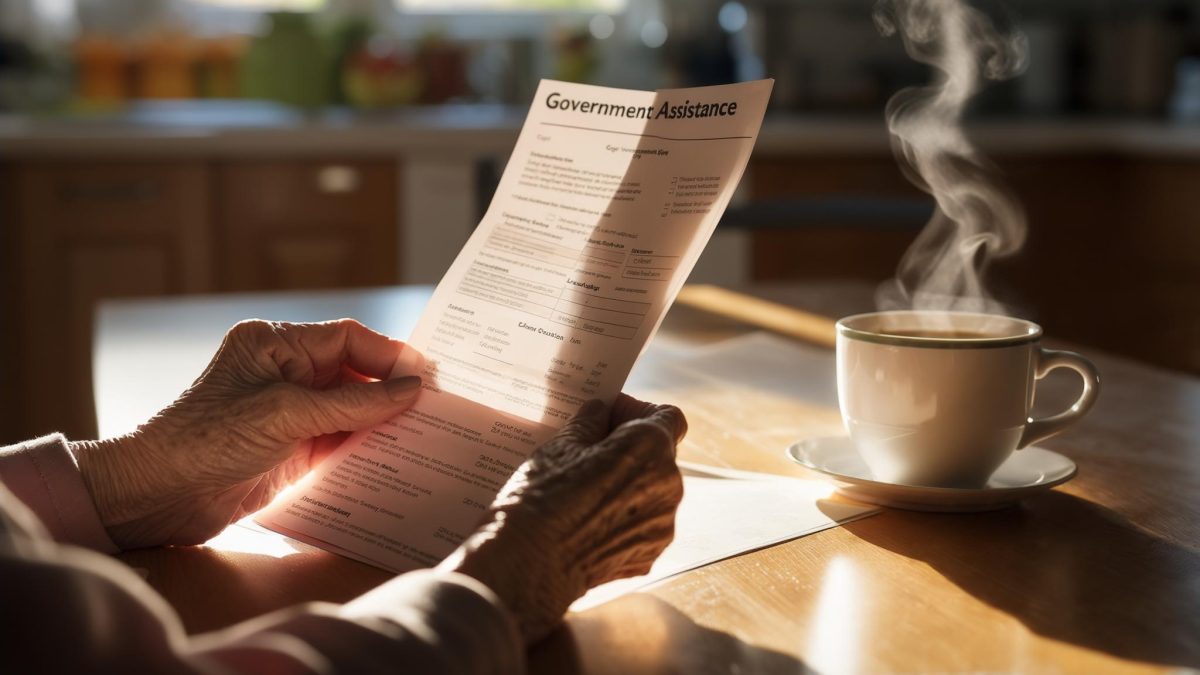
Most people assume that a government pension plus Social Security equals security in retirement. Patricia Novak assumed the same thing — until a death certificate and a $1,400-a-month income gap proved otherwise. Three years later, she’s clipping coupons and driving 20 minutes each way to a discount grocery store, all while a deteriorating roof drips water into the attic of the Pittsburgh home she’s owned since 1987.
When I sat down with Patricia Novak at her kitchen table in Pittsburgh’s Beechview neighborhood on a cold Tuesday in March 2026, she was direct about why she’d agreed to share her story. “I kept thinking I was the only one in this situation,” she told me. “Then I started talking to women at my church and realized half of them were living the exact same way — too proud to say anything, too scared to ask.”
A Pension That Once Felt Like Enough
Patricia retired from the United States Postal Service in 2018 after 32 years, qualifying for a Civil Service Retirement System (CSRS) pension. Because CSRS workers paid into a separate pension system rather than Social Security during most of their careers, her own Social Security benefit is reduced under a rule called the Windfall Elimination Provision — a policy that has drawn sustained criticism from postal workers’ advocacy groups for decades.
Her combined monthly income after retirement — pension plus her reduced Social Security — came to approximately $2,850 per month. Her husband Richard’s Social Security added another $1,400. Together, they managed. Then Richard died in early 2023 from complications following cardiac surgery.
The mechanics of what happened to her income are important and often misunderstood. Under Social Security survivor benefit rules, a surviving spouse receives the higher of their own benefit or the deceased spouse’s benefit — not both. Patricia’s own benefit was already reduced by the Windfall Elimination Provision. She was left with $2,850 a month, a figure that hasn’t meaningfully grown despite the 2.5% Cost-of-Living Adjustment applied to Social Security in 2025, according to the Social Security Administration.
“The bills didn’t go down when Richard died,” Patricia told me, folding her hands around a coffee mug. “The electric bill is the same. The property taxes are the same. It’s just me paying all of it now.”
The Roof, the Furnace, and the Savings She Won’t Touch
Patricia’s 1960s-era home needs two major repairs that contractors have quoted at a combined cost of roughly $18,000 to $22,000: a full roof replacement and a new furnace. She has savings — she was careful about that during her working years — but she will not spend them on the house. Her reasoning is not stubbornness. It is fear.
This is a calculation millions of older Americans are making silently every month: spend savings on the house, or preserve them for healthcare. Patricia has Medicare, but she pays for a supplemental Medigap policy out of pocket to cover gaps. She told me that combination runs her approximately $310 per month — money that directly competes with her heating bill every winter.
When I asked why she hadn’t looked into home repair assistance programs earlier, she gave an answer I’ve heard in various forms from other subjects I’ve reported on in this space. “I didn’t think I qualified,” she said. “I have a pension. I own my house. I thought those programs were for people who really had nothing. I didn’t think my situation counted.”
What She Found When She Started Asking
Patricia’s search for help began not with a government agency but with a caseworker at a senior center near her home. That referral chain eventually led her to three programs she had not previously known existed.
The USDA Section 504 denial was the piece that stung. According to the USDA Rural Development program page, the grants are reserved for applicants whose household income does not exceed 50% of the area median income. Patricia’s pension income pushed her just over that line in Allegheny County — a boundary that left her, in her words, “too poor to fix it myself, too rich for the program.”
“That part was hard,” she told me quietly. “You get your hopes up. You think, finally, something is going to work. And then they tell you that you make $200 too much per month.”
The Outcome, and What Remains Unresolved
Patricia’s situation at the time of our interview was partially improved and substantially unresolved — which is, in my experience covering this beat, a more honest outcome than most stories about benefit programs deliver.
Her LIHEAP approval is real money, and she was grateful for it. The SLMB review — which, if approved, could eliminate her Medicare Part B premium of approximately $185 per month — was the piece that had her most hopeful. According to Medicare.gov, the SLMB program pays Medicare Part B premiums for qualifying beneficiaries, which can represent more than $2,200 in annual savings.
The roof, however, remains untouched. And the furnace — now 24 years old — ran through the winter without failing, but Patricia described checking it the way someone checks a sick relative: with dread and hope in equal measure.
Her caseworker had also flagged SNAP as a program worth exploring. Pennsylvania uses a net income test for elderly applicants, and given Patricia’s medical expenses and Medigap premiums, the deductions might bring her net income below the eligibility threshold. She had not yet applied at the time we spoke — she told me she was working up to it. “One thing at a time,” she said.
What Patricia’s Story Reveals About the Gap Programs Don’t Fill
Patricia Novak is not, by most official measures, in poverty. She owns her home. She has savings. She has a pension. By the criteria used to determine eligibility for the most generous federal programs, she earns too much. By the reality of her monthly budget, she is cutting coupons and rationing the thermostat.
This is the gap that doesn’t get named enough in policy conversations: the space between the poverty threshold and actual financial stability, occupied by millions of older Americans on fixed incomes who own depreciating assets and cannot grow their income. According to the Benefits.gov portal, there are more than 30 federal benefit programs for seniors — but navigating eligibility across all of them requires time, documentation, and the kind of resilience that Patricia almost didn’t apply.
What changed her mind, she told me, was a conversation with a neighbor who had received a property tax reduction through Allegheny County’s senior tax freeze program — something Patricia had never heard of and immediately planned to investigate next.
As I drove away from Patricia’s house that afternoon, I kept thinking about her word: counts. She’d said she didn’t think her situation counted. Thirty-two years of mail delivery in Pittsburgh winters, a pension smaller than it looks on paper, a furnace held together by a retiree’s prayers — it counts. The question the programs haven’t fully answered is whether the systems count it too.
Related: After 32 Years at USPS, She Retired Comfortably — Then Her Husband’s Death Changed Everything

Leave a Reply