

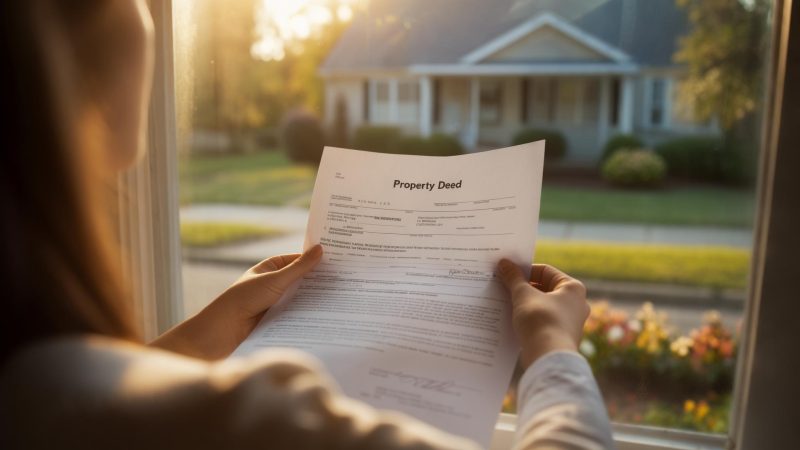
The lien sale notices in Virginia don’t come with much warning. By the time a homeowner in the City of Richmond receives the formal delinquency letter from the Department of Finance, the clock is already running — and a public auction of the tax lien on their property can follow within months. It was that letter, dated October 14, 2024, that pushed Dianne Gantt to finally ask for help.
I first connected with Dianne in late January 2026 through Pastor Gerald Watkins of Calvary Baptist Fellowship on Broad Street in Richmond. Pastor Watkins had heard I was reporting on homeowners navigating the city’s property tax enforcement process and mentioned that one of his congregants — a woman he described as “proud, hardworking, and too embarrassed to tell anyone” — had recently come through a frightening stretch. A few phone calls later, Dianne agreed to sit down with me at a coffee shop near her home in the Northside neighborhood.
She arrived early, ordered black coffee, and set a manila folder on the table between us. Inside were printouts, letters, payment receipts, and a timeline she had written out by hand. “I’m an analytical person,” she said with a short laugh. “I needed to see it all laid out before I could talk about it.”
The Gap Between a Good Income and Financial Security
On paper, Dianne Gantt’s finances look solid. She is 49 years old, has driven for UPS for 22 years, and earns approximately $94,000 annually — a wage that reflects her seniority and union membership. Her husband, Marcus, 51, has been a stay-at-home parent since their youngest child, now seven, was born. They own a three-bedroom home in Richmond that they purchased in 2011 for $187,000.
But a high gross income and financial stability are not the same thing. Between 2021 and 2022, Dianne and Marcus were hit with roughly $18,000 in medical bills after Marcus underwent an emergency appendectomy and a subsequent infection required a second hospitalization. Insurance covered most of it — but not all of it. The remaining balance went to collections, dragging Dianne’s credit score from the low 700s down to the high 500s. They spent the next two years paying down the debt while also covering daily expenses for a family of five on a single income.
The property taxes fell behind quietly, almost accidentally. In 2023, Dianne had been making partial payments on the city’s semi-annual tax bills, assuming partial compliance would prevent any serious action. It did not. By October 2024, the accumulated balance — two years of shortfalls plus accrued penalties — had reached $4,217. The delinquency notice informed her that unless the full balance was paid, her property could be referred to the city’s delinquent tax enforcement process, which in Richmond can include the sale of a tax lien to a third-party purchaser.
Discovering That Richmond Has a Delinquent Tax Installment Program
What many Richmond homeowners don’t realize — and what Dianne didn’t know until Pastor Watkins mentioned it — is that the City of Richmond’s Department of Finance offers a formal installment agreement for homeowners with delinquent property taxes. The program allows qualifying property owners to pay down overdue balances over an extended period rather than facing immediate lien enforcement, provided they remain current on all future tax obligations during the repayment term.
According to the City of Richmond Department of Finance, homeowners who enter a delinquent tax payment agreement must typically make a down payment of at least 20 percent of the outstanding balance and then pay the remainder in equal monthly installments. The agreement does not eliminate penalties that have already accrued, but it stops the clock on further enforcement action as long as payments are made on time.
As Dianne explained, finding this information was not straightforward. She had initially called a general city helpline and been transferred three times before anyone mentioned the installment option. “The third person I talked to finally said, ‘have you heard about the payment agreement?’ I hadn’t. Nobody told me that was even a thing.”
She submitted her application for the installment agreement in November 2024. Her down payment of $844 — 20 percent of her total balance — was due within 30 days of approval. The remaining $3,373 was to be paid over 18 months, in installments of approximately $187 per month.
The Guilt That Comes With Asking for Help at a Certain Income Level
One of the most consistent themes across my conversation with Dianne was the sense of shame she associated with seeking any form of government assistance. She mentioned her income more than once — almost as a disqualifier, an explanation for why she felt she had no right to be sitting in a city office asking for relief.
This emotional dynamic is something I have heard from other working-class and middle-income homeowners in my reporting. Programs designed to prevent displacement often go underutilized not because people don’t need them, but because the people who need them don’t believe they belong in line. Dianne’s story is a clear example of that pattern.
Her husband Marcus, she told me, was actually the more proactive of the two when it finally came down to action. He researched the installment agreement process online, printed the forms, and helped her prepare the application packet. “He’s not the one with the income, but he’s the one who fixed this,” she said. “That’s a hard thing to sit with.”
Virginia also operates the Virginia Department of Housing and Community Development, which has historically administered homeowner assistance programs at the state level. Dianne looked into whether she qualified for any state-level aid, but the programs available in early 2025 were primarily income-capped well below her household earnings. She did not qualify. The city installment plan was the mechanism that ultimately worked for her situation.
Where Things Stand — and What Dianne Is Still Worried About
When I met with Dianne in late January 2026, she was ten months into her 18-month installment agreement. She had made every payment on time and remained current on her regular semi-annual property tax bills. The enforcement action had been fully paused. On that front, the story has a relatively clean resolution.
But Dianne was clear that she did not feel fully secure. Her credit score, still recovering from the 2021-2022 medical debt fallout, sat at approximately 612 at the time of our conversation — better than its lowest point of 574, but still below the threshold she would need to refinance her mortgage or access a home equity line of credit at a reasonable rate. She also spoke at length about retirement anxiety — a fear she described as “the one thing that keeps me up at night.”
The property tax episode had cost the family more than money — it had surfaced a structural vulnerability they had been avoiding examining. A two-income household absorbs shocks differently than a one-income household at the same gross earnings level. Dianne acknowledged that directly. “We made a choice for Marcus to stay home,” she said. “I don’t regret that. But we made that choice and then acted like it didn’t change anything financially. It changed everything.”
According to HUD’s housing counseling resources, homeowners facing delinquency can access free or low-cost guidance through HUD-approved agencies regardless of income level. Dianne told me she was eventually connected with a housing counselor through a local nonprofit — not through a government referral, but through Pastor Watkins again — who helped her review her full financial picture. That conversation was, by her account, the most useful single hour of the entire ordeal.
She is still working through the repayment plan. She is still rebuilding her credit. She is still not entirely sure what comes after the truck route ends. But the house is not going anywhere — and on a cold morning in January, sitting across from me with her folder of printouts, that counted for something.
“I wish someone had just told me about the payment plan earlier,” she said as we were wrapping up, sliding the folder back into her bag. “That’s really all I wanted. Someone to tell me what options exist. Not assume I’d figure it out on my own.”
Dianne Gantt’s story is not one of dramatic rescue or total resolution. It is a story of a working parent who fell into a gap that exists for people who earn too much to qualify for most assistance but not enough to absorb a sustained financial shock without consequence. That gap is wide, and it is full of people who don’t know what to ask for — or whether they are allowed to ask at all.
Related: His Workers’ Comp Was Denied After a Loading Dock Injury — Then a $4,200 Property Tax Bill Arrived



Leave a Reply