
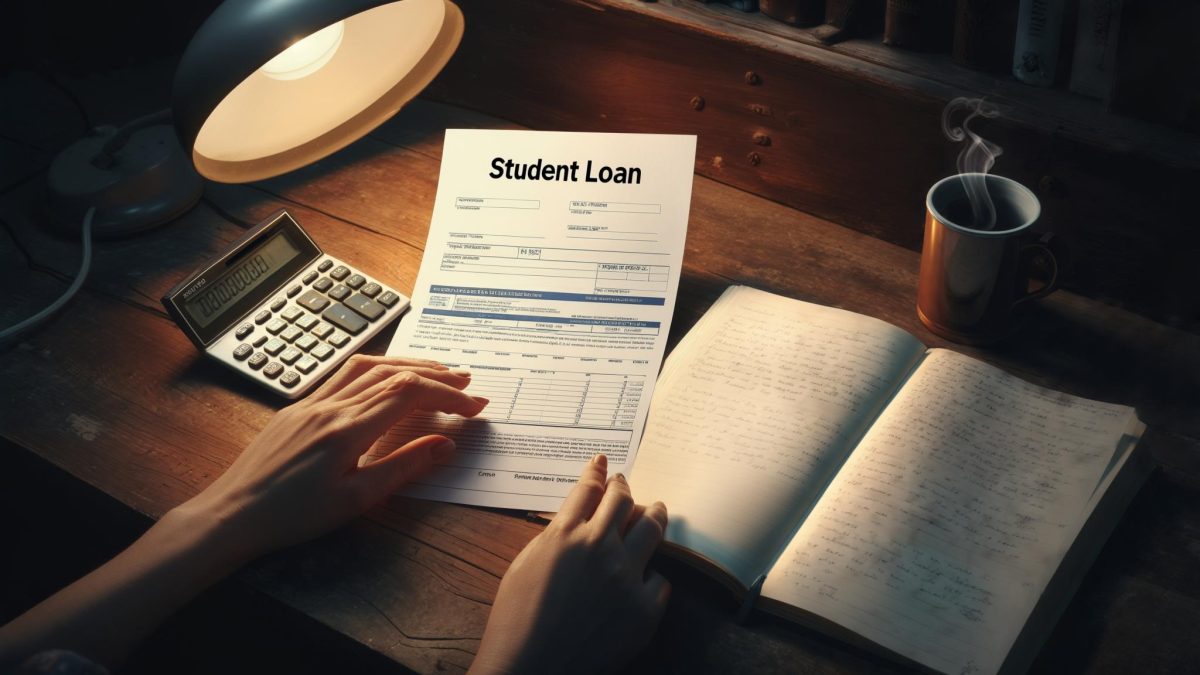
The coffee shop Brittany Holloway suggested was two blocks from the dental office where she works in East Nashville — close enough that she had her scrubs on under her hoodie when we met. She had printed out a spreadsheet. Two pages, single-spaced, listing every piece of financial advice she had seen on social media in the past six months. Pay off debt first. No, invest first. No, build an emergency fund. The columns didn’t agree with each other.
“I feel like I’m doing something wrong no matter what I pick,” she told me, flipping the papers over like she’d rather not look at them. She is 25. She is the first person in her family to finish any college. And she has $8,000 in federal student loans from Nashville State Community College sitting in her name — modest by national standards, but not by hers.
A First-Generation Graduate Facing a Very Familiar Trap
When I sat down with Brittany Holloway, I expected to hear a story about a large debt. What I found instead was a story about a small debt that had grown outsized in her mind because no one had ever taught her the rules of the game. She grew up in a household where money was discussed in terms of survival, not strategy. There were no conversations about loan types, repayment plans, or federal programs — because no one before her had needed to have them.
Brittany earns $17 an hour as a dental assistant — a role she genuinely loves. At roughly 40 hours a week, that works out to approximately $35,360 a year before taxes. In Nashville, where HUD data shows the fair market rent for a one-bedroom apartment has risen sharply over the past three years, that income doesn’t leave much margin. She splits a two-bedroom with a roommate and still pays $875 a month for her share.
On top of the student loans, Brittany carries $3,000 on a credit card she opened at 19 — her first piece of credit, taken out to cover a car repair when she had no savings. The interest rate is 19 percent. She pays the minimum most months because she’s not sure she can do more without something else falling apart.
The TikTok Spiral and What It Actually Cost Her
Brittany described the past year to me as a kind of financial paralysis. She had all the inputs — videos, podcasts, Reddit threads — and couldn’t produce an output. Every creator she followed seemed to contradict the last one. One said attack the credit card first because of the high interest rate. Another said fund an emergency account before paying anything extra. A third said to invest even small amounts in a Roth IRA starting in your twenties because of compound growth.
The result was nine months of paying the federal minimum on her student loans — approximately $89 a month under her current standard repayment plan — and making minimum credit card payments of around $60. She had saved a little, maybe $400 in a checking account she was afraid to move. Nothing was growing. Nothing was shrinking. She was treading water in a city that keeps raising the tide.
What changed was a coworker mentioning something called the SAVE plan — the Saving on a Valuable Education income-driven repayment option introduced by the Department of Education. Brittany said she had heard the name but assumed it was for people with much larger debt loads. “I figured it was for people with like, $60,000 in loans,” she told me. “I didn’t think $8,000 was enough to qualify for anything.”
What She Found When She Actually Looked Into Federal Repayment Options
I want to be careful here: what Brittany discovered, she discovered through her own research and conversations with her loan servicer. I am reporting what she found, not advising on what anyone else should do. Her loans are federal Direct Loans from her time at Nashville State — that matters, because federal programs don’t apply to private loans.
According to information available through Federal Student Aid, income-driven repayment plans calculate monthly payments as a percentage of a borrower’s discretionary income, which is defined relative to federal poverty guidelines. For someone earning roughly $35,000 a year in a single-person household, discretionary income calculations can produce significantly lower monthly payments than a standard 10-year repayment plan.
Brittany logged into studentaid.gov for the first time since she’d left school. She told me it took about 45 minutes to get through her loan summary and read about each repayment plan type. What she saw surprised her: under one IDR calculation based on her reported income, her estimated monthly payment came out to significantly less than her current $89 — she said the loan servicer quoted her a figure closer to $40 to $50 per month, depending on the final plan she chose.
The Part Nobody Told Her: Recertification and the Long View
This is where Brittany’s story gets more complicated — and more honest. Income-driven repayment is not a clean fix. It is a trade-off. Lower monthly payments can mean a longer repayment window and, potentially, more interest paid over time. For someone with only $8,000 in debt, the math looks different than it does for someone with $80,000.
Brittany said the recertification requirement caught her off guard. “I thought once you picked a plan, you were locked in,” she told me. “I didn’t know I’d have to go back every year and prove what I make.” That ongoing administrative responsibility is something her servicer was upfront about — and something she said she wished someone had mentioned in the community college financial aid office back when she first borrowed the money.
The credit card debt, she’s still working through. She acknowledged that the $3,000 balance at 19 percent interest is mathematically the more urgent problem, and that reducing her student loan payment might free up $30 to $50 a month she could redirect. But she also said she doesn’t want to make any move until she understands all of them. That caution has costs, too.
What Brittany’s Story Reveals About Financial Literacy Gaps
I’ve reported on public assistance programs for several years now, and what strikes me most about Brittany’s situation is how ordinary it is. She is not in a crisis by conventional measures. She has a job, a roof, food. But the absence of early financial education — the kind that would have told her at 18 what a federal loan servicer actually does, or that income-driven repayment exists — created a vacuum that the internet has filled with noise.
According to the National Center for Education Statistics, roughly 40 percent of community college students are first-generation — meaning they are navigating higher education and its financial aftershocks without a family blueprint. Brittany is one of millions who borrowed relatively little and still find themselves confused, not because the debt is catastrophic, but because no one handed them a map.
Brittany hasn’t finalized her plan yet. When we spoke in late March 2026, she had submitted an inquiry to her servicer but hadn’t completed the formal IDR application. She said she wanted to read through the terms one more time before signing. That is not avoidance — it is, in her own way, a kind of progress.
Sitting across from Brittany in that coffee shop, I found myself thinking about the spreadsheet she’d brought. Two pages of advice that didn’t add up to anything. She’d done the research. She’d done more than most people do. What she’d lacked wasn’t information — it was the context to evaluate it. That’s a different problem, and a harder one to solve with a 60-second video.
She folded the pages and tucked them back into her bag on the way out. I don’t know if she’ll keep them or throw them out. But she walked out knowing that $8,000 in federal loans qualifies for the same federal programs as $80,000 — and that the application is free, and it lives at studentaid.gov, and no one needs to charge her $200 to fill it out for her. Sometimes that’s the thing that changes everything.
Related: He Tripled His Salary, Bought Two Rentals, and Still Hides the Debt From His Wife




Leave a Reply