

The federal student loan repayment landscape has shifted dramatically heading into spring 2026, with the SAVE income-driven repayment plan still frozen by federal court orders and millions of borrowers stuck in administrative forbearance with no clear path forward. For most people, student loan stress is something you carry quietly. For Ivan Neville, it became a public crisis the moment someone else stopped paying a loan he had signed his name to.
I first encountered Ivan in the produce section of a King Soopers on Colfax Avenue in Denver — a Tuesday afternoon in early March 2026. He was scrutinizing a bag of apples with the focused energy of someone who approaches everything as a problem to be solved. When a conversation about avocado prices turned into a longer exchange about running a small business, he mentioned student loans in the same flat, tired tone that people use when they’ve said something so many times it has lost its sting. I asked if he’d be willing to sit down and talk. He said yes before I finished the sentence.
The Debt He Chose — and the Debt He Inherited
Ivan Neville, 52, owns and operates Sunshine Sprouts Early Learning Center, a licensed daycare facility in Denver’s Sunnyside neighborhood. He has run the center since 2014. By most external measures, he is doing well: the business generates roughly $395,000 in annual revenue, and his personal income sits around $102,000. He is engaged to Marguerite, who is finishing a nursing program. They have no children together.
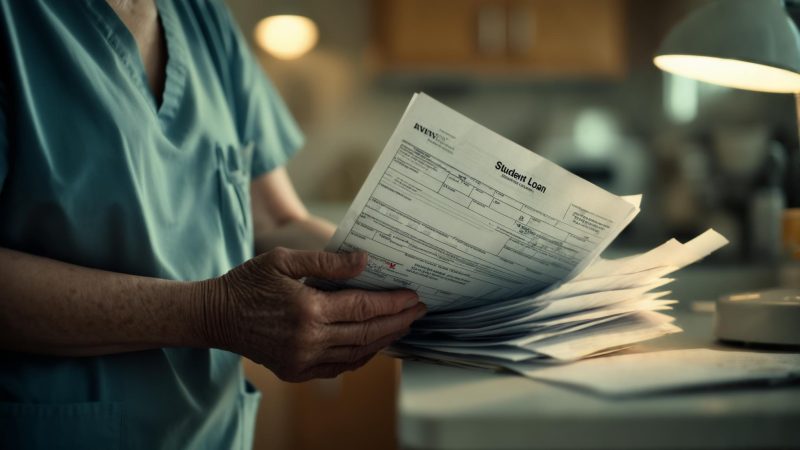
When I sat down with Ivan at a coffee shop near his center, he spread a folder of printed documents on the table between us — loan statements, credit reports, payment histories — with the precision of someone who has rehearsed this presentation in his head many times. “I’m a planner,” he told me. “I like to have every variable accounted for. That’s probably why this has been so hard. There are variables in my financial life right now that I cannot control, no matter how many spreadsheets I make.”
In 2017, Ivan enrolled in a Master’s program in Education Administration at the University of Denver, wanting credentials that would help him expand Sunshine Sprouts. He graduated in 2019 and took on $58,400 in federal student loans to do it. At the time, the math felt manageable. He enrolled in an income-driven repayment plan and kept his monthly payment around $480. It was a burden, but a predictable one.
The second debt was not his choice, exactly. In 2022, his younger sister, Danielle, was accepted into a dental hygiene program in Colorado Springs. She needed $34,000 in private student financing and could not qualify alone. Ivan cosigned. “She was my sister. She had a plan. I didn’t think twice about it,” he told me. He paused, then added: “That’s the part that keeps me up at night. That I didn’t think twice.”
When the Default Hit — and What It Cost
Danielle completed her program but struggled to find stable work. By late 2023, she had missed three payments. In January 2024, the private lender declared the loan in default. Because Ivan had cosigned, the default was reported to all three credit bureaus under his name as well.
His credit score dropped from 741 to 654 — a fall of 87 points in a single reporting cycle. For context, according to the Consumer Financial Protection Bureau, cosigners are equally liable for the full loan balance and any negative payment history is reported on both the primary borrower’s and the cosigner’s credit files. There is no legal distinction between the borrower’s default and the cosigner’s.
The lender contacted Ivan directly and demanded he begin making payments on the full outstanding balance, which had grown to approximately $36,200 with fees and accrued interest. He negotiated a temporary repayment agreement to avoid the loan being sent to a collections agency, agreeing to pay $610 per month — on top of his existing $480 federal loan payment. That is $1,090 in monthly student loan obligations on a debt load he entered voluntarily, and one he did not.
The SAVE Plan Freeze and What It Meant for His Federal Loans
While managing the cosigned loan fallout, Ivan had hoped to restructure his federal loan payments under the SAVE plan — the Biden-era income-driven repayment program that would have lowered his monthly federal payment based on his discretionary income. But those plans stalled when federal appellate courts blocked SAVE’s implementation in mid-2024, and as of early 2026, the program remains in legal limbo.
According to Federal Student Aid, borrowers who were enrolled in SAVE have been placed in a general forbearance while the litigation continues. Interest is not accruing during this period, but payments are also not counting toward forgiveness timelines under Public Service Loan Forgiveness or other programs. For Ivan, who had hoped to eventually reach forgiveness after years of qualifying payments, the freeze is not a pause — it is a gap.
“I had a plan,” he told me, tapping the folder of documents. “I was supposed to have maybe eighteen years of payments left, then forgiveness on whatever balance remained. Now nobody can tell me what’s going to happen. I’m just sitting in forbearance while they fight it out in court.”
Zero Retirement Savings at 52 — The Number That Defines His Anxiety
If the cosigned loan default is Ivan’s acute crisis, the retirement savings gap is the slow-moving emergency underneath it. When I asked him directly how much he had saved for retirement, he looked at the table for a moment before answering. “Zero,” he said. “Exactly zero dollars. I’m fifty-two years old and I have nothing in a 401(k), nothing in an IRA. Nothing.”
He is not without income — his daycare business is profitable. But for years, profit has gone back into the business: a facility expansion in 2021, staff salary increases to retain qualified teachers, new curriculum licensing. He describes it as a deliberate investment strategy that made sense until it suddenly didn’t. “I kept telling myself I’d start saving for retirement next year. And then next year kept coming.”
His fiancée, Marguerite, is completing a nursing program and will begin working in her field later in 2026. That income — projected at roughly $65,000 to start — will shift their household finances. But Ivan is acutely aware that a couple entering their mid-50s with no retirement savings and nearly $95,000 in combined student loan obligations is starting from a precarious position regardless of income.
Where Things Stand — and What He Has Not Resolved
This is not a story with a clean resolution. When I asked Ivan what had changed since January 2024, his answer was measured. He had contacted the private lender and confirmed there is no cosigner release option on his sister’s loan — something he says he should have verified before signing. He has been making the $610 monthly payment consistently for fifteen months to prevent further credit damage. His score has recovered slightly, to 671 as of February 2026, but remains well below where it was.
On the federal loan side, he is waiting. The SAVE forbearance means he owes nothing on those loans month to month right now, but that pause has not given him peace of mind. “I don’t know if the plan I was counting on will exist when this is over,” he said. “That’s the problem. I built a strategy around something that might not be there anymore.”
Ivan told me he has started researching whether his business could establish a SEP-IRA, which would allow him to make retirement contributions as a self-employed business owner. He has not yet opened one. “I know what I need to do,” he said. “I just haven’t done it yet. And that’s the thing that tells me where my head is. I’m a planner who can’t make himself plan for the most obvious thing.”
As I packed up my recorder and he tucked his folder back together, Ivan said something I have thought about since. “The cosigned loan — I don’t blame my sister. She didn’t intend this. But I wish someone had sat me down and made me understand that signing that paper made me the borrower. Not the backup. The borrower. Nobody said it that plainly.” He shrugged. “Now I’m saying it plainly to anyone who will listen.”
For millions of Americans navigating the federal student loan system in 2026 — with repayment rules still contested in courts and private loan protections paper-thin — Ivan Neville’s story is less an outlier than a preview of what methodical planning looks like when the rules change underneath you. He built something real in Sunnyside. He is still building. But the weight on his ledger is heavier than it should be, and some of it arrived without warning.



Leave a Reply