
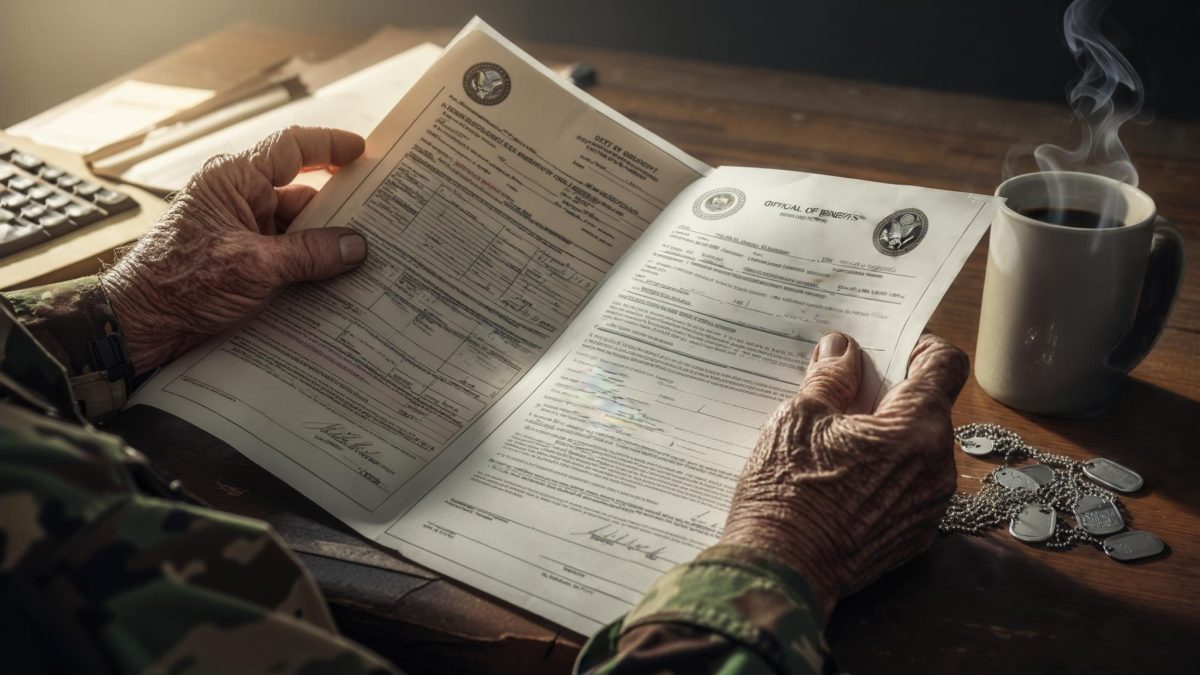
In late January 2026, a comment appeared beneath one of my earlier pieces on federal workers navigating injury claims. The commenter identified himself only as “C. Uribe, Albuquerque” and wrote, in part: “My wife thinks we’re fine. We are not fine.” I followed up within 48 hours, and three weeks later I was on a video call with Curtis Uribe, 31, a former Army veteran and medically retired USPS mail carrier trying to hold his household together on roughly $1,800 a month.
The story Curtis told me over two hours is not a clean redemption arc. It is messier and more instructive than that — the story of a confident man who let years of eligible benefits expire unclaimed because he assumed he didn’t qualify, then scrambled when the floor dropped out.
A Back Injury, a Denial, and a Secret
Curtis left the Army in August 2018 and was hired by the United States Postal Service that November. For five years, he worked a delivery route in the South Valley neighborhood of Albuquerque. In October 2023, while lifting a 74-pound mail tray off a loading dock — alone, because his partner called out sick — he herniated two discs in his lower back.
He filed a workers’ compensation claim under the Federal Employees’ Compensation Act within two weeks. By January 2024, the claim was denied. The Office of Workers’ Compensation Programs cited insufficient medical documentation linking the specific incident to the documented injury. Curtis told me he was floored.
Curtis and his wife, Renata, have a 17-year-old daughter, Marisol, who is scheduled to begin community college in fall 2026. Curtis also carries $47,200 in federal student loans from a Master’s in Public Administration he completed in 2021 — a degree he pursued while working full-time, believing it would eventually open a management track at USPS. The injury ended that plan before the degree paid off.
Eight Years of Unclaimed VA Benefits
When I asked Curtis whether he had ever filed a VA disability claim, he paused for a long moment. “I looked at it once, maybe 2019,” he said. “I figured my knee thing was minor. I didn’t want to take something from someone who needed it more.”
That kind of deference is something I hear repeatedly when reporting on younger veterans. Curtis’s exit physical in 2018 had flagged right knee instability — a condition the Army attributed to repetitive formation drills and load-bearing exercises. That documentation existed in his service record. He simply never pursued it.
After the workers’ comp denial, Curtis finally created an account on VA.gov and submitted his first disability claim in February 2024. He rated the knee condition as his primary complaint and added a secondary claim for the herniated discs, arguing aggravation of a service-connected condition. As Curtis explained to me, he wasn’t even certain the back claim would connect — he just knew he had nothing to lose.
The Claim Assist Portal and What It Changed
Curtis’s initial claim sat in processing for nearly seven months. He told me he checked his status daily, sometimes twice, growing more anxious each week that passed without movement. The turning point came in September 2024, when he received a notification through what the VA now calls the Claim Assist Portal — a tool the Veterans Benefits Administration launched to allow claimants to respond directly to requests for evidence without mailing physical documents.
The portal flagged that the VA had requested Curtis’s military separation physical from 2018 — a document he hadn’t thought to submit. He uploaded it within 24 hours. “That one document,” Curtis told me, “was apparently the thing they were waiting on for months. I had no idea they even wanted it until the portal told me.”
What the Rating Covers — and What It Doesn’t
A 30% combined disability rating translated to approximately $524 per month for Curtis as a single veteran with dependents, based on 2025 VA rate tables. It is not a livable income on its own. Combined with Renata’s part-time income as a dental assistant — roughly $1,300 monthly — the household clears about $1,800 to $2,000 depending on the month. Against a mortgage of $1,140 and Marisol’s upcoming college costs, that math is tight.
Curtis told me he had looked into whether his $47,200 in student loans might qualify for any veteran-specific relief. According to Military.com’s 2026 state veterans benefits directory, New Mexico offers limited property tax exemptions for disabled veterans but no specific student loan forgiveness program at the state level. Curtis said he is currently on an income-driven repayment plan, with monthly payments around $89.
That pattern — confident that things would resolve themselves, reluctant to disclose the full picture to his wife — is something Curtis acknowledged directly during our conversation. He said Renata now knows about the loans and the denied workers’ comp claim. He told her in December 2024, after the VA rating came through and he felt he had something concrete to show her alongside the problem.
Where Things Stand in March 2026
When I spoke with Curtis in mid-March 2026, his supplemental VA claim — filed in January seeking a rating increase to 50% — was still pending. At 50%, his monthly payment would rise to approximately $958, a meaningful difference. He was also awaiting word on a reconsideration request for his original FECA workers’ comp denial, submitted with additional physician documentation in October 2025.
Marisol’s college enrollment is three months away. Curtis told me he is proud of her and terrified in equal measure.
Reporting Curtis’s story, I kept returning to how much of his situation was shaped not by ineligibility but by assumption. He assumed the VA was for more severely injured veterans. He assumed the workers’ comp process would be straightforward. He assumed he could manage both without his spouse knowing. None of those assumptions held. What he found when he finally started filing — an accessible claims portal, a documented service injury, and a family more resilient than he’d given them credit for — had been there the whole time.
That is not a lesson I can offer Curtis as advice. But it is a fact I can report.




Leave a Reply