
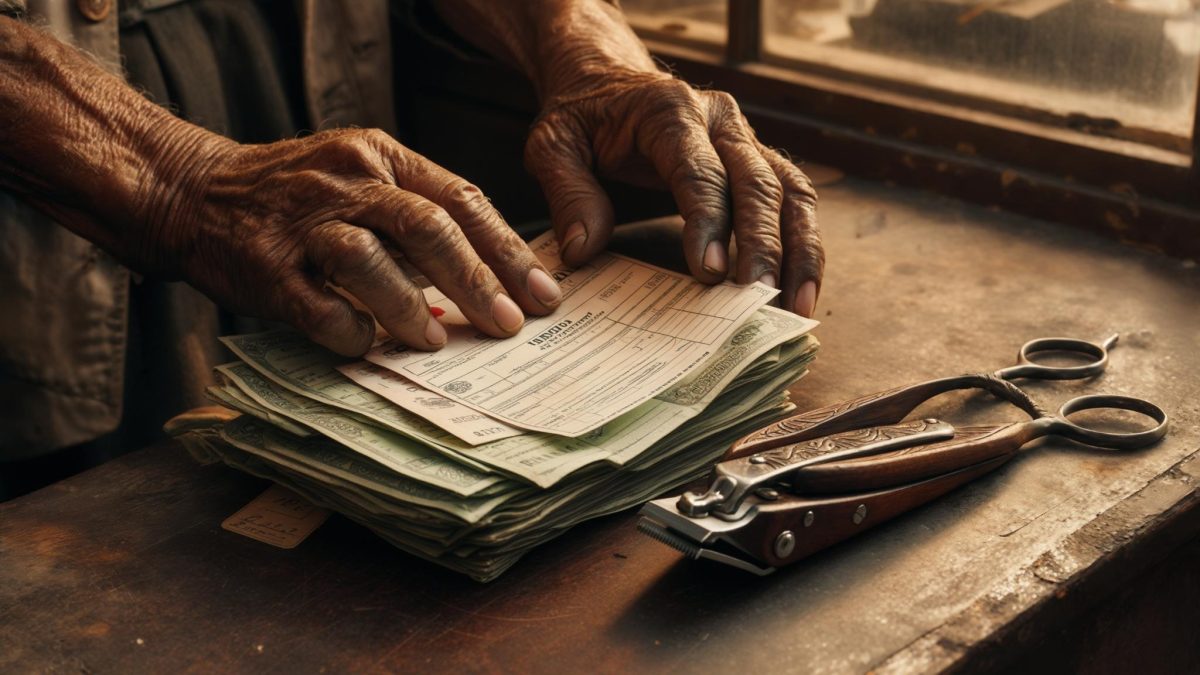
Most people assume that stubborn pride is something you eventually outgrow. Grace O’Brien, 65, would tell you that’s a comfortable lie told by people who’ve never had to build something from nothing with their bare hands. And he’d probably say it while sweeping hair off the floor of the same Detroit barbershop he’s owned since 1994.
I met Grace in February 2026, not through a referral or a press release, but during a Meals on Wheels delivery route on Detroit’s east side. I’d joined a volunteer driver named Paulette for a Saturday morning shift, more out of curiosity than anything else. She mentioned, almost offhandedly as we parked outside a brick two-flat on Kercheval Avenue, that the man inside was one of the most financially complicated cases she’d ever seen — not because his situation was unusual, but because he refused to acknowledge it was a situation at all.
That was Grace. He answered the door in a barber’s apron, invited me in with a look that suggested he was doing me a favor, and said exactly one sentence about government assistance before I’d even introduced myself properly: “I don’t do handouts.”
Thirty Years of Going It Alone
Sitting with Grace O’Brien for the better part of an afternoon, I came to understand that his self-reliance wasn’t performance — it was infrastructure. He opened O’Brien’s Cuts on East Jefferson Avenue in the spring of 1994 with a $3,200 loan from his older brother and a secondhand barber chair he found in a classified ad. He has never had an employer. He has never had employer-sponsored health insurance. For thirty-two years, that was simply the cost of ownership.
When I asked what he did when he got sick, he shrugged the way a man shrugs when you ask him how he carries something heavy. “You push through,” he said. “Or you pay whatever it costs and you deal with it later.”
The “deal with it later” part had been accumulating quietly for years. Grace was diagnosed with Type 2 diabetes in 2019 and hypertension around the same time. By late 2024, his monthly out-of-pocket costs for insulin, a blood pressure medication, and two quarterly doctor visits had climbed to approximately $870 — money pulled directly from the shop’s cash register some months. His credit score, already weakened by a string of medical bills from a 2017 kidney stone procedure, sat somewhere in the low 500s. And in December 2025, his 2009 Chevrolet Impala threw a transmission issue that a mechanic on Mack Avenue quoted at $1,400 to fix. The car has been parked since.
What Finally Cracked the Wall
Grace told me it wasn’t a single moment that made him reconsider. It was arithmetic. In January 2026, his insulin supplier stopped carrying the brand he’d been buying in bulk from a Canadian pharmacy online — a workaround he’d used for four years to keep costs down. The replacement, through a U.S. pharmacy, would cost him $340 a month for that prescription alone. He did the math on a yellow notepad and showed it to me: medications, visits, and the occasional lab work would now run closer to $1,100 monthly.
Paulette, who had been delivering his meals since October 2025, had mentioned Medicaid more than once. Each time, Grace had redirected the conversation. The third time, in mid-January 2026, he didn’t redirect it. He just said, “Fine. Tell me where to go.”
Michigan expanded Medicaid under the Affordable Care Act in 2014 through a program called Healthy Michigan Plan, and by 2026, it covered more than 2.5 million state residents. For Grace, whose net shop income after expenses averaged roughly $16,400 annually, eligibility was not in question. The question was whether he would apply.
The Application Process — and Where It Got Complicated
Grace applied online through Michigan’s MI Bridges portal on January 22, 2026. He told me the process took about 45 minutes and required three years of tax returns, documentation of his business expenses, and a bank statement. Without his car, he couldn’t drive to a Michigan Department of Health and Human Services office to drop off documents, so a neighbor scanned and uploaded them on his behalf.
The approval took 28 days from first submission to confirmation — longer than Michigan’s standard 45-day window but faster than Grace had expected. What caught him off guard was the retroactive coverage date. Because he’d applied in January, his coverage was backdated to the first of that month, which meant a $210 lab bill he’d paid out of pocket on January 9th was potentially reimbursable.
“I didn’t know they could go backwards like that,” Grace told me, clearly still processing it. “I paid that bill. I thought it was gone.”
The Outcome — and What It Didn’t Fix
When I spoke with Grace again in late March 2026, his medications were fully covered under his Medicaid plan. His monthly health-related out-of-pocket spending had dropped from $870 to approximately $35 — a modest copay on one specialist visit. He described the experience of filling his first fully-covered prescription at a Walgreens on East Warren Avenue as “strange, like waiting for something to go wrong.”
But Medicaid didn’t solve everything, and Grace was candid about that. His car remains parked. His credit score, dinged by years of deferred medical debt, still needs sustained work that goes beyond what any assistance program directly addresses. The shop brings in enough to keep the lights on, but foot traffic has been inconsistent since a construction project blocked the block for most of 2025.
As Grace explained it, the coverage was one wall repaired on a house with several still leaking. “I’m grateful,” he said, choosing the word carefully, like a man who doesn’t use it often. “But I’m not fixed. Don’t write that I’m fixed.”
What Grace’s Story Actually Says About Self-Reliance
Leaving Grace’s apartment that afternoon, I kept thinking about the word “handout” — the one he’d used when I first arrived. By the end of our conversations, he hadn’t abandoned it entirely, but he’d started putting it in a different box. He’d paid into the tax system for over three decades as a self-employed business owner. Medicaid wasn’t charity handed down from a stranger. It was a program he’d been contributing to, at arm’s length, his entire working life.
“I still think most of these programs are designed for people who don’t try,” he said, with the bluntness of a man who has no interest in softening his views for a journalist. “But maybe I was wrong about this one. Or maybe I just got old enough to qualify.”
According to the Medicaid.gov eligibility overview, self-employed individuals can qualify in expansion states based on net income, a nuance that isn’t well publicized and that Grace says no one had ever spelled out for him clearly before Paulette pushed the issue. Roughly 40% of uninsured adults in the U.S. are estimated to be eligible for either Medicaid or subsidized marketplace coverage but haven’t enrolled, according to KFF research on uninsured Medicaid-eligible adults.
Grace O’Brien is one data point inside that statistic — a man who built something real on his own terms, and who spent thirty-two years paying a price he didn’t have to pay, for reasons that made complete sense until they suddenly didn’t. That’s not a failure of character. It’s what happens when information doesn’t reach the people who need it most.
He walked me out through the shop, past the chair he’s been working in for three decades. The floor was swept clean. The pride in it was obvious and entirely earned. Some things, at least, hadn’t changed at all.
Related: I Almost Claimed Social Security at 62 — The Math That Changed My Mind
Related: She Had No Health Insurance for 3 Years. A Credit Union Manager’s Tip Changed That for Her Family.




Leave a Reply