
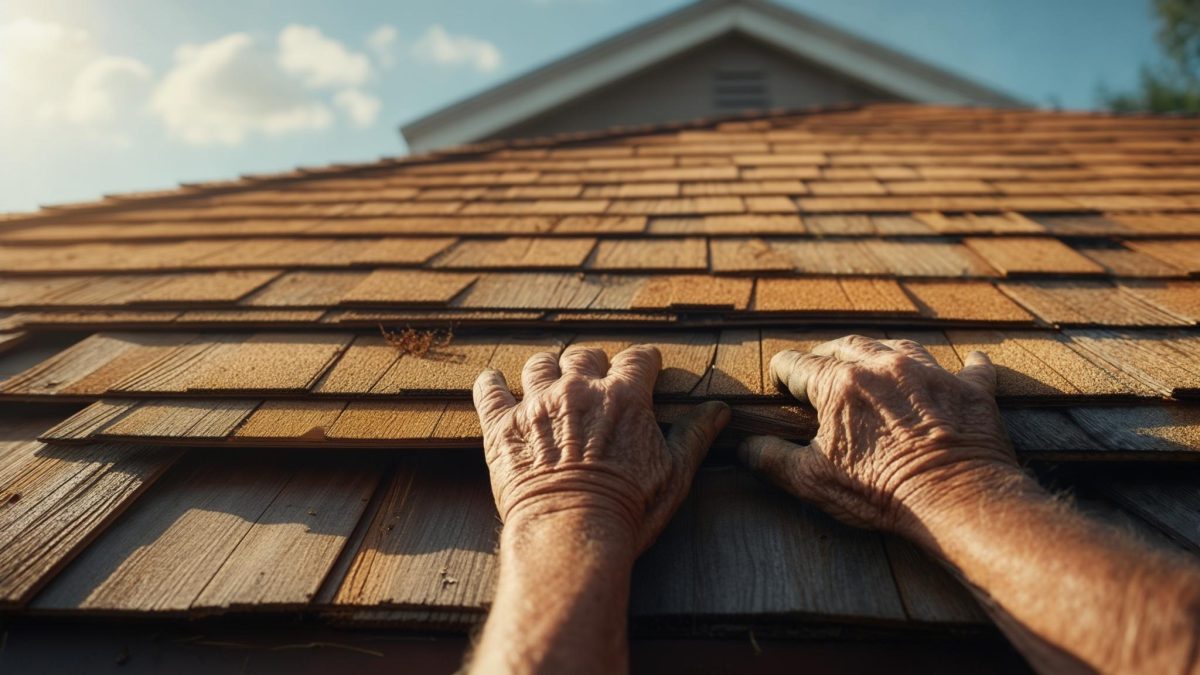
What would you do if the one government benefit keeping your household afloat suddenly couldn’t cover the cost of keeping your house standing?
That is not a hypothetical for Eddie Kirby. When I first met him last October, it was through a mutual friend who pulled me aside at a neighborhood barbecue in Fresno’s Tower District. “You should talk to this guy,” she said, nodding toward a stocky man in a work polo quietly nursing a soda near the fence. “He’s been dealing with something that would break most people.”
Eddie Kirby is 50 years old, a licensed pest control technician who has worked routes across the Central Valley for the better part of two decades. He owns a modest three-bedroom house in southeast Fresno with his wife, Tamara, who works part-time as a school aide. They have two kids — a 10-year-old daughter and a 4-year-old son. By most measures, they are a working family doing exactly what the system says you should do.
But by the time I sat across from Eddie at a picnic table that evening, he had a $14,500 roofing estimate sitting on his kitchen counter, a stack of medical bills from a lumbar injury sustained on the job in 2022, and a monthly budget that had been underwater for the better part of a year.
When Disability Benefits Don’t Add Up to Enough
Eddie’s lower back injury — two herniated discs from years of crouching under crawl spaces — left him on reduced hours and partial California State Disability Insurance (SDI) payments for several months in 2023. At its peak, the SDI benefit covered roughly $1,100 per month, calculated against his average weekly wages. His actual housing-related costs, he told me, ran closer to $1,700 once you factored in his mortgage payment, utilities, and the deferred repairs that were no longer deferrable.
“Every month I was just moving money around to plug holes,” Eddie told me. “I’d pay the mortgage, skip the electric for two weeks, catch it up, then something else would fall behind.” His tone wasn’t self-pitying — it was the flat, analytical voice of someone who has run these calculations so many times they’ve become muscle memory.
On top of that, Eddie sends approximately $400 per month to his mother in Bakersfield, who is in her mid-seventies and relies on him to cover her phone bill, occasional prescriptions, and grocery gaps not filled by her Social Security income. It’s a cost he has never once considered cutting. “She’s not going without,” he said simply.
A Roof, a Reckoning, and a Wall of Distrust
The roofing issue had been building for two years before a winter storm in January 2024 pushed it into crisis. Water came through the ceiling in the hallway and the older child’s bedroom. Eddie got three estimates — $11,200, $14,500, and $16,800. He chose to verify the middle estimate with a fourth contractor before committing to anything.
“I don’t trust anybody with my money fast,” he said. This isn’t idle stubbornness. In 2019, Eddie had been approached by a company offering a loan modification on his mortgage. He paid a $1,200 upfront fee — money he still describes as “gone” — before the company stopped returning calls. It was a predatory scheme he later learned had targeted dozens of Fresno homeowners. The experience left a mark.
So when a coworker mentioned that California had housing assistance programs for homeowners with lower incomes, Eddie’s first reaction was skepticism. “I figured it was another thing where you qualify on paper and then they tell you your income is two dollars too high,” he said.
What He Eventually Found — and What It Actually Took
Eddie’s entry point, he told me, was not a government website. It was a housing counselor at a HUD-approved nonprofit agency in Fresno that a neighbor had used the previous year. Through that counselor, he learned about several overlapping options that he had not previously known existed as a current homeowner — not just as someone trying to buy.
Eddie and Tamara’s combined income — roughly $38,000 from his pest control work plus Tamara’s $13,500 in part-time wages — placed them at approximately 62% of Fresno County’s Area Median Income. According to Mortgage Reports’ low-income homebuying guidance, income-based programs in California frequently serve households at or below 80% AMI, which meant Eddie’s family was squarely within range for several assistance tiers.
The Outcome: Partial Relief, Real Complications
When I followed up with Eddie in February 2026, the picture was better — but not simple. The City of Fresno’s rehab program had approved him for a deferred loan of $12,000 toward the roofing project, covering the bulk of the $14,500 estimate he had selected. The loan carries zero interest and is not due until he sells or refinances the home. “That part actually worked like they said it would,” Eddie told me. “I was waiting for the catch. Took me a while to believe there wasn’t one.”
The remaining $2,500 came from a combination of a modest tax refund and a short-term payment plan with the contractor. Eddie’s monthly budget is still tight — he’s back to full hours at work, but the lumbar issue flares regularly, and a second round of physical therapy is not fully covered by his employer’s insurance plan.
The FEMA pathway did not materialize; the storm damage predated the application window by enough months to disqualify the claim. And Eddie remains resistant to any option involving a new lender. When his housing counselor raised the possibility of a cash-out refinance to consolidate some remaining debt, Eddie declined without much deliberation.
What Eddie’s Story Reveals About the Housing Assistance Gap
Across the country, the gap between what assistance programs promise and what they deliver in practice is often navigational, not financial. The programs Eddie accessed existed before he needed them — he simply had no reliable way to find them, and a hard-earned distrust of anything that looked like a financial offer.
According to the Bipartisan Policy Center’s overview of the 21st Century ROAD to Housing Act, new federal legislation introduced in March 2026 includes provisions intended to streamline access to repair assistance and expand HUD counseling funding — though it has not yet cleared both chambers. For families like Eddie’s, that timeline is academic.
HUD-approved housing counselors — the kind Eddie finally connected with — offer free or low-cost guidance and are searchable through the HUD program directory. The counselor Eddie worked with charged nothing for the initial session. That detail alone, he said, was what got him in the door.
When I left Eddie that February afternoon, the new roof was visible from the street — clean composite shingles replacing the original 1990s installation that had finally given out. His daughter was doing homework at the kitchen table. His son was asleep on the couch. The house was dry.
He still sends $400 a month to Bakersfield. He still watches his budget the way a man watches weather he doesn’t trust. But for the first time in a long while, the ceiling above his children’s beds was solid. In Eddie Kirby’s world, that is not a small thing.
(function(){var w=document.getElementById(‘pvv-scenario-s1775655595147as0v’);if(!w)return;var btns=w.querySelectorAll(‘button[data-choice]’);btns.forEach(function(b){b.addEventListener(‘click’,function(){if(w.dataset.revealed)return;w.dataset.revealed=’1′;btns.forEach(function(x){x.style.opacity=x===b?’1′:’0.45′;x.style.cursor=’default’;x.style.transform=’none’});var o=document.getElementById(‘s1775655595147as0v-out-‘+b.dataset.choice);if(o){o.style.display=’block’}});b.addEventListener(‘mouseenter’,function(){if(!w.dataset.revealed){b.style.borderColor=’#38bdf8′;b.style.transform=’translateX(4px)’}});b.addEventListener(‘mouseleave’,function(){if(!w.dataset.revealed){b.style.borderColor=’#334155′;b.style.transform=’none’}})})})();
.pvv-faq-section details summary::-webkit-details-marker{display:none}.pvv-faq-section details summary::marker{display:none;content:””}.pvv-faq-section details[open] summary .pvv-faq-arrow{transform:rotate(90deg)}



Leave a Reply