

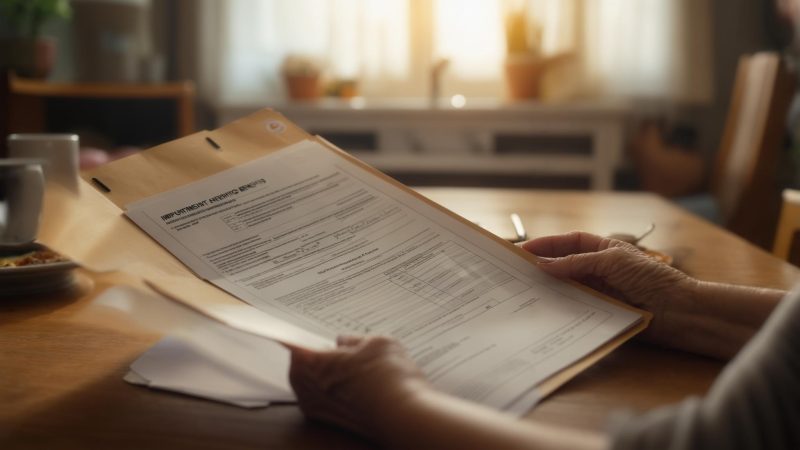
The application window for Georgia’s Supplemental Nutrition Assistance Program does not pause for personal crises. It does not wait while you process a medical diagnosis, negotiate a pension appeal, or try to track down an ex-partner who stopped paying child support thirteen months ago. Doris Becerra learned this in the hardest way possible — sitting in a county office in DeKalb County, Atlanta, in January 2026, filling out her first-ever SNAP application at age 33 with a graduate degree on her wall and $47,000 in student loan debt on her credit report.
A social worker at that same assistance office suggested I speak with Doris after she completed her intake appointment. The social worker described her as someone who had “fallen through every crack the system has.” When I introduced myself in the hallway outside the waiting room, Doris shook my hand firmly and said she didn’t mind talking. “Somebody should write this down,” she told me, “because I know I’m not the only one.”
A Medical Retirement Nobody Plans For
Doris worked for the United States Postal Service for eight years, starting as a mail processing clerk in 2016. She was good at the job, she told me — efficient, punctual, union-proud. She was also quietly pursuing a Master of Public Administration degree at Georgia State University on nights and weekends, racking up roughly $47,000 in federal graduate student loans by the time she finished in 2022.
The injury came in the spring of 2024. A repetitive stress condition in her lower back and both wrists — accelerated, her doctors concluded, by years of sorting and lifting on a high-volume processing line — left her unable to perform her core job duties. USPS placed her on modified duty for several months, then the agency’s medical review process found her eligible for a Federal Employees Retirement System (FERS) disability retirement. The retirement was finalized in October 2024.
Her disability annuity from FERS came to approximately $1,310 per month after federal withholding — a figure she described to me with a short, humorless laugh. “That’s less than I was making in two weeks,” she said.
After rent on her two-bedroom apartment in East Point — a neighborhood she chose for its proximity to her daughter Amara’s daycare — she was left with roughly $235 a month for everything else. Utilities, diapers, groceries, gas, and the minimum payment on her student loans consumed that sum before the tenth of each month.
The Child Support Gap That Made Everything Worse
Amara’s father, from whom Doris separated in early 2024, had been ordered by a Fulton County family court to pay $412 per month in child support. He made the first three payments. Then, Doris told me, the payments stopped entirely in December 2024 without explanation.
She filed a non-compliance report with Georgia’s Child Support Services division. The case was opened, but as of the day we spoke in January 2026, she had received nothing. “The system is slow,” she said flatly. “I can’t feed Amara on a pending case number.”
According to Georgia DFCS, child support payments that an applicant receives count toward gross income for SNAP eligibility purposes — but payments that are court-ordered and simply not being paid do not. Doris’s caseworker confirmed that her household income for the SNAP calculation would be based solely on her annuity, which worked in her favor, though she made clear she would have much preferred the $412 a month instead.
Navigating SNAP Eligibility With a Graduate Degree and a Pension
The SNAP application process in Georgia requires documentation of all household income, identity, residency, and — for households with able-bodied adults without dependents — work registration. Doris qualified for an exemption from work requirements because she is the primary caregiver for a child under six, and because her disability status was already documented through her federal retirement paperwork.
What she did not expect was the interaction between her student loan debt and the benefit calculation. Her $47,000 in federal loans are currently in an income-driven repayment plan, with a monthly payment of approximately $0 under the SAVE plan — a Biden-era program that the Federal Student Aid office has confirmed remains in a complex legal and administrative limbo as of early 2026. Because her payment was $0, no student loan expense was being deducted from her budget, which meant the SNAP calculation could not count it as an allowable deduction.
Her caseworker walked her through the net income calculation. Georgia, like all states, uses both a gross income test and a net income test for SNAP. For a household of two in 2026, the gross limit is approximately 130 percent of the federal poverty level — roughly $2,248 per month. Doris’s gross income of $1,310 cleared that threshold with room. Her net income, after the standard deduction and a shelter deduction for her rent, came to around $530 per month — below the 100 percent poverty threshold for a two-person household.
According to USDA Food and Nutrition Service, SNAP benefits are calculated as 30 percent of a household’s net income subtracted from the maximum allotment for that household size. For Doris and Amara, that math produced an approved monthly benefit of $296 — deposited to an EBT card within roughly two weeks of her approval letter.
The Side Hustle Question
Doris is not someone who sits still. She told me she has three side income streams she rotates depending on how her back is holding up on a given week: selling handmade beaded jewelry through an Etsy shop she launched in November 2025, completing grocery delivery orders through a gig platform when she can manage the driving, and occasionally doing virtual data entry work she found through an online job board.
Her monthly earnings from these activities fluctuate — she estimated an average of $180 to $340 per month, with some months bringing in nothing if her pain flares. She was upfront with her caseworker about all of it. What she didn’t fully anticipate was the reporting requirement.
“I told the caseworker everything,” Doris said. “I didn’t want to get a letter six months from now saying I owe money back. I’ve heard that happens to people and it wrecks them.” Her concern was well-founded — SNAP overpayments can result in benefit reductions or repayment demands, a process that can strain already-thin budgets considerably.
Her caseworker noted that at her current side income levels, her combined household income was still well below the gross threshold. But she was advised to document her business expenses carefully so that the net self-employment figure used in any future recertification reflects actual earnings, not gross deposits.
A Mixed Outcome, Honestly Described
When I asked Doris to describe where things stand today, she paused before answering. The $296 a month in SNAP benefits has materially changed her grocery situation — she is no longer choosing between protein and produce, she told me, and Amara is eating better. But the larger financial picture has not resolved. The student loan uncertainty nags at her. The child support case remains open and unresolved. Her back limits the gig work she can do, which limits how much she can earn on the side.
She is exploring whether her disability status qualifies her for a Total and Permanent Disability discharge of her federal student loans — a program administered through the Federal Student Aid office that can discharge loans for borrowers who are unable to engage in substantial gainful activity due to a medically determinable condition. Her FERS disability determination may support that application, though the process requires a physician’s certification and careful documentation.
She has not yet applied. “I’m working on it,” she said. “I’m always working on something. That’s just who I am.”
When I left the county office that afternoon, Doris was already on her phone — looking up craft supply prices for a new jewelry design she wanted to list before the week was out. The $296 a month in SNAP benefits is a floor she didn’t want, but it is a floor she built carefully and honestly. That, in a system this complicated, is no small thing.
Related: He Retired at 44 on a Fixed Income and Got Hit With a $14,000 Hospital Bill — What Happened Next
.pvv-faq-section details summary::-webkit-details-marker{display:none}.pvv-faq-section details summary::marker{display:none;content:””}.pvv-faq-section details[open] summary .pvv-faq-arrow{transform:rotate(90deg)}



Leave a Reply