
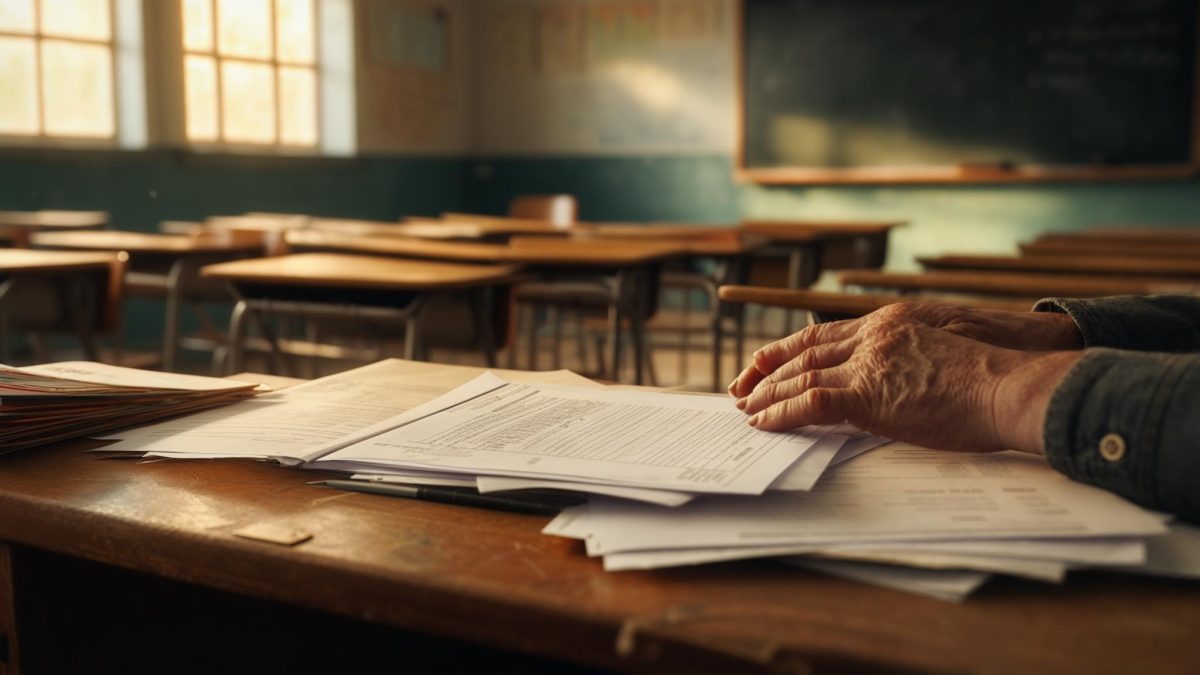
With federal student loan policy in open flux as of early 2026 — the Biden-era SAVE repayment plan still frozen by federal courts and millions of borrowers sitting in administrative forbearance with no clear path forward — I went looking for someone living through the confusion rather than just reading about it. I found Marcus Dillard through a teacher advocacy group on social media, where he had posted a measured but unmistakably frustrated comment: “I don’t even know if my payments are counting toward anything anymore.” We met at a coffee shop near his school in southwest Atlanta on a Tuesday afternoon in late February 2026. He arrived with a worn tote bag and his phone already open to a Federal Student Aid login screen.
Marcus is 34, a high school math teacher entering his eighth year in the classroom. He carries $62,000 in federal student loans from the master’s degree in education he completed in 2019 — a credential he pursued specifically to increase his earning potential and qualify for department leadership roles. Neither of those things happened the way he planned.
A Master’s Degree That Cost More Than Anyone Told Him
Marcus grew up in a household where money was not discussed — not because things were comfortable, but because they weren’t, and his parents preferred silence to worry. He carried that pattern into adulthood. When I asked him about the loan paperwork he signed in 2017 to fund his graduate program, he looked at the table for a moment before answering.
By the time Marcus finished his degree, he was earning roughly $54,000 a year at a public school in Atlanta. His salary has since risen to approximately $61,000 with experience step increases, according to the district pay schedule he pulled up on his phone during our interview. His wife, Tanya, worked as a dental hygienist and brought in comparable income until their second child arrived in 2023. She shifted to part-time after that, and the household effectively became a single-income situation for most months.
Childcare for two children in the Atlanta metro area now runs the family more than $1,500 a month — a figure Marcus mentioned almost in passing, the way people do when a number has stopped surprising them. The family’s credit card balances have climbed to just under $9,000 across two cards. Marcus told me he sometimes goes two or three weeks without opening his banking app. “I know that’s not good,” he said. “I know.”
The PSLF Promise — And the Fine Print No One Explained
Public Service Loan Forgiveness exists specifically for people in Marcus’s position. The program, administered by the U.S. Department of Education, promises full federal loan forgiveness after 120 qualifying monthly payments made while working full-time for a qualifying employer. Public schools qualify. Marcus’s district qualifies. He has been vaguely aware of PSLF since graduate school, but he did not formally submit an Employment Certification Form until 2022 — three full years after completing his degree.
Those three uncertified years were not necessarily lost — the program allows retroactive employment certification — but the documentation process was complicated by incomplete early payment records. When I spoke with Marcus in February 2026, he believed he had somewhere between 78 and 84 confirmed qualifying payments, though he expressed uncertainty because his loan servicer had changed twice since he entered repayment in 2020.
The servicer transitions created gaps in Marcus’s payment history that he described as “just gone — like they evaporated.” He spent several evenings in late 2024 on hold with MOHELA, his current servicer, attempting to reconstruct records from 2020 and 2021. He eventually recovered most of the documentation, but the process consumed hours he did not have and produced a specific category of low-grade anxiety he has not fully resolved.
When the Repayment Plan Changed Everything
In 2023, Marcus enrolled in the SAVE plan — the Saving on a Valuable Education income-driven repayment plan introduced by the Biden administration. For Marcus, SAVE brought his monthly payment down to approximately $310, compared to the roughly $680 he would owe under the standard 10-year plan. The reduction gave the family breathing room they badly needed after Tanya cut her hours.
Then the legal challenges arrived. In 2024, federal courts blocked the SAVE plan following lawsuits brought by a coalition of Republican-led states. The Department of Education’s SAVE litigation page placed affected borrowers into an interest-free administrative forbearance while appeals proceeded. As of March 2026, that forbearance remains in effect — and months spent in administrative forbearance generally do not count as qualifying payments toward PSLF.
When Marcus learned that the forbearance might not be counted toward his PSLF total — from a thread in the same Facebook group where I found him — he described it as one of the more disorienting moments of his adult financial life. He had assumed the payment pause was neutral, a temporary hold that would cost him nothing. Learning it potentially cost him months of forward progress hit differently.
“I teach kids about rational decision-making every day,” he told me with a short, dry laugh. “And here I am, not understanding the system I’m inside of.”
Where Marcus Stands Today — and What He Still Doesn’t Know
By the time we finished our conversation, Marcus had already taken one concrete step: in January 2026, he switched out of the SAVE forbearance and enrolled in Income-Based Repayment, acting on guidance he found on StudentAid.gov. His monthly payment under IBR is now approximately $380 — slightly higher than SAVE, but actively accumulating qualifying PSLF payments again. If his count of 78 to 84 certified payments is accurate, he could be looking at full forgiveness sometime between late 2029 and mid-2030.
That is still four or more years away. The credit card debt remains. Childcare costs remain. Tanya has increased her hours slightly now that their younger child has started part-time preschool, but the household has not returned to two full incomes. Marcus described their financial situation as “stable, but fragile” — a phrase he delivered with the measured calm of someone who has rehearsed it.
What Marcus regrets most is not the degree itself — he still believes the master’s made him a meaningfully better teacher. What he regrets is the years he spent not engaging with his servicer, not submitting annual employment certification, and not reading the fine print on repayment plan elections. He estimates that administrative confusion and missed certification windows may have cost him 12 to 18 months of qualifying PSLF credit, though he cannot be certain without a formal audit of his account history.
He also carries a quieter anxiety: that PSLF itself may not survive intact through the next several years of federal policy shifts. The program has faced repeated legislative and administrative threats since its inception. Marcus is not a pessimist by nature — he is, by his own description, someone who defaults to optimism — but he has learned not to count on any single outcome.
When I left the coffee shop, Marcus was already back on his phone, pulling up the MOHELA portal to confirm whether his January IBR payment had posted as a qualifying PSLF payment. It had. He showed me the screen — a small confirmation marker next to the payment record — and for a moment something in his expression shifted. Not relief exactly. More like the expression of someone who has learned not to celebrate prematurely but cannot quite stop himself.
The federal student loan system was not built to be navigated alone, and Marcus Dillard is hardly the first person to discover that too late. Whether the SAVE litigation resolves in a way that restores lost months — and whether PSLF survives future policy changes intact — are questions no one can answer for him right now. What he does know is that the next qualifying payment posts in 30 days, and he intends to be watching for it.
Related: My Wife Is Due in Four Months and We Have $22K Saved — Here’s the Impossible Math We’re Facing


Leave a Reply