

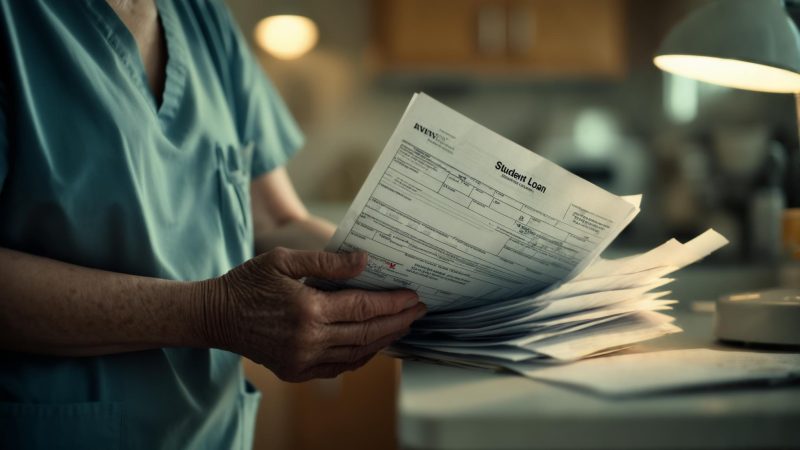
The stack of unopened envelopes on Marcus Dillard’s kitchen counter told its own story before he said a single word. Student loan statements, a credit card bill, a notice from the electric company — all face-down, as if turning them over might make the numbers worse. “I’ve always been better with other people’s problems than my own,” he told me with a dry laugh, sliding the stack to the side to make room for his coffee mug.
Marcus is 34, a high school math teacher at a public school in Atlanta’s southwest corridor. He has two kids under five, a wife who cut her work hours after their second child was born, and a graduate degree that cost him $62,000. When I met him in February 2026, he had been making loan payments for six years and had barely dented the principal.
A Degree That Was Supposed to Pay Off
Marcus grew up in a household where, as he put it, “money was something that happened to other people — not something you planned.” His parents never discussed budgeting, never talked about debt, never explained the difference between a subsidized and an unsubsidized loan. When he enrolled in a master’s program in education at a Georgia state university in 2018, he signed the loan documents without fully understanding what he was committing to.
“I thought a master’s degree meant a higher salary,” he told me. “In education, that’s technically true — but it’s like, a $4,000 raise. And I borrowed $62,000 to get there.”
His standard repayment plan put his monthly loan payment at roughly $640. Combined with childcare costs that climbed above $1,400 a month after their second child arrived, and a household income that effectively dropped when his wife reduced her hours, Marcus said the family was consistently running a monthly deficit. He was covering gaps with credit cards.
“I’m a math teacher,” he said, almost wincing. “I can solve for X in any equation. But I just — I didn’t want to look at our own numbers. Because I already knew what they’d say.”
The Program He Had Never Heard Of
The turning point came not from a financial counselor or a government notice, but from a conversation in the school’s break room. A colleague — a veteran teacher who had been at the school for eleven years — mentioned offhandedly that she was months away from having her remaining loans forgiven through something called Public Service Loan Forgiveness, or PSLF.
Marcus had never heard the term. When he looked it up that night, he found that PSLF is a federal program administered by the Federal Student Aid office that forgives the remaining balance on Direct Loans after a borrower makes 120 qualifying monthly payments while working full-time for a qualifying employer. Public schools qualify. His employer qualified. And he had already been working there for six years.
“I almost cried,” Marcus told me. “Not because it fixed everything right away — but because I realized I had been white-knuckling it for six years and there was a door I didn’t know existed.”
There were complications, though. Marcus discovered that not all of his loans automatically qualified. Some older loan types, including certain FFEL loans, do not qualify for PSLF unless the borrower consolidates them into a Direct Consolidation Loan first — a step that, according to Federal Student Aid, resets the payment count on those specific loans. He had to sort through his loan servicer’s records to figure out what he actually held.
The Application Process — and Where It Got Complicated
When I asked Marcus to walk me through what the application process actually looked like, he described it as “like doing homework for a class where nobody gave you the syllabus.” The first step was submitting an Employment Certification Form — now processed through what the Department of Education calls the PSLF Form — to confirm that his employer qualified and that his employment was full-time.
The PSLF program requires that payments be made under a qualifying repayment plan — which means standard repayment or an income-driven repayment (IDR) plan. Marcus had been on a standard plan, which technically counts, but his servicer flagged that several of his earlier payments may not have been processed correctly for PSLF purposes. He is currently waiting on a formal payment count from his servicer, a process that, as he described it, involves a lot of waiting on hold.
“I’ve spent probably eight hours on the phone in the last six weeks,” he said. “Eight hours that I could have used grading papers or sleeping. But I do it, because on the other end of this is potentially $40,000 or more just — gone. In a good way.”
The Financial Reality Right Now
Marcus’s situation at the time of our conversation was genuinely mixed — not a triumphant resolution, but a cautious exhale. By switching to an income-driven repayment plan, his monthly payment dropped from approximately $640 to roughly $310, based on his household’s adjusted gross income. That reduction freed up roughly $330 a month — not enough to eliminate the credit card debt, but enough to stop adding to it.
He estimates he has approximately four years of qualifying payments left before he reaches the 120-payment threshold — assuming his servicer confirms that the payments he’s already made retroactively count. That confirmation, he told me, has not yet arrived.
The anxiety Marcus describes is not unusual. According to reporting from NPR’s education desk, PSLF has historically had a high rejection rate, with many borrowers denied on technical grounds — wrong loan type, wrong repayment plan, or employer certification issues. The program was overhauled in 2021 through a temporary waiver that allowed retroactive payments to count, and the current rules are more permissive than in earlier years, but borrowers remain cautious given the program’s troubled history.
Marcus is also watching legislative news closely. Any changes to the federal student loan framework — whether through budget reconciliation or executive action — could affect PSLF going forward. He said he tries not to follow every headline too closely, because it triggers the anxiety that makes him avoid his bank statements in the first place.
What Marcus Wants Other Teachers to Know
Near the end of our conversation, I asked Marcus what he would tell a first-year teacher who was sitting in the same position he was in six years ago. He paused longer than I expected before answering.
He also pointed to the gap between what public school teachers are told about their benefits and what’s actually available to them. His school district, he said, does not proactively inform teachers about PSLF eligibility during onboarding — something he now raises in the mentorship work he does with newer staff.
The stack of envelopes on his kitchen counter, he told me, is still there. But lately, he said, he’s been turning a few of them over.
“Progress,” he said. “That’s what I’m telling myself. It’s progress.”
Whether Marcus’s full payment history is certified and his remaining balance eventually forgiven, I can’t say. At the time of publication, he was still waiting on word from his servicer. But what struck me most about his story wasn’t the dollar amounts — it was the six years he spent carrying a burden he didn’t have to carry alone, simply because no one handed him the map.
Related: My Financial Planner Never Warned Me About This — and It Cost Me Thousands



Leave a Reply