
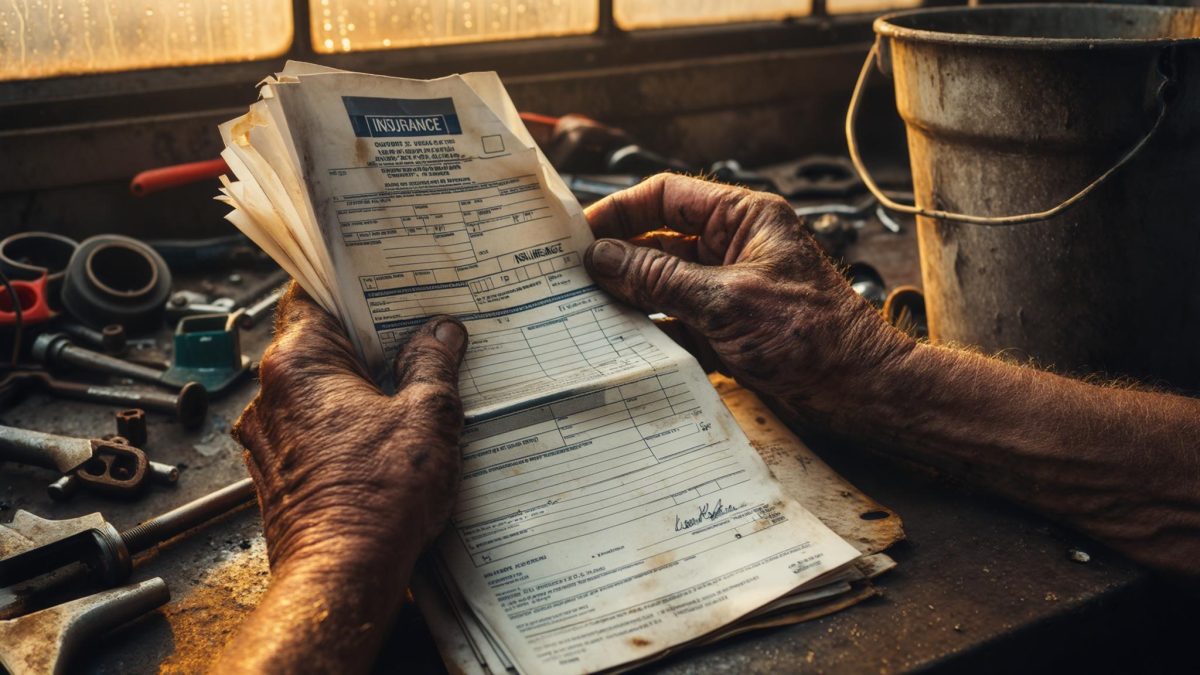
The waiting room at the El Paso Social Security Administration field office on a Tuesday morning in January 2026 moved at the pace of fluorescent lighting and paper forms. Plastic chairs lined every wall. A number dispenser sat near the entrance. I was there to follow a separate story about retirement benefit processing delays when I noticed a woman in the second row — calloused hands, a faded shop jacket with the name Mesa Auto & Repair embroidered on the chest — quietly working through a stack of papers held together by a binder clip.
That was Carmen Guzman, 61, an auto mechanic who has owned her small repair shop in east El Paso for eleven years. We started talking the way strangers sometimes do when a shared wait stretches past forty-five minutes. By the time her number was called, she had given me enough of her story that I asked whether she’d be willing to sit down for a longer conversation. She agreed with a short, dry laugh. “What’s there to lose,” she said. “I’ve already lost most of it.”
When COBRA Costs More Than the Mortgage
Carmen has run Mesa Auto & Repair since 2014. Business is consistent — she nets roughly $2,800 a month after shop expenses, a figure that once felt workable for two people living modestly. Her husband, Marco, 63, worked for a regional logistics company for sixteen years before his knees forced him into retirement in October 2024. His Social Security retirement benefit came through at approximately $1,140 a month — she showed me the award letter screenshot, still saved in her phone’s photo gallery.
Combined household income: around $3,940 per month. Not comfortable, but navigable — until COBRA entered the picture.
When Marco retired, the couple lost employer-sponsored health coverage through his former employer. They elected COBRA continuation coverage — the federal program that allows workers and dependents to maintain group health insurance after a qualifying event like retirement or job loss. The monthly premium came to $1,387 for both of them. According to Medicare.gov, neither Carmen nor Marco qualifies for Medicare until age 65, meaning they face several more years of that premium before the federal health program becomes available to them.
“The first bill came in November,” Carmen told me during a follow-up interview at a coffee shop near her shop. “I stared at it for ten minutes. I kept thinking there was a mistake. But no — that was just what it cost to not get sick without going broke.”
After the COBRA bill, Carmen and Marco had approximately $2,553 left each month. Their mortgage on a 1978-era home in El Paso’s Ysleta neighborhood runs $870 a month. Utilities, groceries, fuel for the shop, and basic maintenance consumed nearly everything that remained. There was almost nothing left for emergencies — and emergencies, as Carmen put it, had stopped asking permission before arriving.
A Home That’s Slowly Falling Apart
Carmen’s house has been in her family since 1994, purchased by her late mother and passed to Carmen and Marco. The home’s age has become a financial adversary. In the winter of 2024, a section of the roof began leaking during an unusually heavy El Paso rainstorm. A contractor quoted her $13,800 to replace the damaged section properly. The HVAC system has been repaired twice in three years; a full replacement would cost approximately $6,400.
Neither repair has happened. Carmen keeps a blue tarp — weighted down with bricks stored in a hardware bucket — ready to cover the leaking section when rain is forecast. She described the routine matter-of-factly, the way someone describes a workaround they’ve made peace with but haven’t accepted.
The bitterness Carmen carries traces back further than the leaking roof. In 2019, a severe pipe burst in the back wall of her shop destroyed two hydraulic lifts and an air compressor — equipment valued at approximately $22,000. An insurance dispute over the policy’s equipment clause left her with a partial payout, and she spent two years paying roughly $16,000 out of pocket to rebuild. That debt erased nearly all the savings the couple had accumulated through her forties.
“We were finally getting ahead,” she said, her voice measured but tight around the edges. “And then just — gone. That’s what I think about when people say just save more. Okay. And then what? Something always comes for it.”
The Search for Housing Repair Assistance
Carmen was at the SSA office that January morning to resolve a clerical issue — one of Marco’s benefit payments had been delayed, though it had since been corrected. But while she sat waiting, she picked up a pamphlet about housing assistance programs and started reading. That pamphlet sent her down a research path that consumed several weeks.
She looked into HUD’s public housing program, which according to HUD.gov exists to provide safe rental housing for eligible low-income families, the elderly, and persons with disabilities. But Carmen isn’t looking for rental housing — she wants to stay in her home and repair it. The distinction matters enormously when sorting through what’s actually available.
Carmen eventually identified the USDA Rural Development Section 504 Home Repair Program as her most promising option. The program provides grants of up to $10,000 and loans of up to $40,000 for very low-income homeowners to address health and safety hazards. Grant eligibility requires the applicant to be age 62 or older — Carmen turns 62 in August 2026, which complicates her timeline. She is applying for the loan component now and will reassess the grant eligibility question later in the year.
She also found information about the Department of Energy’s Weatherization Assistance Program through Benefits.gov, which can fund insulation, air sealing, and HVAC efficiency improvements for households at or below 200% of the federal poverty level — exactly the kind of work her home needs.
What Federal Housing Programs Actually Offer — and What They Don’t
The FY 2026 federal appropriations bill, passed on February 3, 2026, sustained funding for HUD’s core rental assistance and community development platforms, according to NACo’s legislative analysis of FY 2026 appropriations. But Carmen is a homeowner, not a renter — and the federal housing funding landscape treats those two categories very differently.
Home repair assistance at the federal level runs primarily through CDBG-funded local programs and USDA Rural Development. The dollar amounts are capped, the waitlists are real, and priority generally goes to elderly or disabled applicants facing the most acute health and safety hazards. A leaking roof typically qualifies under health and safety criteria — which is one of the few advantages Carmen has in the prioritization queue.
“Nobody gives you a map,” Carmen told me, sorting through a folder of printouts on the coffee shop table. “You just have to know someone who already went through it, or figure it out yourself. Most people figure it out too late.” Her USDA application, submitted in February 2026, remained under review as of our last conversation in late March. El Paso’s CDBG home repair program carried an estimated four-to-seven-month processing window.
Where Carmen Stands Today
As of early April 2026, Carmen and Marco are in a holding pattern. The tarp held through a wet February. The HVAC limped through winter with one more patch repair. Marco’s Social Security payments are current. And the COBRA bill arrives every month, as reliable as anything in their lives right now.
She told me she has no regrets about staying in the house, even as the math stays punishing. “That house is what my mother left us,” she said. “I’m not walking away from it because some program has a waitlist. I’ll wait.”
She has also begun researching the transition to Medicare, now four years away for her and two for Marco. According to SSA.gov’s retirement benefits information, the timing and coordination of Social Security and Medicare enrollment involves decisions that can carry long-term financial consequences — something Carmen says she is already examining carefully so they are not caught off-guard a second time.
Carmen’s situation represents a gap that housing policy debates rarely reach: the low-income homeowner who earns just enough to miss some programs but far too little to pay for major repairs out of pocket. She is not homeless, not in acute crisis, and not the demographic that generates urgent headlines. Her needs are real, structural, and largely invisible to a system that tends to move toward whoever is loudest in the queue.
When I left the coffee shop that afternoon, Carmen was already back on her phone, scrolling through a PDF from a Texas state housing agency. The binder clip was still around her papers. She had more forms to fill out, more boxes to check, more waiting ahead of her. She looked tired. But she was still looking.


Leave a Reply