
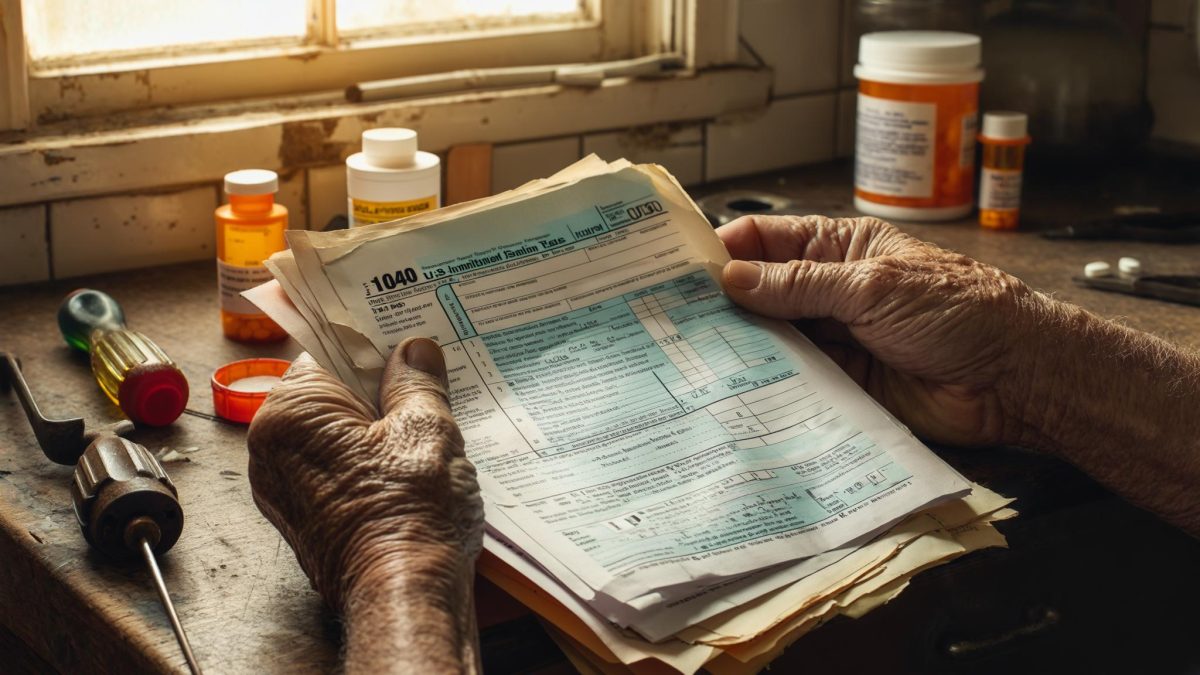
Have you ever looked at your paycheck stub and felt completely certain you were going to be okay — only to discover that the ground beneath your finances had been shifting for years without your knowledge? That question kept returning to me after I spent an afternoon in a folding chair next to Lester Holloway at a free tax preparation clinic run by volunteers out of a church basement on Cleveland’s east side.
I had gone to the clinic in February 2026 to report on how working-class homeowners were navigating Ohio’s property tax reassessment fallout. Lester was the third person I spoke with that day. He was filling out a worksheet with a quiet, mechanical focus — not frustrated, not anxious. Just getting through it. When I asked if he’d be willing to talk for a few minutes, he shrugged and said, “Sure. Not much left to hide anyway.”
A Stable Life That Looked Nothing Like Stability
When I sat down with Lester Holloway, the first thing he told me was that he earns roughly $85,000 a year as a journeyman electrician through IBEW Local 38 in Cleveland. That number typically signals a certain kind of financial security — union benefits, pension contributions, a reliable schedule. For a long time, it was.
Lester bought his house in the Slavic Village neighborhood in 2019 for $127,000. He paid it down aggressively, refinanced once, and by 2023 had equity most people his age would envy. He also started putting money aside to help his younger brother, Marcus, now 22, through a two-year technical program at Cuyahoga Community College. That support runs about $600 a month.
What Lester did not know until March 2025 was that his wife of four years, from whom he separated in late 2024, had opened seven credit accounts in both their names during the marriage — accumulating $43,700 in debt he never saw on a statement. The accounts were on a separate email address. The minimum payments had been coming out of a joint checking account he rarely monitored because she handled the household bills.
“I thought we were fine,” he told me, still without much affect. “I was working sixty-hour weeks. I figured she was handling things. That was stupid. That was on me.”
The Injury That Changed the Math
Before the debt came to light, Lester had already lost his footing in another way. In September 2024, he suffered a partial rotator cuff tear on a commercial job site. Surgery came in November. He has been on workers’ compensation and short-term disability through his union since then, collecting approximately $2,840 per month — compared to the $5,600 monthly take-home he was used to.
His monthly fixed costs — mortgage (he refinanced to a 15-year in 2021), utilities, car payment, groceries, Marcus’s tuition contribution — run about $3,100. The disability payments leave him with roughly $260 a month of margin. Any month with an unexpected bill, he goes negative. Since November 2024, he has missed four consecutive Cuyahoga County property tax installments.
According to Cuyahoga County Treasurer’s Office, property owners who fall more than one year behind on taxes can be placed on the county’s delinquent tax list, eventually making them eligible for a tax certificate sale. Lester is now in that window.
What Disability Benefits Actually Cover — and What They Don’t
Lester is not on Social Security Disability Insurance. He is on a union-negotiated short-term disability plan, which pays 60 percent of his base wage for up to 26 weeks, and a state workers’ compensation claim that partially supplements that. The combination sounds more complete than it is.
As Lester explained it to me, he was initially told he would receive about 70 percent of his pre-injury income. After the offset calculation between the two plans, it came out closer to 50 percent. “Nobody sat me down and walked me through the math before I was on it,” he said. “I just started getting deposits and realized it wasn’t what they told me.”
He expects to return to work in June 2026, pending a clearance from his orthopedic surgeon. That is a hopeful projection. In the meantime, six months of reduced income have stacked against him in ways that will take years to unwind.
Trying to Access Housing Assistance With a High Income on Paper
One of the more frustrating details Lester shared was what happened when he looked into housing assistance programs. His annual gross income — $85,000 — is well above the threshold for most local emergency housing aid, which in Cuyahoga County typically targets households at or below 80 percent of Area Median Income (AMI). For a single person in 2025, that ceiling was approximately $58,150, according to HUD income limit tables.
His current actual income — the $2,840 per month on disability — would put him well under that threshold. But programs generally assess annual income or averaged recent earnings, which means his W-2 from 2024, showing more than $60,000 earned before the injury, disqualified him from several programs before any case worker looked closely at his current situation.
The installment plan was the only concrete relief Lester has secured. It stops the clock on the lien process, but it adds $600 a month to his obligations — money that, on his current disability income, he does not have without cutting Marcus’s tuition support. “I haven’t told my brother yet,” he said. “I’ll figure something out before I do that.”
The Turning Point That Has Not Quite Arrived
When I asked Lester what he thought would change things, he was quiet for a moment. The volunteer tax preparer across the table was busy with someone else’s W-2. The church basement smelled like old coffee and photocopier toner.
The homestead exemption application, if successful, could reduce his annual property tax bill by several hundred dollars going forward under Ohio’s program for disabled homeowners. According to the Ohio Department of Taxation, the Homestead Exemption reduces the taxable value of a qualifying homeowner’s primary residence by $25,000. For Lester’s home, assessed at roughly $98,000 post-reassessment, that could cut his annual tax bill by approximately $350 to $400 — not transformative, but real.
The divorce proceedings are ongoing. His attorney has filed for a marital debt allocation hearing, arguing that the hidden accounts were incurred without Lester’s knowledge or consent. That process has no guaranteed outcome and will cost him in legal fees either way.
What struck me most as I listened to Lester talk through the timeline was how many systems had technically functioned as designed — and how little that had helped him. The disability plan paid out. Workers’ comp processed his claim. The installment plan was approved. Each piece worked, and none of it added up to stability.
What Lester’s Story Reflects About Housing Vulnerability
Lester is not a low-income worker who fell through the cracks of a system designed for low-income workers. He is something the safety net was not built for: a middle-income earner whose income collapsed suddenly, who owns property rather than renting, and whose financial damage came from a private relationship rather than a job loss. Programs calibrated for persistent poverty have a hard time with that profile.
The Ohio Homeowner Assistance Fund, which distributed more than $280 million to struggling Ohio homeowners using federal American Rescue Plan dollars, formally stopped accepting new applications in Cuyahoga County in 2025 after exhausting its local allocation — precisely as more homeowners like Lester were entering financial distress from delayed effects of inflation and post-pandemic income disruption.
When I left the clinic that afternoon, Lester was still at the folding table, reviewing a printout the volunteer had given him about the homestead application timeline. He thanked me with the same flat politeness he had used throughout. No bitterness. No performance of resilience. Just a man doing the next necessary thing because the alternative was doing nothing.
He expects to be back on a job site by summer. He hopes Marcus never has to know how close the money got to zero. He is not sure what happens if the shoulder clearance is delayed past June. I left not knowing what to hope for him, exactly — only that the systems designed to catch people like Lester had mostly looked the other way, and that he had kept moving anyway.
Related: My Wife’s Hidden $18,000 in Debt Surfaced the Same Month Our Insurer Dropped Us — A Detroit Dad’s Survival Story




Leave a Reply