
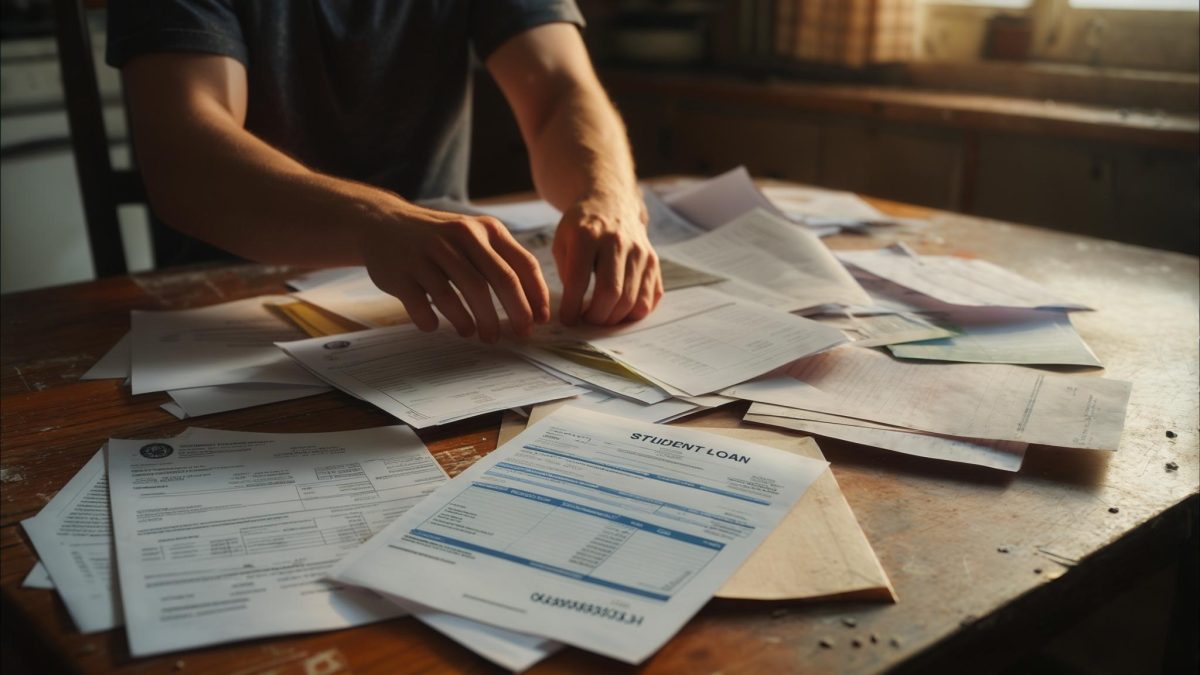
The comment appeared in my inbox on a Tuesday morning in February 2026, buried beneath dozens of reader responses to a piece I’d written about SNAP eligibility changes. It was longer than most — three dense paragraphs from a man in Oklahoma City who described watching his financial life unravel not from poverty or unemployment, but from a collision of identity theft, graduate school debt, and a construction slowdown that briefly transformed upper-middle-class stability into something far more fragile. I reached out that same afternoon.
When I spoke with Terrence Peralta two weeks later over a video call, he was composed and precise — the kind of person who keeps a color-coded spreadsheet for grocery runs. He’s 43, engaged to a woman finishing her master’s degree, and has spent the better part of two years trying to rebuild a financial life that someone else partially dismantled.
When Financial Stability Becomes a Mirage
Terrence told me the first sign came in March 2024 — a bank alert about an unfamiliar charge on a card he rarely used. By the time he’d made three phone calls and pulled his full credit report, the scope was clear: four accounts compromised, approximately $23,400 in fraudulent charges, and a credit score that had fallen from 718 to 511 in what felt like a single weekend.
The student loans he referenced were from a graduate degree in construction management he completed at the University of Oklahoma in 2012. He began with roughly $78,000 in federal debt. By early 2024, he’d worked it down to $64,200 — steady progress requiring disciplined monthly payments of around $740. Those payments didn’t pause when the identity theft hit. Neither did his fiancée’s tuition bills.
Disputing fraudulent accounts proved expensive in its own right. Terrence paid for credit monitoring services, certified mail, and a $200 flat-fee consultation with a consumer law attorney. The fraud wasn’t just emotionally exhausting — it had real carrying costs that ate into savings he’d spent years building.
Applying for SNAP When You Never Thought You Would
By August 2024, the construction project Terrence was foreman on had slowed sharply — weather delays, a materials dispute, and a contract renegotiation ground activity to a crawl. His hours were cut significantly. Where he’d been taking home roughly $6,800 a month, he was suddenly clearing around $2,600. His fiancée, in school full-time, contributed minimally to household income.
A colleague mentioned SNAP almost offhandedly over lunch. Terrence said he dismissed it immediately. “I kept thinking that program was for someone else’s situation,” he told me. “But then I sat down and actually ran the numbers, and I realized I didn’t actually know what the rules were.”
According to NCOA’s SNAP eligibility overview, a two-person household must generally have gross monthly income at or below 130% of the federal poverty level — approximately $2,311 per month for FY2024 — to qualify. Terrence’s reduced income of $2,600 put him slightly above the gross threshold. But allowable deductions changed the calculation: shelter costs, certain utility expenses, and other factors brought his net income within qualifying range.
He applied through Oklahoma’s state DHS portal in October 2024. The process took approximately three weeks from submission to approval. The $340 monthly benefit wasn’t the program maximum, but it was real — and during months when every dollar was tracked, it mattered.
What the Journey Actually Looked Like, Month by Month
Terrence kept records of every step. When I asked him to walk me through the timeline, he pulled up a document without hesitation — the kind of meticulous recordkeeping that comes naturally to someone who manages construction budgets for a living.
His monthly obligations during the slowdown included $740 in student loan payments, roughly $1,100 in rent, $340 in combined utilities and phone, and ongoing dispute-related costs. The $340 in SNAP benefits didn’t repair the damage — but it removed groceries as a variable he had to agonize over each week.
When the Help Ends — and What Lingers
When the construction project resumed in early 2025, Terrence reported the income change to Oklahoma DHS as required. His SNAP enrollment ended. He received approximately $1,020 in total assistance over three months — a modest sum against the scale of the disruption, but one he described as genuinely stabilizing.
According to Propel’s SNAP benefit tracker, maximum monthly amounts for a two-person household increased to $548 starting October 1, 2025. Terrence noted the timing with characteristic dryness: “Of course they increased it after I got off.”
The broader policy landscape around SNAP has grown more volatile. According to CNN’s reporting, approximately 42 million people faced potential disruption to their food assistance in late 2025 amid federal funding disputes. Terrence followed those developments closely even after his own enrollment had ended — partly out of policy interest, partly, he admitted, because the experience had made the issue feel personal in a way it never had before.
As of our conversation in February 2026, his credit score had recovered to 634. He’s targeting 680 — the threshold at which he’s been told student loan refinancing may yield meaningfully better rates. Two fraudulent accounts remain under investigation. His fiancée is expected to finish her degree by December 2026.
When I asked what he wished he’d known before applying, his answer was immediate: “I waited two months because I was embarrassed. I thought my situation wasn’t bad enough. But the program exists for exactly this — temporary disruption. I don’t know why I thought I had to be at rock bottom before it was okay to ask.”
What stayed with me about Terrence Peralta wasn’t the hardship itself — it was the precision with which he’d lived through it. He knew every dollar that moved during those three months. He knew the dates of each fraudulent charge and the name of every caseworker he’d spoken with. That discipline, he said, was what kept the chaos from swallowing him whole.
“I’m an analytical person,” he told me near the end of our call. “When everything around you is chaotic, the numbers are at least honest with you.”
His story doesn’t have a clean ending. The debt remains. The credit dispute continues. But for three months in late 2024, a federal food assistance program he’d never imagined needing turned out to be exactly what his situation called for — and he used it without apology.
Related: He Retired at 44 on a Fixed Income and Got Hit With a $14,000 Hospital Bill — What Happened Next
Related: A $3,200 IRS Refund Sat in ‘Processing’ for 70 Days While This El Paso Daycare Owner’s Bills Kept Coming



Leave a Reply