

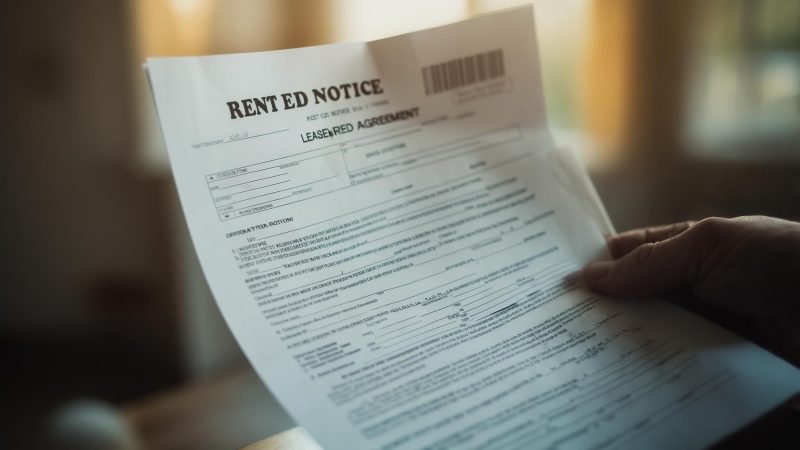
The letter from my lender arrived on a Tuesday in November 2025, and I set it on the kitchen counter face-down. My wife, Adaeze, was making egusi soup and the whole house smelled like home, and I didn’t want to wreck that. I picked up the letter two days later, alone, and read the words “Notice of Default” for the first time in my adult life.
I am forty-one years old. I came to the United States from Lagos at nineteen with one carry-on bag and a scholarship to a state university in Texas. I worked through a petroleum engineering degree, took every overtime shift my company offered, and by the time I was thirty-four, I was making $187,000 a year. I bought a house in Houston’s Energy Corridor for $610,000. Then I bought two rental properties in Katy because everyone in the industry said real estate was the only real hedge. I believed them. I became them.
By late 2024, I was carrying $1.2 million across three mortgages. My monthly debt service on those properties alone was $7,400. I was also sending $800 a month to my mother and two brothers in Lagos. When oil prices softened and my company cut billable hours, my take-home dropped from roughly $12,500 a month to just under $7,100. The math stopped working overnight.
The Months I Spent Pretending
I did not tell Adaeze right away. That is the thing I am most ashamed of. For almost four months, I shuffled money between accounts, paid the primary mortgage first, let the rental property payments slip, and told myself this was temporary. Oil always comes back. I had ridden downturns before.
But this one didn’t move. By February 2025, I was 60 days past due on the Katy properties. My tenant in the larger unit had also stopped paying — he’d lost his job too — which meant I was eating a $1,650 monthly gap on that property with no rental income to offset it. I was burning through a savings account I had told Adaeze was “for the kids’ college.” It wasn’t entirely a lie. It just wasn’t entirely the truth either.
The specific number that finally broke through my denial was $23,400. That was the total I had fallen behind across the two rental mortgages by the time I opened that November default notice. Twenty-three thousand dollars. I had made that in six weeks once. Now I couldn’t find it anywhere.
Finding Out What HUD Housing Counseling Actually Does
I typed “mortgage help Houston Texas” into a search engine at 11:47 p.m. on a Wednesday. I felt ridiculous doing it. I am an engineer. I build things. I don’t apply for government programs. That thought, I now understand, is both a cultural reflex and a form of financial self-destruction.
What I found was the HUD-approved housing counseling program, administered through the U, according to hud.gov.S. Department of Housing and Urban Development. HUD certifies nonprofit agencies across the country to provide free or very low-cost counseling to homeowners facing foreclosure. The key word that stopped my scrolling was “free.” I had been so focused on not appearing to need help that I hadn’t noticed help was sitting there at no cost.
I called a HUD-approved agency in Houston the following morning. The counselor’s name was Marcus. He did not seem surprised by my situation in the slightest, which was its own kind of relief. He told me roughly 40 percent of the people he spoke with had household incomes above $80,000 at some point in the previous three years. Over-leverage does not care about your salary history.
| Program | Who Administers | What It Can Do | My Outcome |
|---|---|---|---|
| HUD Housing Counseling | HUD-certified nonprofits | Negotiate with servicers, advise on forbearance, loss mitigation options | Servicer agreed to 3-month forbearance on primary mortgage |
| Texas Homeowner Assistance Fund (HAF) | Texas Department of Housing and Community Affairs | Covers past-due mortgage, taxes, insurance for qualifying homeowners | Did not qualify — program covered primary residence only, income threshold applied |
| Fannie Mae/Freddie Mac Forbearance | Mortgage servicers | Pause or reduce payments, repayment plan attached | Approved on primary mortgage; investment properties ineligible |
| Deed-in-Lieu / Short Sale Assistance | Servicer-negotiated | Exit strategy to avoid full foreclosure proceeding | Pursued for one Katy property — still in process as of March 2026 |
The Application Process — What I Didn’t Expect
Marcus walked me through what documentation I needed before he could begin contacting my servicers. The list was longer than I expected and took me nearly two weeks to compile, partly because I had to stop pretending and involve Adaeze. That conversation happened on a Saturday morning. It was the hardest one we’ve had in sixteen years of marriage.
The documents I needed included:
- Last two years of federal tax returns (both W-2 income and Schedule E rental income)
- Last three months of pay stubs showing the reduced hours
- Most recent mortgage statements for all three properties
- Bank statements for the previous 90 days across all accounts
- A written hardship letter explaining the income reduction
- Documentation of the non-paying tenant situation (lease agreement and correspondence)
The hardship letter was the one I kept rewriting. Engineers don’t write hardship letters. I stared at a blank document for forty minutes before I typed a single sentence. What I eventually submitted was three paragraphs, plain and factual: my income had dropped from $187,000 annually to approximately $85,200 due to reduced hours in the energy sector, I was carrying three mortgage obligations totaling $7,400 per month, and I was requesting evaluation for all available loss mitigation options. No drama. Just numbers.
Marcus submitted everything to my primary mortgage servicer in early December 2025. The servicer had 30 days under federal RESPA guidelines to acknowledge the request and 30 additional business days to evaluate it. I had not known that timeline existed. Knowing it made the waiting more bearable — barely.
What Actually Got Approved — and What Didn’t
The primary mortgage forbearance came through in January 2026. Three months of paused payments, with a repayment plan to be negotiated afterward. That was $2,890 per month freed up for ninety days. It felt enormous and inadequate at the same time.
The investment properties were a different story entirely. Fannie Mae and Freddie Mac forbearance programs, which cover a large share of conforming mortgages, are primarily structured for owner-occupied primary residences. My servicer confirmed that both Katy properties fell outside the forbearance eligibility criteria because they were classified as investment properties. I hadn’t known that distinction mattered so much. I do now.
The Texas Homeowner Assistance Fund, which was funded through the American Rescue Plan and administered by the Texas Department of Housing and Community Affairs, was also not available to me, according to tdhca.state.tx.us. The HAF program had an income eligibility threshold — in Texas, applicants needed household income at or below 100 percent of the area median income or 150 percent of the U.S. median income, whichever was greater. My 2024 income, even with the cuts, placed me over that threshold. The program also covered primary residences only.
On the larger Katy property, Marcus helped me open a deed-in-lieu conversation with the servicer. That process is still ongoing. I may walk away from that property having lost approximately $62,000 in equity I built over four years. That number sits in my chest like a stone.
Where Things Stand Now
It is March 2026. My primary home is no longer in default. The forbearance period ended in early April, and I am now on a repayment plan that adds $963 per month to my regular payment for the next nine months — a number I negotiated down from an initial repayment schedule that would have added $1,447. The $800 I send to Lagos every month hasn’t stopped. I don’t know how to stop it. My mother is sixty-seven and my youngest brother has a daughter in secondary school.
The smaller Katy rental — a townhouse I paid $248,000 for in 2021 — I sold in February 2026 at $231,000. After realtor fees and the outstanding arrearage, I netted roughly $4,200. That is not a typo. Four thousand two hundred dollars on a property I held for five years and sank maintenance money into every year. The market in that submarket softened harder than I had modeled. I had not modeled softening at all, truthfully. I had only modeled appreciation.
What I want to say — and I am careful about how I say it because I am not in a position to tell anyone else what to do with their money or their lives — is that the programs exist. They are not just for people who earn less than I earned. They are not humiliating to access. Marcus at that HUD agency talked to me like a person, not a statistic, and he knew the federal loss mitigation rules better than my own servicer’s customer service line did. The HUD housing counselor locator is a real resource, not a placeholder on a government website.
I wasted four months pretending I didn’t need it. That pretending cost me, in late fees, in accrued interest, in equity I might have preserved with an earlier conversation. The pride I was protecting wasn’t even real — it was the image I had built of a man who never needed help. That man does not exist. He never did. He was just a story I told myself on the drive to work.
Adaeze knows everything now. That part, at least, is better.
Related: Denied for Earning Too Much, Then Approved Using the Exact Same Income — How SNAP’s Own Two-Step Gross Income Rule Creates a Legal Path to Benefits
Related: People Who Skipped Filing Their 2021 Tax Return Are Actually Owed $1,400 by the IRS — but a Closing Deadline Could Wipe Out Their Claim Forever ( firstpersonfinance.com)



Leave a Reply