
The first Tuesday of March 2026, the waiting room at the Jones Valley Community Center in Birmingham, Alabama was standing room only. A free tax preparation clinic had drawn dozens of working-class residents, most clutching folders of W-2s and crumpled receipts. That’s where I met Yvonne Underwood — seated at the end of a folding table, a teenager beside her scrolling a phone, her own hands folded tight in her lap like she was bracing for something.
She had not come just for tax help. She had come because she needed someone to tell her she hadn’t made a terrible mistake by finally asking for help.
Yvonne Underwood is 56, a bank teller at a regional branch in Birmingham’s Southside neighborhood. She is a single mother to a 14-year-old son, Marcus, with no financial support from his father. For the past three years, she has also been running a small catering operation on weekends — birthday plates, church repasts, family reunions — that once supplemented her income by roughly $600 a month. By the time I met her in early 2026, that number had dropped to closer to $150, as fuel costs and a slow local economy had eaten her margins alive.
A Financial Picture That Was Already Stretched Thin
When I asked Yvonne to walk me through her monthly budget, she did it from memory, without hesitation. Her base pay as a full-time bank teller comes to approximately $2,190 per month after taxes. Rent on her two-bedroom apartment in the Avondale neighborhood runs $1,020 a month. Utilities average $180 in summer, more in winter. She sends $250 a month to her mother in Tuscaloosa, who is 79 and on a fixed Social Security income.
That leaves her, before groceries, before her son’s school expenses, before her own gas and phone bill, with less than $500 a month to absorb everything else. “I’ve been juggling this for years,” she told me. “I thought I was managing it. Then everything just hit at once.”
The breaking point came in October 2024. Yvonne received a letter from the IRS informing her that a federal tax return had already been filed under her Social Security Number for the 2023 tax year — a return she had not filed. Someone had stolen her identity, claimed a $2,800 refund, and routed it to a prepaid debit card. Her actual return, filed in February 2025, was held for over five months while the IRS investigated.
The credit damage was significant. Yvonne told me she discovered two credit card accounts she had never opened and a collection notice for a payday loan taken out under her name in Montgomery. Repairing the records took most of 2025. By January 2026, her credit score sat at 511.
The Decision to Apply for SNAP — and What Happened Next
Yvonne told me she had never applied for government food assistance before. Not in the years after Marcus was born, not during the early pandemic when the catering work vanished completely, not once. “I don’t take handouts,” she said, with a firmness that made clear this was a rule she had lived by for a long time. “That’s not how I was raised. You work, you figure it out.”
By November 2025, though, the math had stopped working. She was skipping her own meals two or three days a week to make sure Marcus had enough. A coworker mentioned SNAP. Yvonne went home, looked up the Alabama DHR eligibility portal, and stared at it for a week before she finally submitted an application on November 19, 2025.
According to USDA’s SNAP eligibility guidelines, a household of two with a gross monthly income at or below 130 percent of the federal poverty level — roughly $2,209 in 2025 for a two-person household — generally qualifies for benefits. Yvonne’s gross monthly income, including her declining catering work, came to approximately $2,340 at the time of her application. She was over the gross income threshold.
Alabama does not participate in broad-based categorical eligibility, which in some states would allow households slightly over the gross limit to still qualify based on net income after deductions. In Alabama, the gross income test is a hard cutoff for most applicants who are not elderly or disabled, according to the Alabama Department of Human Resources.
When the Identity Theft Followed Her Into the System
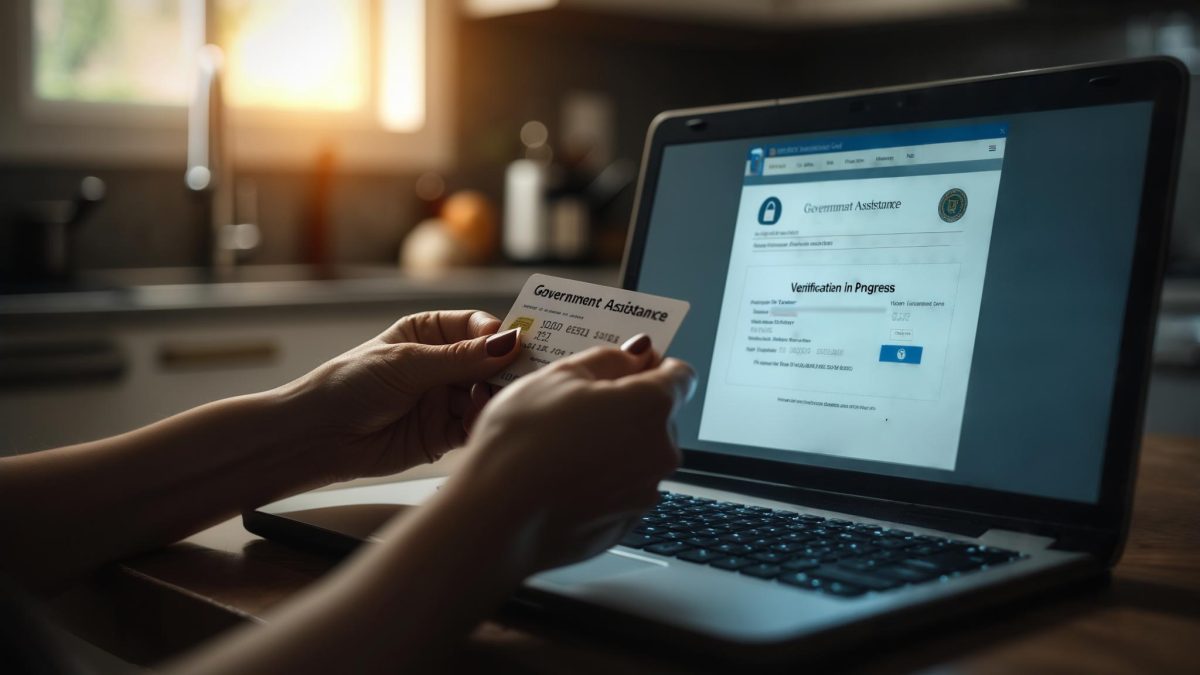
Yvonne’s application was not denied immediately on income grounds. It was flagged. A letter arrived from Alabama DHR on December 4, 2025, requesting an in-person identity verification interview and additional documentation — a response that she had not anticipated and did not fully understand at first.
As Yvonne explained to me, a DHR caseworker later told her that her Social Security Number had been cross-referenced during the application process and returned an inconsistency connected to the fraudulent federal tax filing. The flag was automated. No human had reviewed it yet. The system simply stopped the application and issued a documentation request.
She was asked to bring, in person, to the DHR office on Third Avenue North: a government-issued photo ID, her Social Security card, two proofs of address, documentation of all income sources, and a letter from the IRS confirming that her identity theft claim was on file. She had most of it. The IRS letter — an official Identity Theft Affidavit acknowledgment — took until December 29 to arrive by mail.
Her in-person interview was rescheduled twice. The first appointment, set for January 8, 2026, was cancelled by DHR due to staffing. The second, on January 22, was cancelled by Yvonne herself — Marcus had a stomach virus, and she had no one to watch him. The third appointment held on February 3, 2026.
The Outcome — and What It Actually Meant
When I spoke with Yvonne at the tax clinic in early March, she had just received her first notification since February. Her application had been processed. Because her catering income for November and December 2025 had dropped to approximately $95 a month each — she had records to prove it — her gross monthly income for that period fell to $2,285, just over the limit. The caseworker applied the standard deductions: a 20 percent earned income deduction, a standard household deduction of $204 for a two-person household, and a dependent care deduction for Marcus’s school-related expenses.
Her net monthly income after deductions came to $1,614. She was approved for SNAP benefits beginning February 2026. The monthly benefit: $87.
It is a modest outcome by any measure. According to USDA SNAP data, the national average monthly SNAP benefit per household in fiscal year 2025 was approximately $393. Yvonne’s $87 reflects the narrowness of her eligibility — she qualified, but just barely, and only after her business income had declined enough to shift the math.
There was regret in the story, too. Yvonne told me that if she had not waited so long — if she had applied in early 2024, when her catering income was still declining but before her identity was stolen — she believes she would have qualified for a higher benefit with far less friction. “I kept telling myself I didn’t need it,” she said. “By the time I admitted I did, someone had already messed up my records. I was fighting two things at once.”
She is also still carrying the weight of the fraudulent accounts on her credit file. Two of the three have been formally disputed and removed. A third — a small-balance collection from a fraudulent utility account in Montgomery — remains under review as of early April 2026.
When I left the Jones Valley Community Center that afternoon, Yvonne was still at the table, working through her tax documents with the volunteer preparer. Marcus had fallen asleep in his chair. She glanced at him, then back at the paperwork, and kept going. That image stayed with me — the particular determination of someone who has spent a long time refusing help and is only now beginning to learn what asking for it actually costs, and what it returns.
Her story is not a success story in any simple sense. The benefit is small, the process was long, and the identity theft damage is not finished. But she is in the system now, documented, verified, and receiving something — however modest — that she earned the hard way.
Related: He Co-Signed a Loan That Destroyed His Credit, Then His Rent Jumped 30% — Now His Family Relies on SNAP
Related: The Self-Employed Tax Deduction That Saved This Omaha Mechanic $3,800 After a Medical Crisis



Leave a Reply