
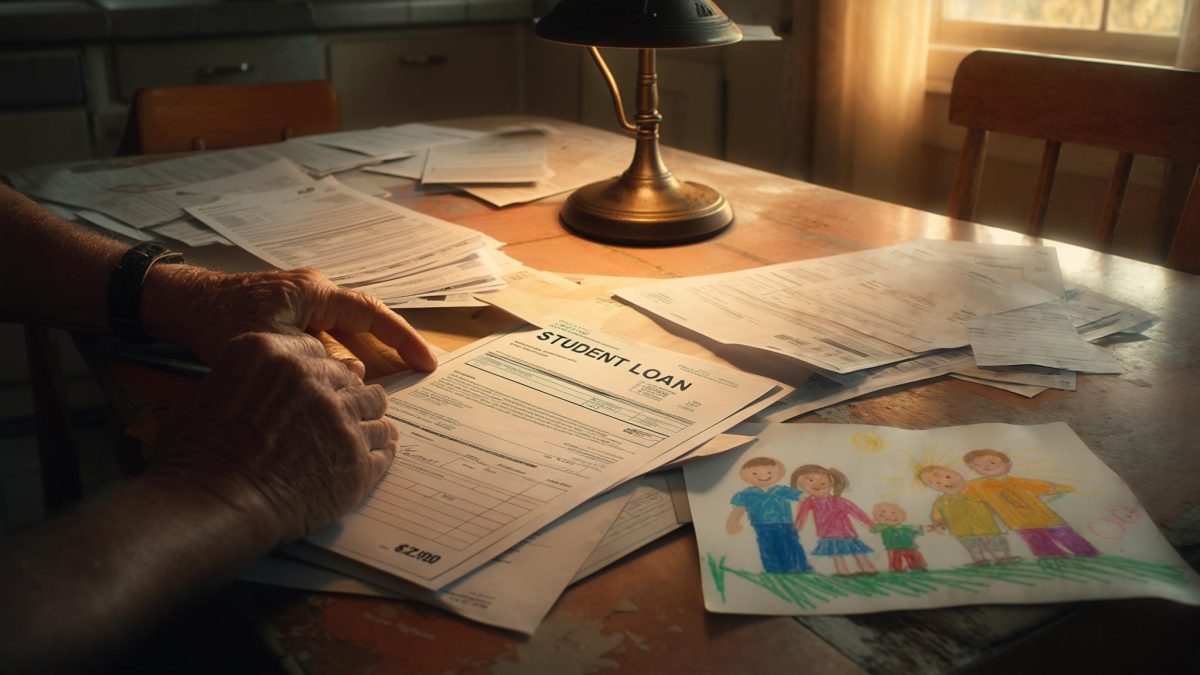
Have you ever felt like you did everything right — got the degree, worked your way up, built a family — and still ended up treading water? That question was running through my mind on a Tuesday morning in February 2026 when I walked into a county social services office in northwest Houston looking for a story.
A social worker named Patricia, who coordinates financial counseling referrals, pulled me aside between appointments. “You want to talk to someone who falls through every crack in the system?” she asked. She handed me a sticky note with a name and a phone number. That’s how I found Benny Gutierrez.
A Warehouse, a Family, and a Graduate Degree Nobody Warned Him About
When I sat down with Benny Gutierrez at a diner off the 610 Loop two weeks later, he arrived in work clothes and ordered black coffee. He’s 44, a warehouse supervisor for a regional logistics firm, married with three kids — ages 8, 12, and 15. His wife, Sandra, stays home to manage the household and care for their youngest, who has a learning disability requiring frequent specialist appointments.
On paper, Benny looks comfortable. He earns roughly $87,000 a year, which disqualifies him from most federal assistance programs and puts him solidly in the “you should be fine” category that policymakers seem to default to. The reality is more complicated.
In 2017, Benny finished a master’s degree in supply chain management at a private university in Texas. He borrowed $68,000 to complete it, expecting the degree to accelerate his career. It did — eventually. But between graduation and landing his current role, he spent nearly three years in lower-paying logistics positions while making minimum payments on his loans. By the time his salary climbed, the debt had compounded to $91,400.
“I thought once I got the degree and a real salary, the loans would feel manageable,” Benny told me, wrapping both hands around his mug. “But then you do the math — $760 a month, and the balance barely moves. I’ve been paying for four years and I still owe more than I originally borrowed.”
The SAVE Plan, the Lawsuits, and the Months of Suspended Payments
Benny enrolled in the SAVE (Saving on a Valuable Education) income-driven repayment plan in mid-2023, which the Biden administration launched as its most borrower-friendly IDR option. Under SAVE, payments are calculated at 10% of discretionary income for graduate loans, with interest subsidies meant to prevent balances from ballooning when payments fall short.
But as Federal Student Aid has documented, legal challenges from multiple states placed the SAVE plan in a federal court injunction beginning in mid-2024. Benny’s account was placed in a general forbearance — he wasn’t required to pay, but interest continued accruing on his unsubsidized graduate loans during the blocked periods.
For Benny, those suspended months weren’t a relief — they were a source of anxiety. He wasn’t sure whether to keep paying voluntarily, whether those months would count toward Public Service Loan Forgiveness (they don’t apply to him — he works in private logistics), or whether he should switch repayment plans entirely. He spent hours on hold with his loan servicer, MOHELA, across three separate calls in late 2024.
That freeze — the paralysis of too many moving parts and not enough clear information — is something Benny described repeatedly throughout our conversation. He’s not impulsive. He’s the kind of person who keeps a spreadsheet of monthly expenses and tracks every bill. But the complexity of the federal loan system, layered over a busy household and a demanding job, wore him down in a way he hadn’t expected.
When the Car Died and the Tradeoffs Became Visible
The loan stress might have stayed abstract if not for a Wednesday morning in January 2026, when Benny’s 2014 Honda Pilot refused to start in the warehouse parking lot. The diagnosis: a failed transmission. The estimate from three separate shops ranged from $4,200 to $5,800 to repair. A replacement vehicle of comparable reliability would run $16,000 to $22,000 used in the current market.
“That was the moment it all crystallized,” Benny told me. “I’m bringing home decent money. We’re not struggling in the traditional sense. But I have no cushion. Every extra dollar goes to the loan payment, the kids’ stuff, Sandra’s appointments for our youngest. There’s nothing sitting there for a transmission.”
He’s been borrowing his brother-in-law’s truck to get to work. Sandra hasn’t had a car for six weeks. Their oldest is missing after-school activities because the logistics of one vehicle for a family of five in a city built around car ownership has become unsustainable.
Those numbers don’t leave room for a $5,000 transmission. Benny applied for a personal loan through his credit union and was approved — at 14.9% interest. He hasn’t decided whether to take it yet. “Taking on more debt to fix a car so I can keep working to pay my other debt feels like something out of a bad joke,” he said.
The Programs That Don’t Reach Him
Patricia, the social worker who connected me with Benny, told me she sees cases like his with growing regularity. “He’s the person nobody built a program for,” she said when I checked back with her after the interview. “He earns too much for emergency assistance, doesn’t qualify for needs-based transportation programs, and the federal loan system is too complicated for him to navigate alone without taking half a day off work he can’t afford to lose.”
Benny looked into the income-driven repayment options still available through the Department of Education following the SAVE injunction. He’s considering switching to IBR (Income-Based Repayment) for graduate borrowers, which would cap his payments at 10% of discretionary income. His servicer told him the transition could take six to eight weeks to process — weeks during which his account status would remain uncertain.
The table makes it look like a simple choice. For Benny, it isn’t. He has roughly 18 years left on his projected repayment timeline under current conditions. The forgiveness at the end of that road — if it survives ongoing legal and political challenges — would be treated as taxable income under current federal law, potentially generating a tax bill in the tens of thousands of dollars at retirement age.
Where Things Stand and What Benny Is Watching For
As of early April 2026, Benny has not switched repayment plans. He’s continued making his $760 voluntary payments even during the SAVE forbearance period, reasoning that paying down principal — even slowly — is better than watching the balance sit and compound. His loan balance as of March 2026 is $91,100, down $300 from when I first spoke with him six weeks earlier.
He’s watching the ongoing federal litigation around income-driven repayment closely, though he told me he’s stopped reading the news articles about it. “Every headline says something different. I just check my servicer account every two weeks and hope for a clear answer eventually.”
The car situation resolved in a partial way: Benny’s employer offered an advance on his next paycheck — $2,500 — which he used alongside a smaller personal loan to cover a $4,400 transmission repair. The Honda is running again. The credit union loan sits at $1,900 remaining balance at 14.9% APR.
There’s no triumphant ending to Benny’s story — at least not yet. When I left the diner that afternoon, he was heading back to the warehouse for a four-hour shift that started at noon. He had a MOHELA callback scheduled for the following Thursday. He was going to ask again, calmly, whether any of his forbearance months would ever count toward anything.
Patricia told me later that she refers a lot of people to resources they qualify for on income. Benny, she said, she just listens to. “Sometimes the hardest thing,” she told me, “is sitting across from someone who did everything they were supposed to do and watching them try to figure out where it went sideways.”
Benny Gutierrez is not a cautionary tale about laziness or poor choices. He is a precise illustration of what happens when a debt instrument designed for 22-year-olds follows a person into middle age — through a marriage, three children, a mortgage, a broken transmission, and a job that demands more than it used to. His resilience is real. So is his exhaustion.
Related: No Coverage at Work, a Defaulted Cosigned Loan, and a Kid Starting College: One Miami Custodian’s Financial Tightrope
Related: Too Much Money to Qualify, Not Enough to Keep Up: One Miami Mom’s Fight Against Three Financial Crises at Once




Leave a Reply