

Have you ever done everything you were supposed to do — worked steadily, helped your family, stayed out of debt — and still arrived at 65 with nothing in the bank? That question sat with me for weeks after I met Lorraine McBride on a Tuesday evening in February 2026 at the Northeast Oklahoma City Library.
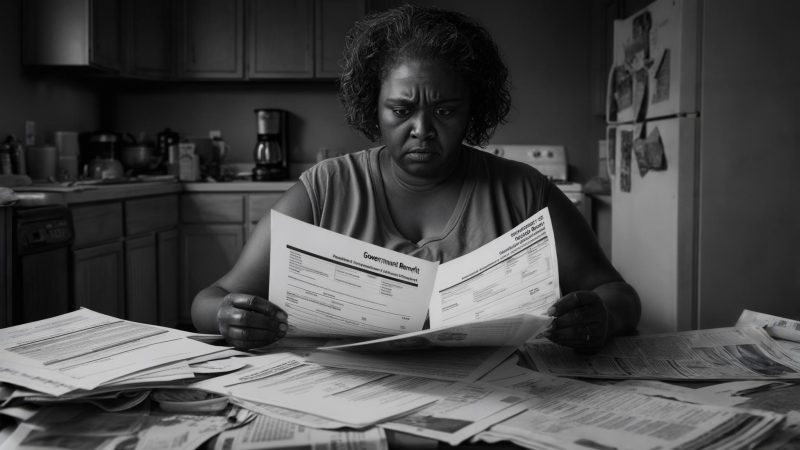
I was covering a free Medicare enrollment assistance event hosted by the State Health Insurance Assistance Program, known as SHIP Oklahoma. Volunteers in blue vests were helping seniors fill out forms at folding tables. Lorraine wasn’t filling out forms. She was standing near the back wall, arms crossed, reading a laminated poster about Medicare Savings Programs with the focused intensity of someone who desperately needed the information to be true.
The Woman Behind the Poster
When I introduced myself, Lorraine McBride looked up with a tired smile and said, simply, “I just turned 65 in January. I’m trying to figure out what I qualify for.” She said it the way you might announce a flat tire on the side of a highway — matter-of-fact, resigned, already calculating the damage.
Lorraine has worked as a dental assistant in Oklahoma City for 28 years. She raised two children mostly on her own after her husband, Ray, died of a heart attack in 2009. Her annual income today sits at roughly $34,500 — enough to keep the lights on in her two-bedroom rental, not enough to build toward anything. Her adult children live out of state, and she described herself, with a short laugh, as “the person everyone calls when they need something.”
When I asked if she had retirement savings, she looked at the floor for a moment. “No. I had some, a little. But it’s gone.” She didn’t say it with self-pity. She said it the way you state weather.
How the Savings Disappeared
Lorraine’s financial unraveling didn’t happen overnight, and it didn’t happen because she was reckless. It happened because she was generous — and because generosity, without guardrails, has a cost that comes due quietly over time.
In 2021, her son Marcus needed a vehicle to keep a new job in Tulsa. He couldn’t qualify for the loan on his own. Lorraine cosigned a $22,000 auto loan without hesitation. “He had a good job lined up,” she told me. “I wasn’t worried. I trusted him.” By mid-2023, Marcus had lost that job, moved to Nevada, and stopped making payments. The lender came after Lorraine for the remaining balance — $18,500 by the time late fees and collection costs had compounded.
She had been putting aside roughly $150 a month in savings — a disciplined habit for someone at her income level. But before the loan default arrived, those savings had already been eroded by another act of generosity. Her daughter Priya, a single mother in Phoenix, had needed help covering childcare costs in 2022 while she went back to work. Lorraine sent $200 a month for nearly 14 months, a total of approximately $2,800 that came directly out of savings.
By the time the collection agency called in the fall of 2023, Lorraine had $4,200 in savings. She used most of it trying to negotiate the debt down. “I just wanted it to go away,” she told me. “I paid $3,100 toward it and they wouldn’t settle. My credit tanked anyway.”
Arriving at Medicare Age With No Net Beneath Her
Lorraine turned 65 on January 14, 2026. She had no employer-sponsored retiree health coverage — the dental practice where she works is a small private office that does not offer post-employment benefits. She was automatically enrolled in Medicare Part A, which covers hospital stays and carries no premium for most workers who paid Medicare taxes for at least 10 years. Lorraine qualifies there. But Medicare Part B — which covers outpatient care, doctor visits, and preventive services — carries a standard monthly premium of $185.00 in 2026.
On her income and with her debt situation, $185 a month is not trivial. What Lorraine didn’t know when she arrived at that library event was that she might qualify for the Medicare Savings Program, a federally funded, state-administered program that can cover Part B premiums, deductibles, and copayments for lower-income Medicare beneficiaries.
The Turning Point at a Folding Table
I watched from a few feet away as a SHIP volunteer named Donna walked Lorraine through a printed income and resource checklist. The conversation lasted about 25 minutes. At one point, Lorraine reached into her purse and produced a folded printout of her most recent pay stub — she had brought it just in case, which told me she had hoped this evening would amount to something.
What Donna found was this: Lorraine’s income placed her within eligibility range for the Specified Low-Income Medicare Beneficiary (SLMB) program, which in 2026 covers the full Medicare Part B premium of $185 per month. She was also potentially eligible for the federal Extra Help program — also called the Low-Income Subsidy — which reduces out-of-pocket costs for Medicare Part D prescription drug coverage. Lorraine takes two daily medications for blood pressure and takes a generic cholesterol drug. Without Extra Help, her estimated annual drug costs under a standard Part D plan would run close to $840 per year.
Lorraine stared at the list the volunteer had written on a notepad. “So there are programs,” she said slowly, “and I’ve just been… not using them.” Donna nodded and said applications could be submitted that week. Lorraine folded the notepad page carefully, the same way she had folded her pay stub, and put it in her purse.
The Outcome — and What Still Isn’t Resolved
I followed up with Lorraine by phone six weeks after the library event. She had submitted her SLMB application through the Oklahoma Health Care Authority in late February 2026 and, as of our call, was waiting on a determination letter. Processing times in Oklahoma have run approximately four to six weeks for Medicare Savings Program applications, according to state DHS estimates. She had also submitted an Extra Help application directly through the Social Security Administration, which she completed online in under 30 minutes.
The SNAP screening was more complicated. Lorraine’s gross monthly income of approximately $2,875 puts her above Oklahoma’s standard SNAP gross income limit of 130% of the federal poverty level — roughly $1,632/month for a single-person household in 2026. She does not currently appear to qualify under standard rules, though the volunteer noted she could explore whether allowable deductions, including medical expenses for seniors over 60, might affect a net income calculation.
The debt from the cosigned loan remains. A portion was charged off and sold to a collections agency. Lorraine told me she receives calls she no longer answers. Her credit score dropped from what she estimated was the “low 700s” in 2022 to somewhere in the 580s by early 2024. She has not sought formal debt resolution help, though the SHIP volunteer mentioned CFPB resources for navigating collections.
She is not retiring anytime soon. She told me she plans to keep working at the dental office for at least another four or five years. “The dentist is good to me,” she said. “And honestly, what would I do at home? Worry more?”
What Lorraine’s Story Tells Us
Lorraine McBride is not a cautionary tale about poor decisions. She made the decisions most people would make — she helped her son, she helped her daughter, she kept working. The systems that were supposed to catch her — employer retirement plans, accessible benefit information, clear pathways to assistance — weren’t there in the form she needed, when she needed them.
What struck me most, driving home from that library, was not the scale of her financial difficulty but the precision of her isolation. She lives alone. Her children are far away. She had never been to a SHIP event before, and she only came to this one because she saw a flyer taped inside the door of a drugstore. If that flyer hadn’t been there, she would have turned 65 and quietly paid $185 a month she may not have owed.
As Lorraine put it, near the end of our phone call in March, with something that sounded almost like resolve: “I’m not embarrassed anymore. I just want to know what I’m entitled to. I paid into this my whole life. I just want to know what’s mine.”
That seems like a reasonable thing to want.
Related: A Delivery Driver Walked Into a Medicare Event With the Wrong Questions — and Left With a Lifeline



Leave a Reply