

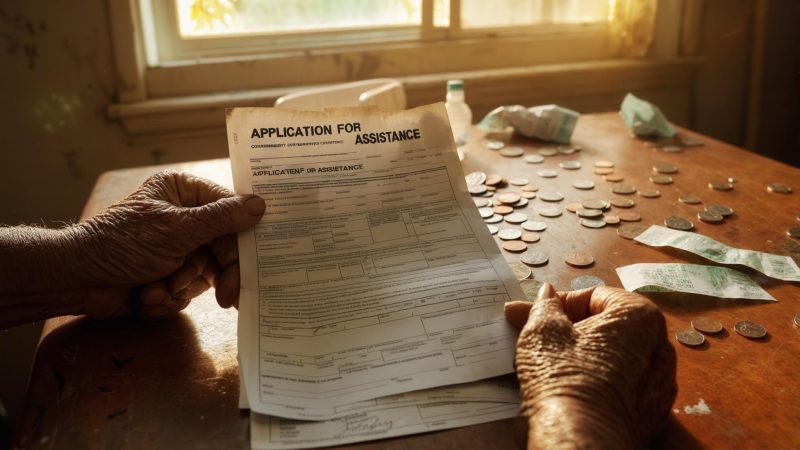
Maria was stocking shelves at a grocery store for 32 hours a week when her electricity bill arrived the same day as her kids’ school lunch notice. She remembers standing at the kitchen table, doing the math for the fourth time that month, convinced the numbers just had to work out differently. A coworker mentioned she received SNAP benefits — while holding the same job. Maria had never considered applying. She assumed that having a paycheck, any paycheck, meant she didn’t qualify.
She was wrong. And she’s far from alone.
The Belief That Locks Working Families Out
The dominant public image of a SNAP recipient is someone who is unemployed, perhaps receiving other forms of public assistance, and unlikely to be working at all. That image is deeply embedded in how many Americans think about the program — and it is largely inaccurate.
According to the USDA Food and Nutrition Service, more than 30 percent of SNAP households include at least one working adult. In households with children, that share is even higher. The stigma attached to the program, combined with a genuine misunderstanding of the income rules, creates a gap between who qualifies and who actually applies.
This matters because the financial consequences of not applying are real. The average SNAP benefit in recent fiscal years has hovered around $187 per person per month — for a family of four, that can represent roughly $700 to $800 in monthly grocery assistance that goes unclaimed.
The Crack in the Assumption: What the Income Rules Actually Say
SNAP eligibility is based on household income — but not simply your gross paycheck. The program uses two thresholds: a gross income test and a net income test. Most households must pass both, and the net income figure is what many applicants never think to calculate.
For fiscal year 2025–2026, the gross monthly income limit is set at 130 percent of the federal poverty level. For a single person, that’s approximately $1,580 per month. For a family of four, it rises to roughly $3,250 per month. Those figures are higher than many working Americans expect.
But here’s the part that changes the math for a lot of working households: the net income calculation. Before SNAP determines whether your income is low enough to qualify, it allows you to subtract a set of standard and itemized deductions from your gross income.
Those deductions include a standard earned income deduction of 20 percent — meaning 20 cents of every dollar you earn from work is automatically excluded. There’s also a standard household deduction, a dependent care deduction if you pay for childcare, a medical expense deduction for elderly or disabled household members, and an excess shelter deduction covering rent or mortgage, utilities, and homeowner’s insurance above a certain threshold.
Why the Myth Persists — and Who It Hurts Most
The gap between perception and reality isn’t accidental. Decades of political rhetoric around welfare and work have blurred into a single cultural message: public assistance is for people who aren’t trying. That framing has made applying feel like an admission of failure, particularly for people who are, in fact, working hard.
The Center on Budget and Policy Priorities has documented that SNAP participation rates among eligible working families are consistently lower than among unemployed eligible households, despite identical legal access to the program. The barrier isn’t the rules. It’s the belief about the rules.
This plays out disproportionately in specific communities:
- Gig and contract workers who earn inconsistent income often assume variability disqualifies them — it doesn’t, though you report income based on how your state calculates monthly averages
- Immigrant families who mix eligible U.S. citizen children with ineligible adult household members often believe the whole household is ineligible — the citizen children can still receive benefits based on their own portion of income
- Single parents working part-time who are also receiving child support often miscalculate total income, not knowing that child support is treated differently across states
- Workers over 50 who entered low-wage employment after a period of unemployment and assume the transition means they’ve “moved on” from needing assistance
The Real Truth: SNAP Was Designed With Working Families in Mind
The 20 percent earned income deduction wasn’t a loophole. It was a deliberate policy choice made by Congress to ensure that working brought a financial advantage over not working — and that employment income wasn’t penalized so severely that holding a job became a liability for assistance. The Supplemental Nutrition Assistance Program was structured, from its modern form onward, to supplement income rather than replace it.
States also have flexibility to raise gross income limits for households with children or elderly members, and some have adopted broad-based categorical eligibility, which effectively eliminates the gross income test for many households. According to USDA guidance on categorical eligibility, these expansions mean that in participating states, a household that receives even a minimal non-cash benefit — like a brochure about TANF services — may qualify for SNAP with higher income thresholds than the federal standard.
These figures are approximate for FY2025–2026 and adjusted annually. Your state may use different thresholds if it has implemented broad-based categorical eligibility.
What You Can Actually Do Right Now
If you’ve been working and quietly assuming you don’t qualify, the most practical first step is a pre-screening tool rather than a full application. The USDA maintains a pre-screener at benefits.gov, and most state SNAP agencies have their own online screeners that take about five minutes to complete. Neither creates a record or affects your eligibility — it’s just a calculation.
Maria ultimately applied, was approved within three weeks, and received benefits retroactive to her application date. She told me she wishes someone had corrected her assumption two years earlier. The paperwork took an afternoon. The relief, she said, was immediate.
If a paycheck has been making you feel ineligible for food assistance, it’s worth spending ten minutes finding out whether the law agrees with that feeling. Frequently, it doesn’t.
Related: He Co-Signed a Loan That Destroyed His Credit, Then His Rent Jumped 30% — Now His Family Relies on SNAP
Related: The April 15 Tax Deadline Is Two Weeks Away — Here’s the Credit That Could Bring You Up to $7,830



Leave a Reply