

Roughly 1 in 6 Americans who qualify for SNAP benefits never apply — and according to researchers at the USDA Food and Nutrition Service, the gap is widest among working adults who assume a steady income disqualifies them. Robert Ochoa nearly became one of those statistics.
I first heard Robert’s name from a social worker at the Pima County Department of Community Services office on South Sixth Avenue in Tucson. She couldn’t share details, but she told me there was a young father in the waiting area she thought I should speak with — someone whose story illustrated exactly why the benefits system confuses the people who need it most. I introduced myself, and Robert agreed to talk over coffee after his appointment.
He showed up in a fresh fade, smelling faintly of clove hair oil, and apologized twice for being five minutes late. Within ten minutes, he was telling me about the month he had $11 left in his checking account after paying all his bills — and his daughter still needed a prescription refill.
A Business That Looks Better on Paper Than It Feels in Practice
Robert Ochoa opened his one-chair barbershop, Sharp Lines, in the Barrio Hollywood neighborhood of Tucson in March 2024. He was 25 years old, newly married, and convinced that owning his own shop was the path to stability. For a while, it was.
By mid-2025, his gross revenue was averaging about $3,400 per month. That sounds workable until you start pulling at the threads. After chair rental, supplies, liability insurance, and the quarterly self-employment tax he sets aside, Robert’s actual take-home lands closer to $2,100 most months — sometimes less if bookings are slow or a piece of equipment needs replacing.
His wife, Daniela, cares for their four-year-old daughter, Marisol, who has a developmental delay requiring speech therapy twice a week and a specialized daycare program five days a week. That program costs $1,200 a month. The family also pays $1,350 in rent, plus utilities. On paper, the household qualifies for food assistance. In practice, Robert didn’t know that — and he didn’t want to find out.
The Child Support Gap That Started Everything
Marisol is Daniela’s daughter from a previous relationship. A court order established in 2023 required her biological father to pay $650 per month in child support. Robert told me that between January and October 2025, that payment arrived exactly twice — once in March for $400, once in July for the full amount.
That missing $650, multiplied across most of the year, represented roughly $5,400 the family had budgeted for and never received. Robert tried filling the gap the way he always does: by hustling harder. He added Sunday hours to the shop, took on mobile cuts for a local sports team, and sold some photography equipment he’d been holding onto since before the shop opened.
But impulsive spending also crept in during the better months. He described buying a $380 barber chair upgrade he didn’t strictly need in August 2025 and a week later panicking over whether he could cover the electricity bill. “I do that,” he told me, without much embarrassment. “When things are good I act like they’ll always be good. Then they’re not, and I’m scrambling.”
By November 2025, the family’s food budget had dropped to roughly $200 for the month. Daniela was buying rice, dried beans, and off-brand bread in bulk and quietly skipping meals so Marisol and Robert had enough. Robert didn’t realize how bad it had gotten until he found her doing it.
Walking Into the County Office — and What He Found There
The social worker Robert saw at the Pima County office was there to help the family navigate Marisol’s enrollment in the state’s Division of Developmental Disabilities services. It was during that appointment, in early December 2025, that the worker noticed the household’s financial picture and raised the question of SNAP eligibility.
Robert said his first reaction was resistance. “She basically had to explain it to me three times,” he told me, laughing a little. “I kept coming up with reasons it wouldn’t work. I own a business. My income is irregular. I thought they’d laugh at me.”
What he learned was that self-employment income is calculated for SNAP purposes using net earnings — gross revenue minus allowable business expenses — and that the household’s net monthly income, when calculated correctly, fell below Arizona’s SNAP gross income limit of 130% of the federal poverty level for a family of three. For 2025, that threshold was approximately $2,311 per month for a three-person household, according to Arizona DES.
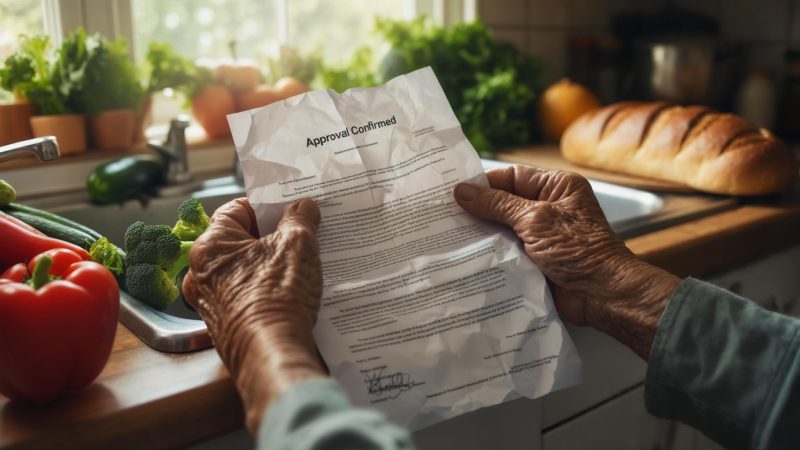
The application itself took about 45 minutes online through the state’s HEAplus portal. Robert submitted in mid-December 2025 with documentation of his last three months of business receipts, his shop’s lease agreement, and a written statement about the unpaid child support. He was approved within 22 days.
What Approval Actually Changed — and What It Didn’t
Robert’s household was approved for $418 per month in SNAP benefits starting January 2026. He told me the first time the EBT card loaded, he and Daniela stood in the grocery store for a moment before putting anything in the cart.
The $418 didn’t solve everything. The child support enforcement case against Marisol’s biological father moved slowly through the Arizona courts, and as of our conversation in late March 2026, payments were still inconsistent. The specialized daycare remained at $1,200 per month, which the family was managing partly through Arizona’s DDD support services and partly out of pocket.
Robert also acknowledged that his spending habits hadn’t transformed overnight. He described buying a $220 limited-edition sneaker in February — “a moment of weakness,” he called it — and immediately regretting it. The SNAP benefit freed up cash that he said he’s now trying to be more deliberate about, though he admitted he’s still working on what “deliberate” actually looks like for him.
He did say one thing shifted in a meaningful way: Marisol’s speech therapy co-pays, which had been quietly coming out of the grocery budget in tighter months, were no longer in competition with food. “She’s making progress,” Robert told me. “Her therapist says she’s doing really well. That’s the part that matters.”
The Regret He Still Carries
Near the end of our conversation, I asked Robert what he wished he’d known sooner. He was quiet for a moment, stirring the last of his coffee.
According to USDA SNAP data, approximately 42 million people received SNAP benefits in fiscal year 2024. Among working households with children — families like Robert’s — participation has historically lagged behind eligibility rates, partly due to stigma and partly due to the complexity of documenting self-employment income.
Robert told me he’s now the person in his neighborhood who tells other small business owners to look into it. Two of his regular clients — a food truck operator and a house cleaner — have since applied after he mentioned his own experience. “I’m not embarrassed anymore,” he said. “I’m just telling people what’s real.”
When I left the coffee shop, Robert had a client waiting at the shop and a Marisol pick-up at 4:30. The hustle hadn’t stopped. But it was carrying a little less weight than it had in December.
Related: He Got a $9,000 Raise at 31 and Lost His SNAP Benefits the Same Month
Related: A Tucson Teacher’s COBRA Bill Was Higher Than His Rent — Here’s How He Finally Got Out



Leave a Reply