
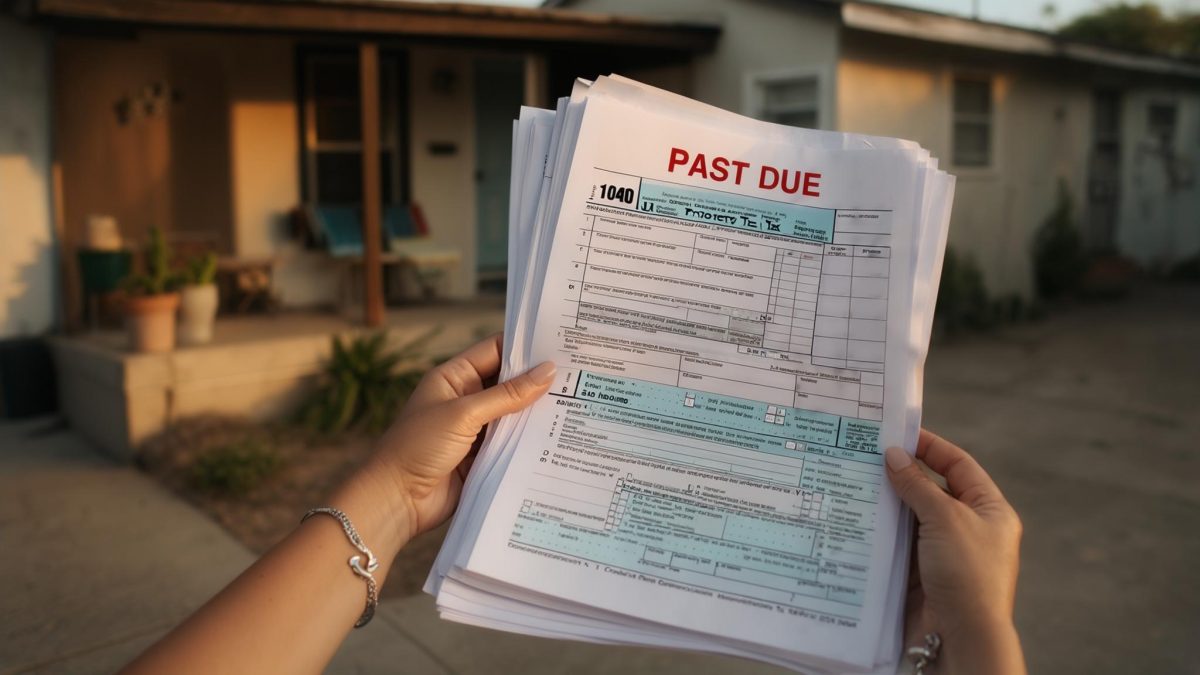
Florida’s property tax deadline for first-installment payments falls on April 30th each year, and as of the morning I spoke with Nelson Lombardi, he had exactly 29 days to figure out what came next. It was a Tuesday in early April 2026, and we met at a coffee shop off Dale Mabry Highway in Tampa, the kind of place where the booths are always half-full with people staring at laptops and trying to solve problems they didn’t expect to have.
Nelson had been recommended to me by a financial counselor named Delores Whitman, who had been working with him since January. “He’s doing everything right on paper,” Delores had told me over the phone, “and it still almost fell apart. People need to hear that.” I agreed, and Nelson did too, once I explained what the story was for.
He’s 29 years old, works overnight shifts in the cardiac care unit at a major Tampa hospital, and earns roughly $105,000 a year. He remarried in 2023 — his wife Priya brought two children into the household, and Nelson has two of his own from a previous relationship who live with them half the time. On most days, he is four children’s dad, a husband, a homeowner, and a nurse who hasn’t slept enough in three years.
The Financial Picture Behind the Scrubs
From the outside, Nelson’s income looks comfortable. Six figures for a 29-year-old with no college debt — he received a nursing scholarship through a workforce development program — sounds like a success story with a clean ending. But Tampa’s housing market has not been kind to recent buyers, and the costs of managing a blended family of six do not bend to income brackets.
Nelson and Priya purchased their home in Hillsborough County in June 2023 for $387,000. Their annual property tax bill came to $6,940 in 2024 — higher than they had budgeted for, but manageable in theory. The problem was the cascading pressure that came from every other direction at once.
His hospital employer switched insurance carriers in January 2025. What had been a $648-per-month family premium for the four-person plan became $1,247 per month — a $599 monthly increase that landed with no warning beyond a November 2024 open enrollment notice that Nelson told me he “skimmed on his phone at 3 a.m. after a shift.”
By the fall of 2025, the family was running about $800 short each month against their essential expenses. They weren’t buying luxuries. They were paying for school supplies, a car note, and the minimum on a credit card that had absorbed three months of grocery overruns. The property tax bill, which arrived in November, went into the drawer.
When the Tax Notice Became Urgent
The second property tax notice — the one with a late interest charge attached — arrived in January 2026. That’s when Nelson called Delores Whitman through a referral from his hospital’s employee assistance program. It was also when he learned something that, by his own description, made him feel sick.
Florida’s Homestead Exemption, administered through the Florida Department of Revenue, allows eligible homeowners to reduce the assessed value of their primary residence by up to $50,000 for property tax calculation purposes. The filing deadline is March 1st of the tax year in which you want the exemption to apply. Nelson had purchased his home in June 2023 and missed the March 1, 2024 filing window entirely.
By the time Delores flagged the error, Nelson had already paid the full 2024 tax bill without the exemption — effectively overpaying by an estimated $1,150 compared to what he would have owed with the exemption applied. The 2025 bill, which was still outstanding, carried the same gap.
The Homestead Filing and What It Actually Changed
Delores helped Nelson file the homestead exemption application with the Hillsborough County Property Appraiser’s office in late January 2026, before the March 1st deadline. The exemption will take effect on the 2026 tax bill — not retroactively, and not for the 2025 bill that remains delinquent. That boundary was painful to accept.
When I asked Nelson what it felt like to realize the savings had been available all along, he paused long enough that I thought the question had landed wrong.
Hillsborough County’s property appraiser office confirmed to me that the homestead exemption reduces the taxable value of Nelson’s home by $50,000 — meaning his 2026 assessed value of approximately $402,000 (after the county’s adjustments) will be taxed as $352,000. At the current millage rate, that translates to an annual savings of roughly $1,130 per year going forward.
The delinquent 2025 bill of approximately $3,400, however, still needed to be paid. Hillsborough County does offer a property tax installment payment plan under Florida Statute 197.222, which allows eligible homeowners to pay in four installments rather than a lump sum, beginning in June. Nelson applied in February 2026 and was accepted.
Where Things Stand Now — and What Nelson Fears Next
The installment plan gave the family breathing room, but Nelson was careful when he described the situation to me. He did not call it a win. He called it a pause.
His hospital’s open enrollment for 2026 gave him one additional option: a high-deductible health plan paired with a health savings account, which lowered the monthly premium back to $882. The family accepted, though Nelson acknowledged the $6,000 individual deductible gives him anxiety given that two of the four children had urgent care visits last year. Priya’s younger son has a recurring respiratory condition that requires quarterly specialist visits.
I asked Nelson if he had looked into Florida KidCare — the state’s CHIP program that provides low-cost health coverage for children. His household income places him above the standard eligibility threshold for that program, which covers children in families earning up to 200 percent of the federal poverty level, according to the Florida KidCare program. At his income, the children do not qualify.
That particular dead end was not a surprise to him — he had already checked. What he hadn’t fully confronted, before working with Delores, was the combination of small missed steps that had accumulated into something genuinely serious. No single decision had been reckless. No single expense had been frivolous. The gap had opened slowly, in the space between a missed exemption filing, a benefits notice read at 3 a.m., and a month where every urgent thing pushed the tax bill further back in the stack.
When I left the coffee shop that morning, Nelson had a meeting at 2 p.m. with Delores to review his options for resuming retirement contributions at a reduced rate. He was cautiously optimistic — the word he used was “cautiously,” not mine. The 2026 tax bill, when it arrives in November, will be lower by roughly $1,100. The installment plan makes the past-due balance survivable. That is not everything, but it is not nothing either.
His story does not end with a clean resolution, which is exactly why Delores thought it needed to be told. The programs that could have helped — the exemption, the installment option — were available the entire time. Knowing they existed, and knowing the deadlines attached to them, was the part that cost him.
Related: One Year From Medicare, His Health Insurance Hit $674 a Month — and the Property Taxes Went Unpaid




Leave a Reply