
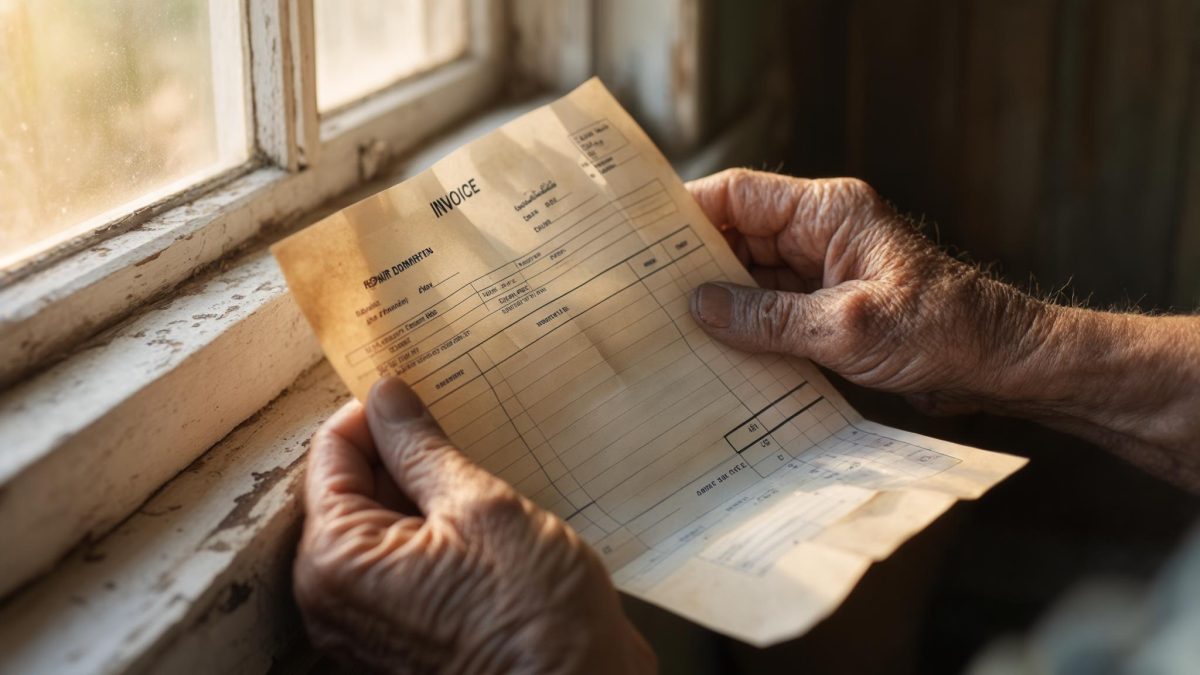
Roughly one in five homeowners who qualify for federal and state home repair assistance programs never apply — not because they don’t know the programs exist, but because applying feels like admitting defeat. That statistic has stuck with me since I first read it, and it came flooding back when Phil Valdez emailed our publication last November.
Phil had read a story I wrote earlier that year about an Ohio woman who used a city repair grant to fix her foundation. He said he almost didn’t write. “I figured it was one of those feel-good pieces,” he told me later. “Not something for people like me.” I called him the next morning, and we arranged to meet at a diner in Columbus’s Hilliard neighborhood, two blocks from the house he’s owned since 1998.
When Pride Costs More Than the Repair Bill
Phil Valdez is 67, broad-shouldered, with the kind of handshake that makes you wince. He runs Valdez Outdoor Services — a three-truck landscaping operation he built from nothing after immigrating from New Mexico in his late twenties. He raised his 13-year-old daughter, Maya, alone after his divorce four years ago. His ex contributes nothing financially, and he says he stopped expecting otherwise.
When I asked him what made him reach out, he paused and looked at his coffee. “The roof started leaking in October 2024. Not a drip — like, buckets in the hallway. And the furnace quit two weeks later. Same month.” He shook his head. “I’ve been through worse. But I had $4,200 in savings and a kid who needed the heat on.”
The roof replacement quote he got from three contractors ranged from $9,800 to $12,400. The furnace replacement — a gas forced-air unit for a 1,650-square-foot house — came in at $4,100 installed. Combined, he was looking at somewhere between $13,900 and $16,500 in repairs before winter deepened. His business slows almost entirely between November and March. The timing could not have been worse.
What He Was Actually Dealing With — The Full Picture
The roof and furnace weren’t Phil’s only financial pressure. In 2022, he financed a 2021 Ford F-250 for the business — a necessary purchase after his old work truck gave out. He borrowed $34,000 at 8.4% interest over 72 months. By October 2024, he still owed approximately $27,500 on a truck that a dealer told him was worth roughly $19,000 on trade. He was underwater by more than $8,000.
Phil’s gross business income runs roughly $62,000 to $68,000 a year before expenses. After payroll for two part-time workers, fuel, equipment maintenance, and the truck payment, he clears somewhere in the mid-thirties. “I’m not poor,” he said firmly. “But I’m not comfortable either. There’s a gap there that nobody talks about.”
That gap — too much income for some programs, too little cushion for unexpected costs — is something housing researchers have documented for years. According to HUD.gov, home repair affordability stress affects homeowners across a wide income band, not just those at or below the poverty line.
The Programs Phil Didn’t Know Existed
After our first call, Phil agreed to let me walk him through what assistance programs were actually available in Franklin County, Ohio. He was skeptical. “I figured it was all for people on welfare,” he said. “I didn’t think someone running a business would even qualify.”
Two programs ended up being relevant to his situation. The first was the City of Columbus Department of Development’s Emergency Home Repair Program, which provides assistance for health- and safety-related repairs to owner-occupied homes. Eligibility is based on area median income (AMI) thresholds — in Franklin County, the 2025 limit for a household of two was approximately $57,100 at 80% AMI. Phil’s adjusted household income, accounting for business deductions, put him near that threshold.
The second was the Ohio Weatherization Assistance Program (WAP), administered through the Ohio Development Services Agency. WAP provides no-cost energy efficiency improvements — including furnace replacement and repair — to income-eligible households. The program prioritizes households with elderly members, children under 18, and people with disabilities.
Phil’s household — himself at 67, plus his 13-year-old daughter — checked two of the three priority boxes. Whether his income would qualify was the harder question. “I told him upfront I couldn’t tell him whether he’d be approved,” I said when we spoke again. “But the only way to find out was to apply.”
What the Applications Actually Looked Like
Phil submitted his WAP application through the Community Shelter Board of Franklin County in December 2024. The documentation required was more extensive than he expected: two years of tax returns, proof of homeownership, utility bills, and income verification for his business. “It took me three weekends,” he said. “I’m not great with paperwork. I kept thinking, this is why people don’t do this.”
The WAP application moved faster than he anticipated. A home energy auditor visited in mid-January 2025, assessed the furnace, and the replacement was completed in February — a new high-efficiency gas unit installed at no cost to Phil. “I kept waiting for someone to tell me I owed something,” he said. “Nobody did. I still don’t entirely believe it.”
The Columbus Emergency Repair Program application for the roof was a different story. As of early April 2026, when I spoke with Phil for a final update, that application remained in a review queue. A city housing counselor had informed him in March 2025 that his income documentation required additional clarification around business expenses — a common friction point for self-employed applicants, according to housing advocates in Franklin County.
In the meantime, Phil paid $4,200 — nearly his entire savings — for emergency roof patching to stop the active leaking. “Not a replacement,” he clarified. “A patch. The real fix still needs to happen.” He expects that to cost another $8,000 to $10,000. Whether the city program will cover some of that cost remains unresolved.
Where Things Stand Now — And What Phil Still Regrets
When I called Phil in early April 2026, he was three weeks into the busy season. The trucks were running, Maya was in eighth grade, and the house was warm. The roof situation remained an open wound. “I got the furnace taken care of and I’m grateful for that,” he said. “But I waited three years to even look into any of this. Three winters.”
The truck loan remained unresolved. Phil said he had looked briefly into refinancing but was told his credit profile — which took hits during the slow winters of 2022 and 2023 — made favorable terms unlikely. “That one I’m just going to grind through,” he said. “I’ve got about 28 months left on the loan. I’ll make it work.” He didn’t want to discuss it further, and I didn’t push.
What struck me sitting across from Phil was that his resistance to assistance programs was never really about the programs. It was about identity — the self-made-man story he had been telling himself since he was in his twenties. That story had served him well for a long time. It had also cost him, quietly and cumulatively, in ways he’s only beginning to account for.
Phil’s story doesn’t have a clean ending — the roof isn’t fixed, the city program is still pending, and the truck is still underwater. But the furnace is running, and according to the U.S. Department of Energy, the average WAP recipient saves approximately $372 per year in heating costs. For a man running a tight operation through cold Ohio winters, that’s a number that matters.
He’s agreed to let me follow up when the city program makes its final determination. I’ll report back when that happens.
Related: He Spent 25 Years Treating Patients Who Used SNAP. At 55, Roy Haddad Became One of Them.
Related: A Social Worker Who Spent His Career Helping Others Found Himself Drowning in Debt — Until One Tax Credit Changed His Math
.pvv-faq-section details summary::-webkit-details-marker{display:none}.pvv-faq-section details summary::marker{display:none;content:””}.pvv-faq-section details[open] summary .pvv-faq-arrow{transform:rotate(90deg)}



Leave a Reply