

According to the U.S. Department of Veterans Affairs, roughly 5.8 million veterans received disability compensation in fiscal year 2024. A significant portion of those veterans have not updated their ratings in five years or more — even as their service-connected conditions deteriorate and the cost of living in cities like Baltimore climbs well past what those fixed checks were ever designed to cover.
I learned about Joanne Velasquez through a mutual friend at a neighborhood barbecue in Baltimore’s Waverly neighborhood in September 2025. The friend pulled me aside near the end of the evening and said, quietly, that Joanne had been doing everything right her whole life and still couldn’t make the numbers work. That’s a sentence I’ve heard before in this reporting beat. It almost always means something structural is failing — not the person.
When I sat down with Joanne at her kitchen table two weeks later, she had a printed spreadsheet in front of her — color-coded, with three months of data. She is 60 years old, divorced, and pays $650 a month in child support for two children. She retired from the United States Postal Service in March 2023 after 28 years of service, and before that she served eight years in the U.S. Army, leaving in 1995 with a service-connected lumbar spine injury and bilateral tinnitus.
A Monthly Math Problem That Had No Good Solution
Joanne’s monthly income when I met her consisted of two fixed sources: a FERS retirement annuity of approximately $1,773 from the Postal Service, and VA disability compensation at a 50% rating — which, at 2025 rates for a single veteran with no dependents, amounts to $1,102.04 per month. Her gross monthly income was just under $2,900.
On paper, that sounds manageable. In Baltimore in late 2025, it was not. Her one-bedroom apartment in the Waverly area ran $1,500 a month. Child support took $650. Utilities, prescriptions for a blood pressure condition not covered by the VA, and medical copays consumed another $320 on average. That left her with roughly $330 for groceries, transportation, and anything unexpected.
Joanne told me she had been managing the gap for two years through a combination of depleting a small savings buffer she had built during her postal career and occasionally borrowing from her sister. She described the process with the detachment of someone who had systematized her own financial anxiety.
What Joanne did not know — and what took two years and a casual barbecue conversation to surface — was that her VA disability rating was not a permanent verdict. It was a starting point.
Eleven Years at 50%: What the VA Never Told Her
Joanne received her initial 50% disability rating in 2014, roughly seven years after she first filed a claim. The rating covered her lumbar spine condition and tinnitus. She told me she accepted it without question. The check arrived each month. She was working full-time at the post office. She didn’t push further.
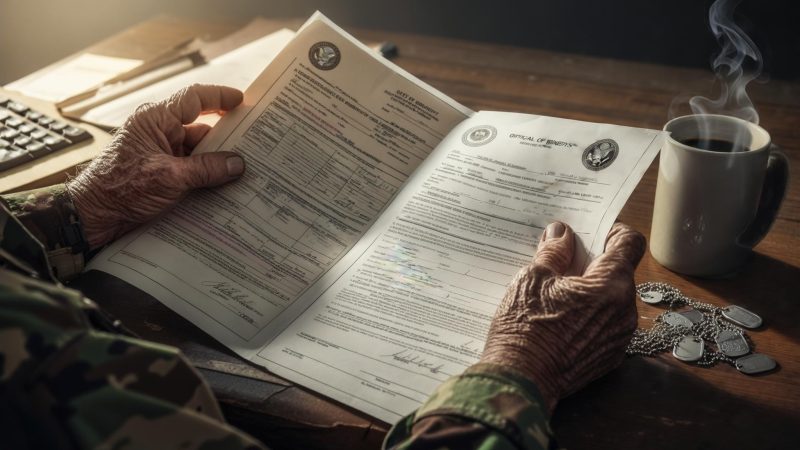
According to VA.gov’s Supplemental Claim guidance, veterans can file for a rating increase at any time by submitting new and relevant evidence — typically updated medical records showing that a service-connected condition has worsened. The form, VA Form 20-0995, is two pages long. The VA’s average processing time for supplemental claims was approximately 125 days in fiscal year 2024.
Joanne didn’t learn any of this from the VA. She learned it from a neighbor’s son who worked at a veterans service organization, whom she happened to mention her situation to after the barbecue where my colleague first heard her story. He walked her through the process over a single afternoon in July 2024.
Filing the Supplemental Claim: What the Process Actually Looked Like
Joanne filed her Supplemental Claim in August 2024. The new evidence she submitted included updated imaging from her VA primary care physician showing worsening disc degeneration at L4-L5, a functional assessment from a physical therapist documenting reduced range of motion and increased pain levels, and a personal statement documenting how the condition now affected her ability to stand and carry weight — something she had managed to hide during her postal years through sheer stubbornness, she said.
Joanne told me the Compensation and Pension examination was the part she dreaded most. She had heard from other veterans that examiners could be skeptical or rushed. Her appointment lasted about 40 minutes. She said the examiner was thorough and did not minimize what she described.
The Outcome: Real but Not Enough to Exhale Completely
The January 2025 decision letter raised Joanne’s rating from 50% to 70%. Under the VA’s 2025 compensation rate tables, a 70% rating for a single veteran with no dependents pays $1,663.06 per month — an increase of $561.02 over what she had been receiving. The adjustment was applied retroactively to her August 2024 filing date, resulting in a back-pay lump sum of approximately $2,805 covering the six months before her adjusted payments began.
Joanne used most of the back-pay to replenish the savings account she had drawn down during 2023 and 2024. She kept $600 in cash as a small emergency buffer. She told me that having that cushion — even a modest one — changed how she sleeps.
But Joanne is clear-eyed about the limits of what changed. Her rent increased by $75 a month in March 2025 when her lease renewed. Her older child’s college expenses are not covered by child support alone, and she contributes informally. The math is tighter than the spreadsheet suggests on paper. The $561 provided room to breathe, not room to stop counting.
What Joanne’s Story Reveals About How the System Is Built
When I asked Joanne what she would tell another veteran in her position — someone who filed once, accepted the result, and moved on — she paused for a long time before answering. She is not someone who rushes toward conclusions. That methodical quality, she told me, is what got her through 28 years of early morning postal routes and what kept her from panicking when the numbers stopped working.
The structural reality Joanne’s story surfaces is not unique to her. The VA’s rating system was designed around a snapshot of a veteran’s condition at the time of assessment. It does not follow the veteran forward. Conditions that worsen over decades — particularly musculoskeletal injuries like Joanne’s lumbar disc disease — can qualify for higher ratings, but only if the veteran initiates the process. The VA does not send reminders. It does not monitor. It responds.
For Joanne, the cost of not knowing was roughly $561 a month over eleven years — a figure she does not dwell on, but that I found myself thinking about long after I left her apartment. That comes to approximately $74,052 in benefits she was technically entitled to pursue but never did, not out of negligence, but because the information was never placed in her path.
She walked me to the door holding the same color-coded spreadsheet she’d had on the table when I arrived. She had already updated one column in green.
Related: He Got a $9,000 Raise at 31 and Lost His SNAP Benefits the Same Month
Related: A Columbus Teacher’s Denied Workers’ Comp Claim Led Him to a Benefits Program He Didn’t Know Existed



Leave a Reply