
I almost didn’t stop to talk to her. Crystal Becerra was in the cereal aisle of a Sedano’s Supermarket in Miami’s Little Havana neighborhood on a Tuesday afternoon in February 2026, holding two boxes side by side — store brand versus name brand — doing the kind of careful math with her eyes that I recognized immediately. She set the name brand back on the shelf. When I mentioned I wrote about government assistance programs, she laughed — not warmly.
“That stuff isn’t for people like me,” she said. “I’m not some deadbeat. I have a job.”
She agreed to sit down with me the following Saturday. What I heard over two hours at her kitchen table in Hialeah changed how I think about the gap between needing help and accepting it.
A Household Running on Empty
When I sat down with Crystal Becerra, 28, she had already been a marketing manager at a small Miami tech startup for three years. Her base salary sat at roughly $2,200 a month gross — modest for the role, but the startup offered flexibility she needed as a mother of two. Her husband, Marco, works part-time at a packaging facility and brings in about $900 a month. Together, their household income runs approximately $37,200 a year before taxes.
For a family of four in Miami-Dade County — one of the most expensive metro areas in Florida — that number leaves almost no margin. Their two kids, ages 9 and 10, are in elementary school. Rent on their two-bedroom in Hialeah runs $1,850 a month. Before anything went wrong, they were already living close to the edge.
Then, in March 2024, someone stole her identity.
When Identity Theft Does More Than Hurt a Credit Score
Crystal told me the first sign was a credit alert on her phone — a new card had been opened in her name at a bank she’d never used, with a $4,500 credit line maxed out within two weeks. By the time she filed a report with the FTC and contacted all three credit bureaus, the thief had opened two additional accounts totaling another $7,200 in fraudulent charges.
“I spent months on hold,” Crystal said. “Hours every week, trying to prove I didn’t buy a refrigerator in Tallahassee or a flat-screen in Tampa. My credit score went from 641 to 489. I couldn’t refinance anything, I couldn’t get a new card. I was frozen.”
The identity theft didn’t directly affect her SNAP eligibility — but it set off a chain reaction. Because her credit was destroyed, she couldn’t access a personal loan to cover a $2,700 emergency room bill from 2021 that had gone to collections. That debt, she assumed, had simply aged out of her life.
It hadn’t.
The Garnishment That Finally Broke Through Her Pride
In January 2025, Crystal received a notice from her employer’s HR department: a civil judgment had been entered against her in Miami-Dade County court, and beginning February 1, $412 a month would be withheld from her paycheck. She hadn’t been properly served the original lawsuit — she suspects paperwork went to an old address — and by the time she found out, the window to contest the default judgment had closed.
“I cried at my desk,” she told me quietly. “Not because of the money. I cried because I felt stupid. I thought I was handling everything, and I wasn’t.”
With $412 leaving her paycheck every month, the household was suddenly short. After rent, utilities, and transportation costs, the family had approximately $280 left for groceries each month. For four people.
A coworker mentioned SNAP. Crystal dismissed it the first time. Then again three weeks later when the coworker brought it up a second time. It took six more weeks — and a particularly brutal grocery run where she had to put back a pack of chicken thighs — before she looked up the eligibility requirements on her phone.
Navigating SNAP With a Complicated Paper Trail
Florida’s SNAP program is administered through the Department of Children and Families. According to Propel’s 2026 SNAP income limit data, a household of four in Florida must have a gross monthly income at or below approximately $3,483 to pass the initial eligibility threshold — 130% of the federal poverty level. Crystal’s household came in at $3,100 a month gross, putting her well within range.
But applying wasn’t simple. The identity theft had left a trail of inconsistencies. Her credit report showed addresses she’d never lived at. One fraudulent account had briefly reported income under her Social Security number that didn’t match her actual earnings. A DCF caseworker flagged her file for manual review.
The process took approximately 11 weeks from first application to approval — longer than the standard 30-day processing window, but not unusual when identity complications require manual verification. Crystal told me she called the DCF helpline eight times during that period. Three of those calls resulted in someone actually picking up.
“The system is not built for people who have problems,” she said flatly. “It’s built for people who are already organized, already stable. If your life is messy, good luck.”
What the Benefit Provided — And What It Did Not Fix
Crystal has been receiving $714 a month in SNAP benefits since June 2025. According to Think Global Health’s reporting on 2026 SNAP benefit changes, benefit amounts are calculated based on net income after allowable deductions — including a standard deduction and a 20% earned income deduction — meaning households with employment income often qualify for more than a raw income figure might suggest.
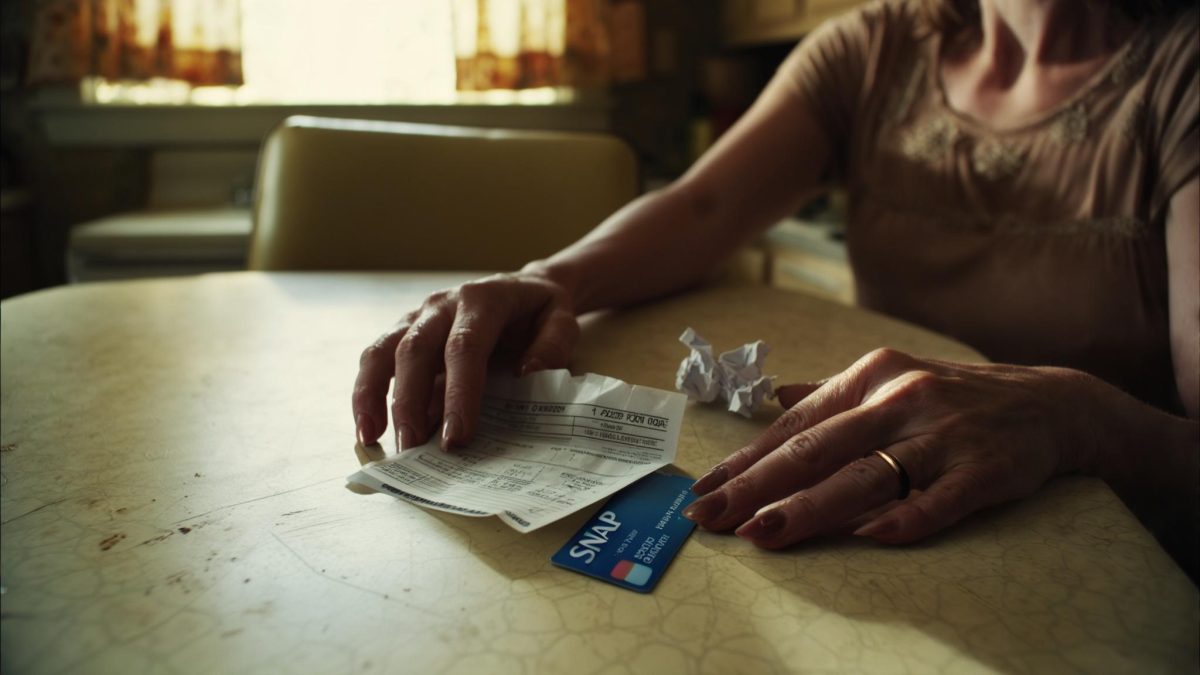
For Crystal, the EBT card changed the texture of daily life in concrete ways. Chicken thighs went back in the cart. She stopped rationing fruit. Her younger daughter asked why there was suddenly more food, and Crystal told her she’d gotten a raise at work. She hasn’t corrected that yet.
What the benefit didn’t solve: the garnishment continues. The $412 monthly withholding runs through at least October 2026, when the judgment amount will be satisfied. The identity theft recovery is ongoing — one disputed account remains unresolved as of April 2026, still appearing on her Equifax report. Her credit score, last checked in March, sits at 512.
“SNAP helped,” Crystal told me as I was getting ready to leave. “But it didn’t fix any of this. I’m still in the same hole. I just have groceries now, which sounds small until you don’t have groceries.”
There was nothing small about how she said it.
Crystal Becerra is not a cautionary tale and she is not a success story — she is something more honest than either. She is a person who needed help, spent two years refusing it out of a deeply held sense of self-reliance, and finally accepted a fraction of what is available to her. Driving back across the causeway that Saturday evening, I kept thinking about all the people who never pick up the phone at all — and what it costs them to stay stubborn inside a system that rewards persistence above almost everything else.
(function(){var w=document.getElementById(‘pvv-scenario-s1775662271599k9zj’);if(!w)return;var btns=w.querySelectorAll(‘button[data-choice]’);btns.forEach(function(b){b.addEventListener(‘click’,function(){if(w.dataset.revealed)return;w.dataset.revealed=’1′;btns.forEach(function(x){x.style.opacity=x===b?’1′:’0.45′;x.style.cursor=’default’;x.style.transform=’none’});var o=document.getElementById(‘s1775662271599k9zj-out-‘+b.dataset.choice);if(o){o.style.display=’block’}});b.addEventListener(‘mouseenter’,function(){if(!w.dataset.revealed){b.style.borderColor=’#38bdf8′;b.style.transform=’translateX(4px)’}});b.addEventListener(‘mouseleave’,function(){if(!w.dataset.revealed){b.style.borderColor=’#334155′;b.style.transform=’none’}})})})();
.pvv-faq-section details summary::-webkit-details-marker{display:none}.pvv-faq-section details summary::marker{display:none;content:””}.pvv-faq-section details[open] summary .pvv-faq-arrow{transform:rotate(90deg)}


Leave a Reply