

The Facebook post was short, almost apologetic in tone. “Anyone else in their 60s still dealing with student loans?” Joanne Washington had written one Tuesday evening in February 2026, in a private group for Milwaukee-area retirees. “Not looking for pity — just want to know I’m not the only one.” When I reached out to her via direct message the following morning, she took nearly two days to respond. “I wasn’t sure I wanted to talk about it publicly,” she told me when we finally connected over a video call. “Money stuff feels so personal. Like it means you failed.”
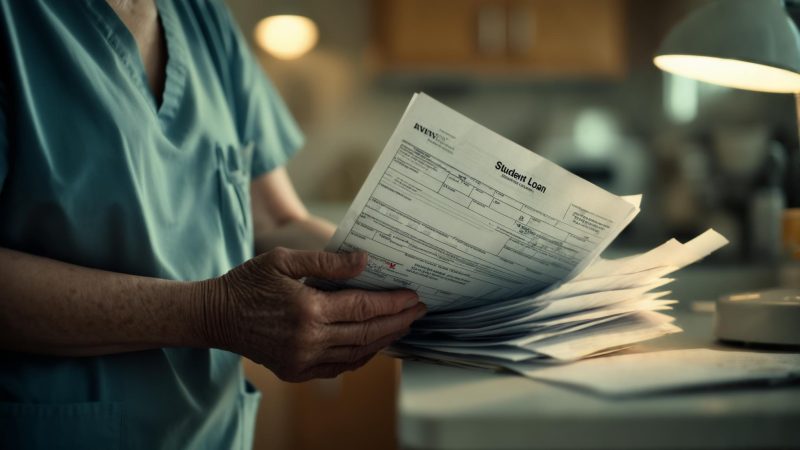
She hadn’t failed. But sitting across from her on screen — her reading glasses pushed up on her forehead, a cup of tea going cold beside her laptop — I could see that the years of carrying this particular weight had left their mark. Joanne Washington is 66 years old, a senior accountant at a small nonprofit in Milwaukee, and the primary caregiver for her 89-year-old mother. She also owes $47,200 in federal student loans from a master’s degree in public administration she earned in her mid-40s, believing it would open new doors in her career. It did, for a while. Then life intervened in the ways it tends to.
A Degree That Made Sense at 44 — and a Debt That Followed Her Into Retirement
Joanne enrolled at the University of Wisconsin-Milwaukee in 2004, taking evening classes while working full-time. She graduated in 2007 with her MPA and a loan balance of roughly $38,000. For several years, she made regular payments, and the balance barely moved. “I didn’t understand how interest worked on these things,” she said. “I thought I was doing the right thing, making the minimum payment every month. But the balance just kept creeping up.”
In 2015, her mother had a serious fall and required full-time care. Joanne moved her mother into her home, took on additional household expenses, and — stretched too thin financially — entered her loans into forbearance for 14 months. The interest that capitalized during that period added approximately $4,800 to her principal. Her credit score, which had been hovering around 680, dropped into the low 600s after she missed two credit card payments during the same stretch.
By the time Joanne came out of forbearance in 2016, she owed $43,500. She rejoined the standard repayment plan, her monthly payment set at $412. On her salary of approximately $41,000 a year, that payment took a significant bite. “I was making it work,” she said. “But ‘making it work’ meant I wasn’t saving anything. Every month I was just moving money from one place to another and hoping nothing broke.”
The Small Win That Scared Her
In late January 2026, Joanne received a letter from her federal loan servicer confirming that her application for an income-driven repayment plan had been approved. Her new monthly payment: $189. Her previous payment had been $412 per month under the standard 10-year plan.
That difference — $223 a month — sounds modest in the abstract. For Joanne, it was the margin between barely surviving and having something left over. “My first thought was, this is a mistake,” she told me. “I’ve been dealing with the government long enough to know that good news usually comes with an asterisk.” She called her servicer twice to confirm. She read the letter four times.
How the Application Actually Happened — and Why It Took So Long
Joanne had heard of income-driven repayment plans for years but had always assumed they were for younger borrowers, or for people who earned less than she did. She learned she was wrong when a coworker in her early 40s mentioned her own IDR enrollment in passing last fall. “She was talking about it like it was just a normal thing you do,” Joanne said. “And I thought — wait. Why didn’t anyone ever tell me this was an option for me?”
According to Federal Student Aid, income-driven repayment plans set monthly payments at a percentage of a borrower’s discretionary income, typically between 5% and 20% depending on the plan, with any remaining balance potentially forgiven after 20 or 25 years of qualifying payments. For borrowers nearing or in retirement with limited income relative to their debt, the monthly payment can drop substantially.
Joanne submitted her application through the studentaid.gov portal in November 2025, after spending two evenings gathering her tax documents and employment verification. The process took approximately nine weeks from submission to approval. During that window, she said, she received no updates and couldn’t confirm whether anything was happening. “I just sent it and waited and tried not to think about it,” she said. “Which for someone with anxiety is not exactly easy.”
The Credit Score Problem That Still Lingers
The IDR approval was the small win. The credit score is the ongoing wound. Joanne’s score, as of March 2026, sits at approximately 618 — a number that has consequences she feels every month. Her auto insurance premiums are higher than they would otherwise be. She was turned down for a modest personal line of credit in 2024 that she had hoped to use for a bathroom renovation her mother needed for accessibility. “The bank was perfectly nice about it,” she said with a dry laugh. “They said my score ‘didn’t meet their current criteria.’ What they meant was, she’s a bad bet.”
The two missed credit card payments from 2015 aged off her report in 2022, and her score recovered modestly. But years of high credit utilization — often running her one credit card near its $4,500 limit to cover her mother’s medical copays — kept her score suppressed. She’s been methodically paying it down since early 2025, and her current balance is approximately $1,100. “I know what I’m doing wrong. That’s the painful part,” she said. “I know the rules. I just couldn’t always follow them.”
That gap between knowledge and capacity is one of the things that struck me most in my conversation with Joanne. She is, professionally, someone who manages numbers for a living. Her struggles weren’t rooted in ignorance — they were rooted in the compressing weight of a caregiver’s life, a fixed income, and a loan balance that simply outpaced what her salary could absorb.
Looking Forward With Cautious Optimism
When I asked Joanne what she was most afraid of right now, she paused for a long moment. “That something will change,” she finally said. “That they’ll claw back the IDR or adjust the rules and I’ll be back where I was.” Her concern isn’t unfounded — according to Federal Student Aid, IDR plans require annual recertification of income and family size, meaning the payment can change year to year. For a borrower on a fixed or slowly growing income, that creates ongoing uncertainty.
She’s also aware that at 66, the loan forgiveness provision at the end of an IDR repayment term — typically 20 to 25 years — is functionally irrelevant. She won’t be making payments for another two decades. What matters to her now is managing the monthly cash flow and, eventually, retiring without handing this balance to anyone she loves.
Joanne told me she has started attending a free financial counseling workshop offered through a Milwaukee-area nonprofit, primarily to stay accountable and to ask the questions she feels too embarrassed to ask online. “You’d think I wouldn’t need financial counseling given my job,” she said. “But there’s something about having someone else look at your situation with fresh eyes. It’s easier to see what you’ve been avoiding.”
Before we ended our call, Joanne mentioned something that has stayed with me. She said she hesitated to post in the Facebook group that night because she assumed people would judge her — a 66-year-old accountant who still couldn’t get her own finances straight. Instead, the post received 47 comments within 24 hours. Most of them started the same way: “I thought I was the only one.”
Joanne Washington’s story is not a triumph, not yet. It’s a turning point — the kind that’s fragile and provisional and real. She made $223 of breathing room appear in a budget that had none, through paperwork and patience and finally asking the right question. That’s not a small thing. For her, right now, it’s everything.
Related: She Owed $47,000 in Student Loans and Faced a 30% Rent Hike. Then a Tax Clinic Changed Her Math.



Leave a Reply