
The afternoon I met Renee Kowalski, she was sorting meal containers in the back of a delivery van, cheerfully arguing with the driver about the best route through the Highlands neighborhood of Louisville. She was volunteering on her day off — a Thursday in late February 2026 — because, as she later told me, it helped her feel useful in a way that didn’t involve paperwork. I had joined that Meals on Wheels route as part of a longer reporting project on how middle-income workers navigate public assistance, and one of the program coordinators had quietly suggested I talk to Renee. “She’s got a story,” the coordinator said. “And she actually tells it.”
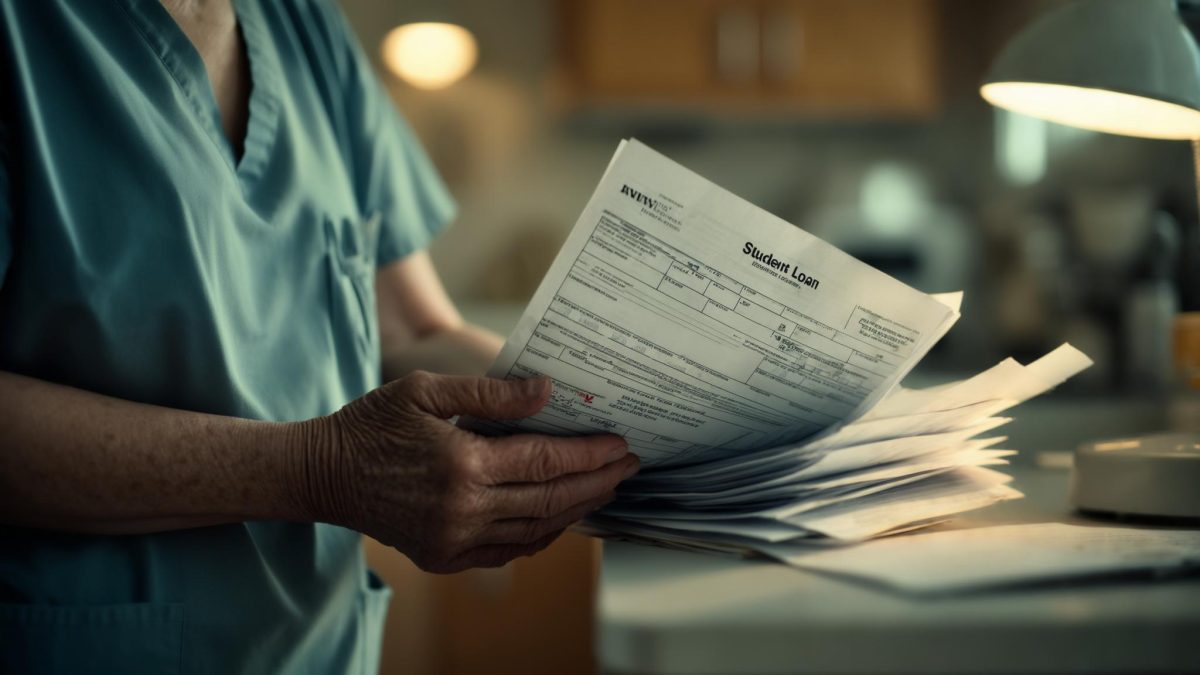
She does. When I sat down with Renee Kowalski two days later at a coffee shop near Norton Audubon Hospital, where she works as a registered nurse on the cardiac floor, she spread out a manila folder stuffed with printed emails, loan statements, and federal forms. She is 47 years old, remarried, and raising four children between herself and her husband — two from her previous marriage, two from his. She has a master’s degree in nursing science from the University of Louisville that she finished in 2017. And as of January 2026, she owed the federal government approximately $94,000 in student loan debt.
A Graduate Degree, a Blended Family, and a Monthly Bill That Felt Permanent
Renee started her nursing career in 2013 with an associate degree and a job at a community hospital. She was good at the work, and her supervisors encouraged her to go back for her MSN. “They told me a graduate degree would open doors,” she said. “And it did — but nobody mentioned the doors would have a $94,000 toll booth in front of them.”
She took out federal Direct Loans between 2015 and 2017 while working part-time and attending the University of Louisville’s accelerated nursing program on evenings and weekends. By the time she graduated, her loan total sat at $78,400. By 2026, thanks to years of income-driven payments that didn’t fully cover accruing interest, that balance had grown to $94,000 — despite never missing a payment.
Childcare compounded everything. With four children ranging from age 8 to 15, and two different custody schedules to manage, Renee and her husband were paying roughly $1,740 per month in afterschool care and summer programs for the younger two children. Her take-home pay as a senior RN was approximately $5,900 per month. Her husband, who works in logistics, brought in around $4,200. On paper, they are a middle-income household. In practice, Renee told me, they were cash-flow negative three months out of every year.
What Is PSLF — and Why It’s Harder to Access Than It Looks
The Public Service Loan Forgiveness program, administered through the Federal Student Aid office, promises to forgive remaining federal loan balances after a borrower makes 120 qualifying monthly payments while employed full-time by a government or nonprofit organization. On paper, Norton Audubon Hospital — where Renee works — qualifies as a 501(c)(3) nonprofit employer. She should have been on track from the moment she consolidated her loans into the Direct Loan program.
The reality was messier. Renee first submitted an Employment Certification Form in 2018 and was told her payment plan at the time — a graduated repayment plan — did not qualify. She had to switch to an income-driven repayment plan. That transition took four months, during which she made two payments that would not count toward her 120. She started over, effectively, in mid-2018.
PSLF has a well-documented history of high denial rates. According to data from the Federal Student Aid data center, approval rates for PSLF applications improved significantly after a 2021 waiver program, but processing backlogs and plan eligibility confusion continued to affect borrowers well into 2025. Renee’s experience fit a pattern that tens of thousands of public-sector workers have reported.
The IDR Account Adjustment — and What Changed in Early 2026
The turning point in Renee’s story came in January 2026, when she received a notice from her loan servicer confirming that an Income-Driven Repayment account adjustment had retroactively credited her with additional qualifying months. The adjustment — a policy that the Department of Education began rolling out in 2023 and continued processing through 2025 — reviewed past payment histories and granted credit for months that had previously been miscounted or disqualified.
Renee’s count moved from 94 qualifying payments to 108. She now needed just 12 more to reach the 120-payment threshold required for full forgiveness. “When I saw that number change,” she told me, “I cried in my car in the hospital parking garage. Like, ugly-cried. And then I was immediately terrified it was wrong.”
The Fear Behind the Relief
Renee’s wariness is not unfounded. The legal and political environment surrounding federal student loan programs shifted substantially between 2024 and 2026. Court challenges to the SAVE repayment plan created months of uncertainty for millions of borrowers, and Renee watched those developments closely. She had been enrolled in SAVE when a federal court blocked the plan’s implementation in mid-2024, forcing her into a forbearance period. Those months in forbearance, she was told, would count toward PSLF under existing guidance — but she’s still waiting for written confirmation.
“Every time I think I understand the rules, something changes,” she said, stacking her papers back into the folder. “I’m not complaining about the program existing. I’m grateful it exists. I just wish I didn’t have to be an expert in federal loan policy to use it.”
Her current monthly payment, under the IDR plan she remains enrolled in, is $312. Before the adjustment and plan changes, she had been paying $890 per month under a standard repayment structure she had briefly switched to in 2021 when she misunderstood the PSLF requirements. That two-year period cost her roughly $13,900 in higher-than-necessary payments — money that, she noted quietly, could have covered nearly eight months of childcare.
What Renee Wants Other Borrowers to Know
Renee is not a policy advocate. She doesn’t run a social media account about student loans or attend town halls. But when I asked her what she’d tell another nurse — or a teacher, or a social worker — who was just starting the PSLF process, she answered without hesitating.
“File the Employment Certification Form every single year. Don’t wait until year ten,” she said. “And make sure you’re on a qualifying repayment plan before you file — not after. I found out the hard way that the order matters.” She also mentioned the PSLF Employer Search tool on studentaid.gov, which she used in 2023 to confirm that Norton Audubon Hospital remained listed as a qualifying employer.
- Confirm your employer qualifies using the official PSLF Employer Search before enrolling
- Submit an Employment Certification Form (now called the PSLF Form) annually — not just at the end
- Verify that your repayment plan is income-driven before submitting any certification
- Keep paper or PDF copies of every confirmation email and payment statement
- Check your qualifying payment count on your servicer’s portal at least twice per year
She paused after that list, looking at the manila folder on the table between us. “I have nine years of paperwork in there,” she said. “My kids make fun of me for it. But every time something went wrong, that folder was the thing that fixed it.”
A Tentative Hope, Carefully Held
When I left Renee at that coffee shop, she had 12 qualifying payments left to make — roughly one year, assuming no further program disruptions. If everything holds, she will submit her final PSLF application in early 2027, and the approximately $94,000 remaining on her loans will be forgiven tax-free under current federal law. That’s not a small number. For her family, it represents nearly eight months of combined gross income.
But Renee has been here before — close, cautiously optimistic, paperwork in hand — and had the rules shift under her. The hopeful version of her future is vivid and specific: no loan payment, more room in the monthly budget, maybe a small college savings account for the kids. The scared version is just as vivid. “I keep telling myself not to make plans around it,” she told me as we walked out. “But I also keep making plans.”
That tension — between earned hope and hard-won caution — is what stayed with me after I drove away. Renee Kowalski did everything the program asked of her: she worked the job, filed the forms, stayed enrolled in the right plan, and kept the folder. Whether the system holds up its end of the agreement is a question she cannot answer. Only time, and twelve more monthly statements, will.
Related: He’s 49 With $41,000 Saved for Retirement — Then a $312 Monthly Garnishment Started Draining What Little Was Left
Related: A $4,400 Raise Left This Indianapolis Nurse Worse Off Than Before



Leave a Reply