

The April 30, 2026 deadline for submitting updated Employment Certification Forms under the Public Service Loan Forgiveness program is weeks away — a detail that has taken on new urgency for thousands of public school teachers who may still not know their loans could be wiped out entirely. When a social worker at the Bexar County assistance office suggested I speak with Travis Stanton earlier this year, she described him simply as “someone who almost fell through the cracks.” That turned out to be an understatement.
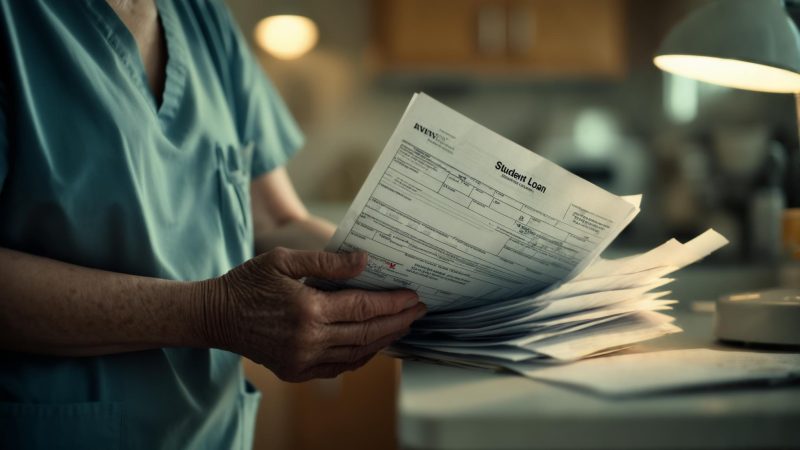
When I sat down with Travis at a corner table in a San Antonio diner in late February 2026, he arrived carrying a manila folder thick enough to double as a doorstop. Inside were 16 years of loan statements, employer certification forms, and two rejection letters from MOHELA, the federal student loan servicer. He ordered black coffee, set the folder down like it had weight beyond paper, and said, “I’ve been paying on this debt since George W. Bush was in the White House.”
A Graduate Degree, a Good Career, and $67,000 That Wouldn’t Go Away
Travis Stanton, now 54, earned his Master of Arts in Mathematics Education from Texas A&M San Antonio in 2009. The degree cost him roughly $41,000 in tuition and fees. By the time interest had compounded through years of income-driven payments and two brief forbearance periods — one in 2015 when his father’s health declined sharply, another in 2020 during the pandemic — that balance had grown to approximately $67,400 by January 2026.
Travis has taught at a Title I high school in the Northside Independent School District for fifteen consecutive years. Under the rules of the Public Service Loan Forgiveness program, administered by the U.S. Department of Education, borrowers employed full-time by a qualifying public school district who make 120 payments on an eligible repayment plan can have their remaining federal loan balance forgiven entirely. Travis qualified on every count — except the ones he didn’t know about.
The problem, as Travis explained it to me, was that for the first eight years of his repayment, he was enrolled in a standard 10-year repayment plan — not an income-driven repayment plan, which is required for PSLF eligibility. Every payment he made between 2010 and 2018 counted for nothing under the program’s rules. “I didn’t know there was a difference,” he told me, rubbing the back of his neck. “My loan servicer at the time never mentioned it. I just paid what they billed me.”
The Side Hustle Years and the Credit Score That Suffered
Travis’s financial picture is more complicated than his loan balance alone. He described himself to me as someone who is “always running three plans at once,” and his history bears that out. Over the past decade he has tutored privately, sold lesson plan bundles on Teachers Pay Teachers, and briefly operated a weekend SAT prep course out of a local library meeting room. At his peak, these side ventures added roughly $14,000 to his annual income on top of his teaching salary of approximately $62,000.
But the restlessness that fueled those side hustles also led to some financial missteps. In 2017, Travis opened three credit cards to fund what he described as a “tutoring center that never got off the ground” — a small commercial space he leased for six months before closing it at a loss of roughly $8,200. Two of those cards went delinquent. By early 2018, his credit score had dropped to 581. “I thought I was being entrepreneurial,” he said, with a short, dry laugh. “I was just being reckless.”
His father, now 81, was diagnosed with early-stage vascular dementia in 2015. Travis is the sole caregiver, managing medications, driving his father to appointments, and contributing roughly $900 per month toward his father’s assisted living costs — a financial obligation that showed no signs of decreasing. When I asked how he managed all of it, Travis was quiet for a moment before answering. “Math teacher. I build spreadsheets. I just keep recalculating.”
Two Rejections and a Turning Point at the County Office
Travis first heard about PSLF in 2019, through a colleague at his school. He submitted his first Employment Certification Form that October. The rejection came four months later: his loans were Federal Family Education Loan (FFEL) loans, which are not directly eligible for PSLF without first being consolidated into a Direct Loan. His servicer had never flagged this.
Travis consolidated his loans into a Direct Loan in March 2020 and switched to an Income-Driven Repayment plan — specifically the SAVE plan, which had recently replaced REPAYE. He resubmitted his certification. His second rejection arrived in August 2021: several of his employment certification periods had gaps where his school district’s HR department had used an outdated form version, causing MOHELA to reject that block of employment history entirely.
It was the Bexar County social worker — the same one who later pointed me toward Travis — who changed the trajectory. In January 2023, Travis visited the county office looking for resources related to his father’s care costs. The social worker, who dealt regularly with public employees navigating benefit programs, recognized immediately that Travis might be eligible under the limited PSLF Waiver that had been announced in 2021, which temporarily allowed previously ineligible payment periods to count. She helped him compile the correct documentation and directed him to a nonprofit student loan counselor.
What the Numbers Looked Like When the Process Finally Worked
By November 2025, after working with the nonprofit counselor for nearly two years to reconstruct his full payment history and resubmit corrected employment certifications, MOHELA confirmed that Travis had 127 qualifying payments on record — seven more than the required 120. His forgiveness application is currently under review, with an expected determination date in late spring 2026.
The forgiveness, if approved, will not arrive without a cost. Because Travis was on a standard repayment plan for his first eight years, he paid down a significant portion of principal during that period — meaning the amount forgiven will be lower than it would have been had he enrolled in IDR from the start. He estimates he paid approximately $28,000 more than he needed to over those eight years. “That’s a car,” he said. “Or two years of my dad’s care. I try not to think about it too much.”
Travis’s credit score, for its part, has recovered substantially. After paying off the two delinquent credit cards in 2022 using a combination of his summer tutoring income and a small personal loan from a credit union, his score climbed from 581 to approximately 714 by early 2026. He described rebuilding his credit as “the one part of this whole mess that actually followed a formula.”
The Ledger at 54 — Relief, Regret, and What Comes Next
Travis Stanton is not entirely out of the financial woods. Even if his forgiveness application is approved this spring, he will still be managing his father’s care costs, a modest retirement account that he describes as “underfunded by about a decade,” and the lingering psychological weight of years spent feeling behind. But the tone when he talked about the next few years was different from the tone when he described the years behind him.
“If this goes through, I can stop the side hustle math,” he told me, near the end of our conversation. “I can just teach. And take care of my dad. And maybe — maybe — start actually saving for retirement instead of just thinking about it.” He closed the manila folder and set it aside for the first time in two hours.
What stays with me from that conversation is not the dollar figure, large as it is. It is the folder. Sixteen years of paper, accumulated as evidence of a program that was theoretically designed to reward exactly the kind of career Travis has built — and that still managed to cost him years of unnecessary payments simply because no one told him the rules. As Travis put it on his way out the door: “I teach kids to check their work. Turns out I should’ve been checking the paperwork too.”
Related: A Detroit Bus Driver Cosigned a $17,500 Loan in Good Faith — Then Came a Tax Bill for Money She Never Received



Leave a Reply