

What would you do if, in the span of eighteen months, your insurance company dropped you, your property tax bill went unpaid, and you were still writing checks toward a graduate degree you earned twenty years ago — all while working a factory floor job at 66 years old?
I drove to Tampa on a Tuesday in late February 2026, after a coordinator at the Hillsborough County Family Resource Center reached out to say she had someone whose story my publication needed to hear. Brenda Dawkins met me in the center’s small conference room, a paper cup of coffee in both hands. She wore her work badge clipped to her jacket — she had a shift starting at 3 p.m. and was not going to miss it.
A Stack of Problems That Didn’t Arrive All at Once
Brenda Dawkins, 66, has lived in the same three-bedroom home in East Tampa for 27 years. She and her late husband Calvin bought it in 1999 for $88,000. Calvin passed in 2021 from a cardiac event, and since then Brenda has managed everything alone — the mortgage, the upkeep, the bills — on a machine operator’s wage of approximately $31,400 a year before taxes.
Her two adult children live out of state, one in Atlanta and one in Portland. She talks to them every week and declines their offers to help with money. “They have their own lives to build,” she told me. “I’m not going to be the anchor that pulls them down.” That instinct — to absorb rather than ask — shaped every decision she made over the past two years, and it made almost everything harder.
In September 2023, Hurricane Idalia brought serious wind damage to her roof. Brenda filed a claim with her private insurer — a claim that was paid out at $14,200 for repairs. Four months later, she received a non-renewal notice. The insurer cited her claim history and the property’s age. She was not alone: according to the Florida Office of Insurance Regulation, tens of thousands of Florida homeowners received similar non-renewals between 2022 and 2024 as private carriers exited the state.
Without insurance, her mortgage servicer placed force-placed coverage on the home — a policy that covered the lender’s interest, not hers, at a monthly premium of $417, more than double what she had been paying. That extra cost — roughly $2,300 annually above her prior premium — began quietly eating into the budget she used to pay her Hillsborough County property taxes.
How the Property Tax Bill Became a Crisis
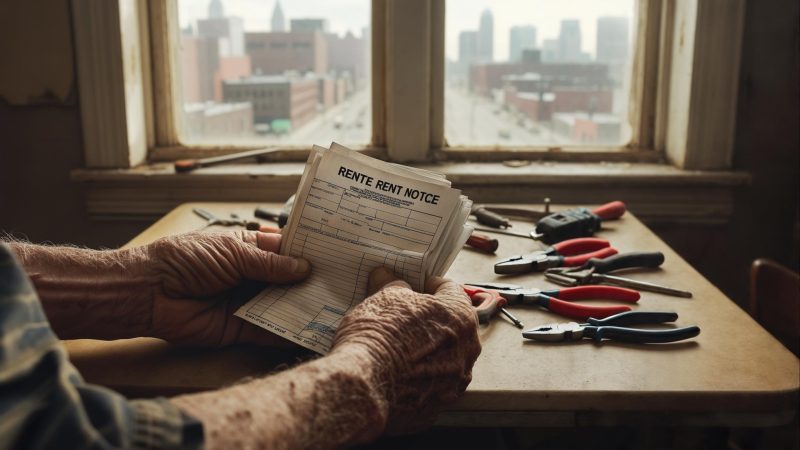
By January 2025, Brenda was $3,200 behind on property taxes. Florida counties begin the tax certificate sale process when taxes go unpaid, which can eventually lead to a tax deed sale — meaning a homeowner can lose their property. The timeline is not immediate, but Brenda did not know that when she first got the delinquency notice.
“I thought they could take my house,” Brenda told me, her voice steady but tight. “I read that letter three times and I just sat on my porch and thought, Calvin would have known what to do.” She didn’t call her children. She called the only number on the letter: the Hillsborough County Tax Collector’s office.
What she found there surprised her. Florida’s Florida Department of Revenue administers a property tax deferral program for low-income seniors. Homeowners 65 and older with household income under $10,000 — a threshold that seemed absurdly low to her at first — can defer taxes, but a separate senior exemption available through the county assessor’s office provided her some relief. Her existing homestead exemption reduced the taxable value of her home by $50,000, but she had never applied for the additional low-income senior exemption, worth up to $50,000 more for qualifying residents.
A caseworker at the Family Resource Center helped Brenda apply for the additional exemption in February 2025. She also helped her set up a payment plan with the county for the delinquent $3,200 balance — $267 a month over twelve months, which Brenda described as “tight, but I can see it.”
The Student Loan Question She Had Stopped Asking
Brenda earned a Master of Science in Industrial Management from the University of South Florida in 2004. She financed much of it through federal direct loans. At the time, she and Calvin were both working and the payments felt manageable. After Calvin died, she applied for an income-driven repayment plan and her monthly payment dropped to $91. But the balance had ballooned due to interest over two decades: as of March 2025, she owed $28,400.
Her caseworker flagged something Brenda had never heard of: Total and Permanent Disability (TPD) discharge and, separately, the potential eligibility for income-driven repayment forgiveness after 20 or 25 years of qualifying payments. Brenda is not disabled, so TPD did not apply. But her payment history — going back to 2005 with documented gaps — was being reviewed for IDR account adjustment credits under the one-time IDR adjustment program the U.S. Department of Education has been processing.
As of the day I interviewed her, the review was ongoing. No discharge had been granted. She was still making $91 monthly payments. The outcome of that review was, and remains, genuinely uncertain.
Getting Insurance Again: The Citizens Option
The insurance gap was the piece that started everything. When Brenda first received her non-renewal, she did not know that Florida operates Citizens Property Insurance Corporation — the state-backed insurer of last resort. She had assumed, she told me, that being dropped meant the market had simply decided her home was uninsurable.
A neighbor — another older woman on her block who had gone through the same non-renewal — mentioned Citizens to Brenda in early 2024. Brenda applied in March. Her Citizens premium came in at $289 per month, still $97 more than her original private policy, but $128 less than the force-placed coverage that had been draining her account for five months. That $128 difference per month — roughly $1,500 annually — became the breathing room that kept the property tax delinquency from compounding further.
“I wish I had known about Citizens the day I got that non-renewal letter,” she said, setting down her coffee cup. “I spent five months thinking I was out of options. Five months of that $417 payment. That money is just gone.”
Where Things Stand Now
When I asked Brenda to describe her financial situation in one word, she thought for a long moment. “Provisional,” she said. Not good, not bad — provisional. She has insurance. She is on a payment plan for the property taxes. Her student loan review is pending. Her monthly budget, she told me, leaves approximately $140 after fixed obligations, food, and utilities.
She is not applying for SNAP — she checked her eligibility and her income puts her just above the gross income limit for a single-person household, which sat at $1,580 per month as of October 2025 federal guidelines. Her take-home after taxes is roughly $1,980. “Twenty dollars a month over the line,” she said, with something between a laugh and a sigh. “Twenty dollars.”
I left Brenda at 2:40 p.m. She had to change into her work clothes. She thanked me for coming, told me she hoped the story would help someone else know about Citizens sooner, and walked toward her car with the same deliberate stride she had walked in with. Nothing about her manner asked for sympathy. She was simply a person who had learned, too late and at too high a cost, where some of the doors were. She was also a person headed to a job at 66 years old, on a Tuesday afternoon, because she had a house she intended to keep.
The student loan review could come back in her favor, or it could not. The property tax plan could hold, or an unexpected expense could break it. Brenda Dawkins is not at the end of anything — she is, as she said, provisional. And in Tampa’s current landscape for low-income older homeowners, provisional is something to hold onto.
Related: She Owed $47,000 in Student Loans and Faced a 30% Rent Hike. Then a Tax Clinic Changed Her Math.


Leave a Reply